


Advertisement|Remove ads.
This eBay Rival Has Delivered Over 30% Quarterly Revenue Growth For Seven Straight Years — So Why Is The Stock Still Falling?



- Despite its strong revenue performance, shares are down 6% year-to-date and have declined more than 22% in the last year.
- Margin compressions and growing liabilities have weighed on the company’s outlook.
- Meanwhile, the company’s long-term liabilities and capital expenditures are also ballooning.
Advertisement|Remove ads.
MercadoLibre Inc. (MELI) is the only publicly listed company in the U.S. to have consistently recorded quarterly revenue growth of more than 30% since 2019. Still, investors have not exactly rewarded the stock.
Latin America’s largest e-commerce and fintech company has posted consistent, sometimes massive, growth for about 28 consecutive quarters, according to data from Fiscal.ai.

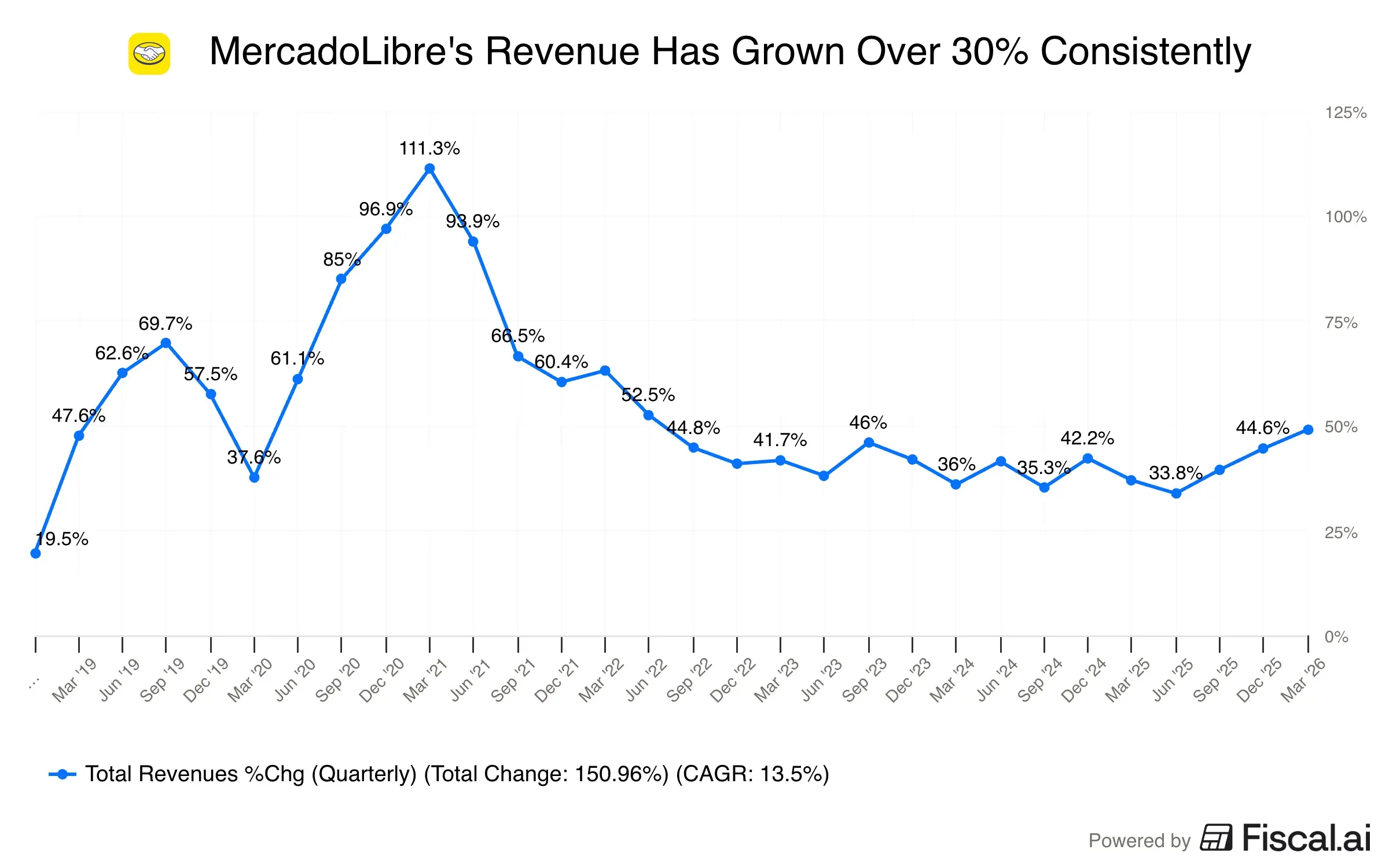
Despite its strong revenue performance, the eBay rival is down about 6% year-to-date and has slumped more than 22% in the last year. Meanwhile, EBAY stock is up nearly 35% this year.
Advertisement|Remove ads.
Even “The Big Short” investor Michael Burry believes the stock remains undervalued despite years of strong execution and called it a “clean long-term winner.” In May, he disclosed a position in MercadoLibre acquired in the mid-$1,500 range, describing it as a modest allocation.
MELI Stock: Margin Pressures, Growing Liabilities Weigh On Company
MercadoLibre's falling prices seem to be driven primarily by margin compressions and growing liabilities, as aggressive investments to fuel long-term growth and higher provisions tied to the rapid expansion of its credit business have added pressure.
In its earnings calls, management has repeatedly said that accepting lower profitability is an intentional attempt to capture a larger opportunity in both e-commerce and fintech.
Advertisement|Remove ads.
Chief Financial Officer Martin de los Santos said in the latest earnings call, “The margin compression reflects our choice to invest in strategic initiatives,” adding that the company is focused on building “the largest and most engaged commerce and fintech platform in Latin America.” He emphasized that the company is “not trying to optimize short-term margins” and will continue investing aggressively as long as returns remain attractive.
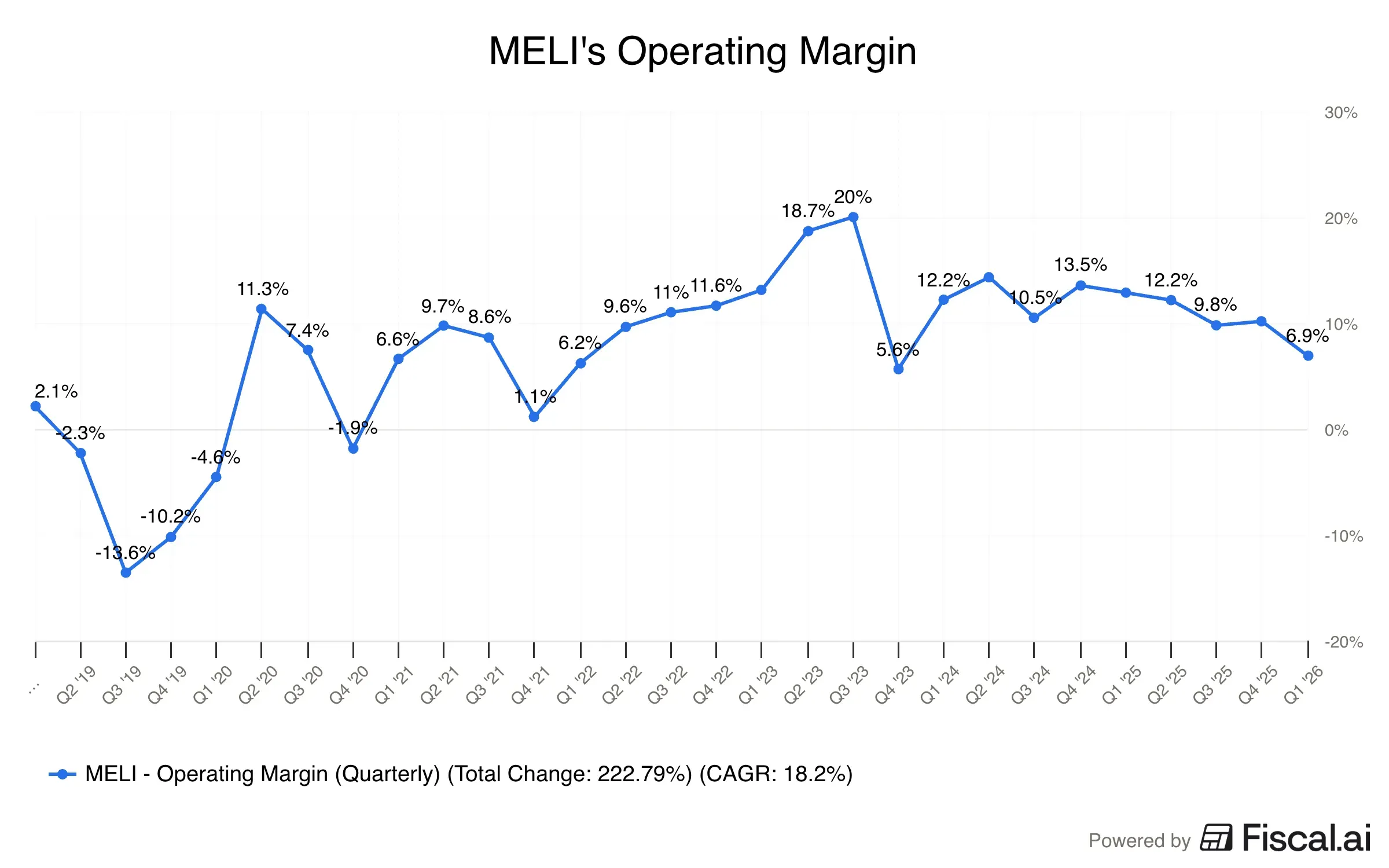
The company's fast-growing credit portfolio is also adding pressure. De los Santos said that the credit book is expanding faster than revenue, requiring the company to set aside provisions for expected loan losses upfront. “As we issue any new loan, we have to provision for the full amount of expected loss of that loan. When we accelerate growth, we need to provision more,” he said.
Management also said that the company is taking “heavy provisions in Brazil” as it extends loan durations and reaches new customer segments as “a deliberate decision to reach out to further segments to continue accelerating growth.”
Advertisement|Remove ads.
CapEx Grows Amid Growth Initiatives
Meanwhile, the company’s long-term liabilities and capital expenditures are also ballooning. The company’s latest spending is heavily focused on expanding its logistics network, strengthening its e-commerce platform, and scaling its fintech operations.
Earlier this year, the company said that it plans to invest 57 billion reais ($10.9 billion) in Brazil in 2026, a 50% increase from the prior year, to open 14 new fulfillment centers, enhance marketplace capabilities and grow Mercado Pago's credit portfolio. The investment would also include hiring initiatives across logistics, financial services and technology, the company said.
Beyond Brazil, MercadoLibre also announced a $3.4 billion investment in Argentina.
Advertisement|Remove ads.
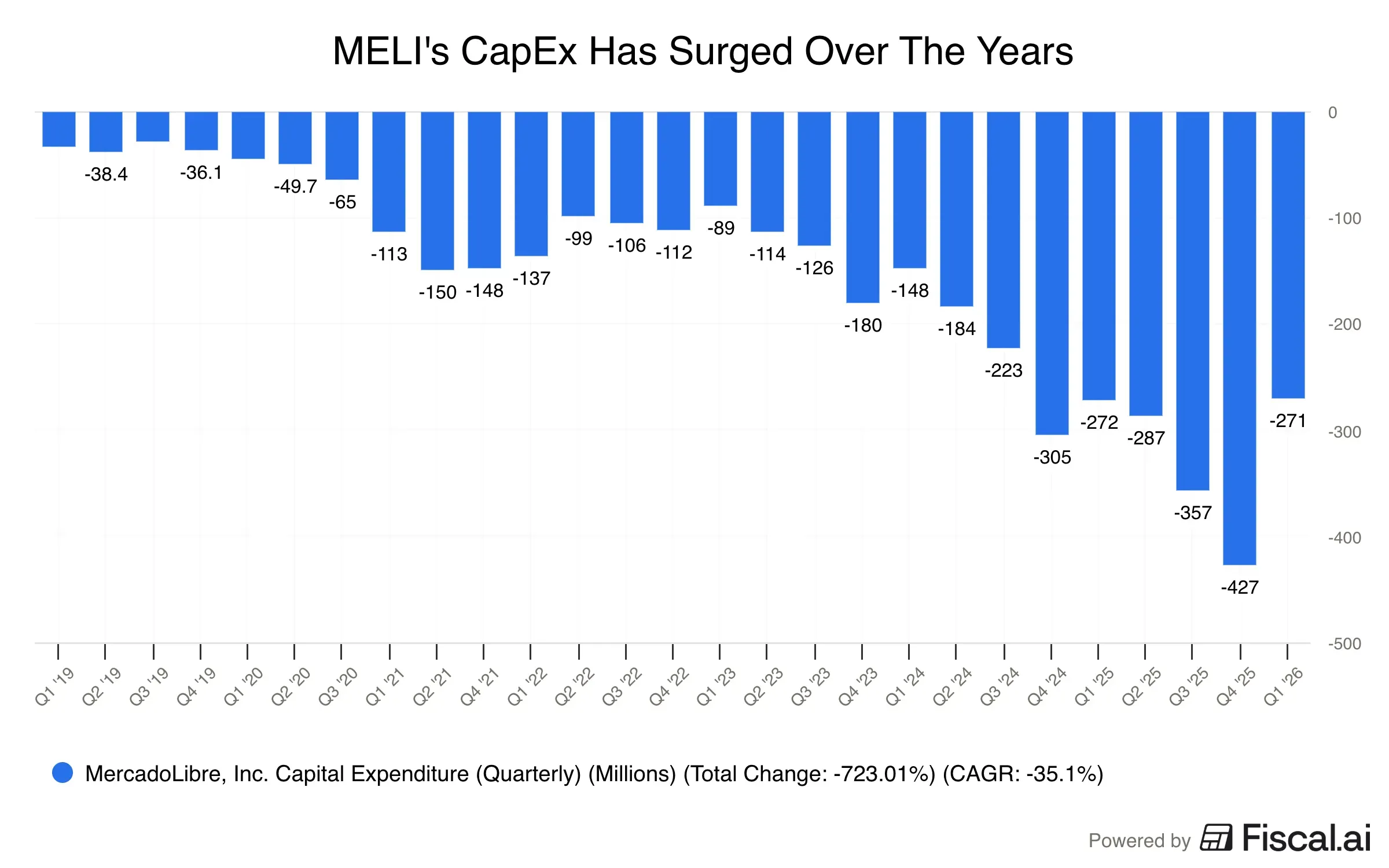
MercadoLibre's investments and take-rate pressure create monetization challenges, Citi noted in May, according to TheFly.
MELI Stock: Wall Street Stance
While multiple analysts lowered MELI’s price target following its first-quarter (Q1) results, Wall Street is still largely bullish on the company.
According to Koyfin data, analysts covering the stock have an average price target of $2,208.63 per share, implying more than 19% upside from its last close.
Advertisement|Remove ads.
Of the 24 analysts covering the stock, 20 rate the company's shares ‘Buy’ or higher. The remaining have a ‘Hold’ rating.
MELI Stock: What’s Retail Saying?
On Stocktwits, retail sentiment around MELI stock has shifted from ‘bearish’ to ‘bullish’ over the past week, with message volume in the ‘high’ range.
One retail user noted the revenue growth of the company, saying, “Consistency like this is extremely rare in the public markets. A company doesn’t maintain this kind of growth for years without strong execution, expanding markets, and a business model that continues to scale.”
Advertisement|Remove ads.
The user also added that while the market often focuses on short-term price movements, long-term winners are usually built on durable revenue growth and compounding fundamentals.
Another user said MELI is “starting to attract more attention as momentum builds. Strong businesses with expanding opportunities often get overlooked before sentiment shifts…”
Advertisement|Remove ads.
For updates and corrections, email newsroom[at]stocktwits[dot]com.
Comments posted here will also appear on symbol pages.

Latest News
/filters:format(webp)https://news.stocktwits-cdn.com/large_Getty_Images_2299253024_e81db8f4a8.jpg)
/filters:format(webp)https://st-everywhere-cms-prod.s3.us-east-1.amazonaws.com/i_OS_App_Icon_1_8054f2a2fe.png) Stocktwits News Desk·41m ago
Stocktwits News Desk·41m ago/filters:format(webp)https://news.stocktwits-cdn.com/large_BE_Bloom_faee9b1d61.webp) Stocktwits News Desk·2h ago
Stocktwits News Desk·2h ago/filters:format(webp)https://news.stocktwits-cdn.com/large_Oil_Iran_tensions_jpg_f34e3cef73.webp) Stocktwits News Desk·3h ago
Stocktwits News Desk·3h ago/filters:format(webp)https://news.stocktwits-cdn.com/large_Getty_Images_2200882557_jpg_53f3e467bc.webp) Stocktwits News Desk·4h ago
Stocktwits News Desk·4h ago/filters:format(webp)https://news.stocktwits-cdn.com/gettyimages_2267701500_594x594_1cfbb8b517.jpg)
/filters:format(webp)https://news.stocktwits-cdn.com/1707726834303_jpg_11f20a9aa9.webp) Shashank Nayar·8h ago
Shashank Nayar·8h ago/filters:format(webp)https://news.stocktwits-cdn.com/large_Getty_Images_1503993596_8deb3f6bd9.jpg)
/filters:format(webp)https://news.stocktwits-cdn.com/unnamed_jpg_9dff551b50.webp) Anan Ashraf·8h ago
Anan Ashraf·8h ago