


Advertisement|Remove ads.
Trump Declares Tariff Win Yet Again As US Trade Deficit Sinks To 17-Year Low — Supreme Court Decision Looms


- The latest data shows the U.S. trade deficit declined 39% to $29.4 billion in October, an unexpected drop.
- Trump hails the reading as a testament to his economic policies.
- Imports decreased 3.2% while exports increased 2.6% for the month.
Advertisement|Remove ads.
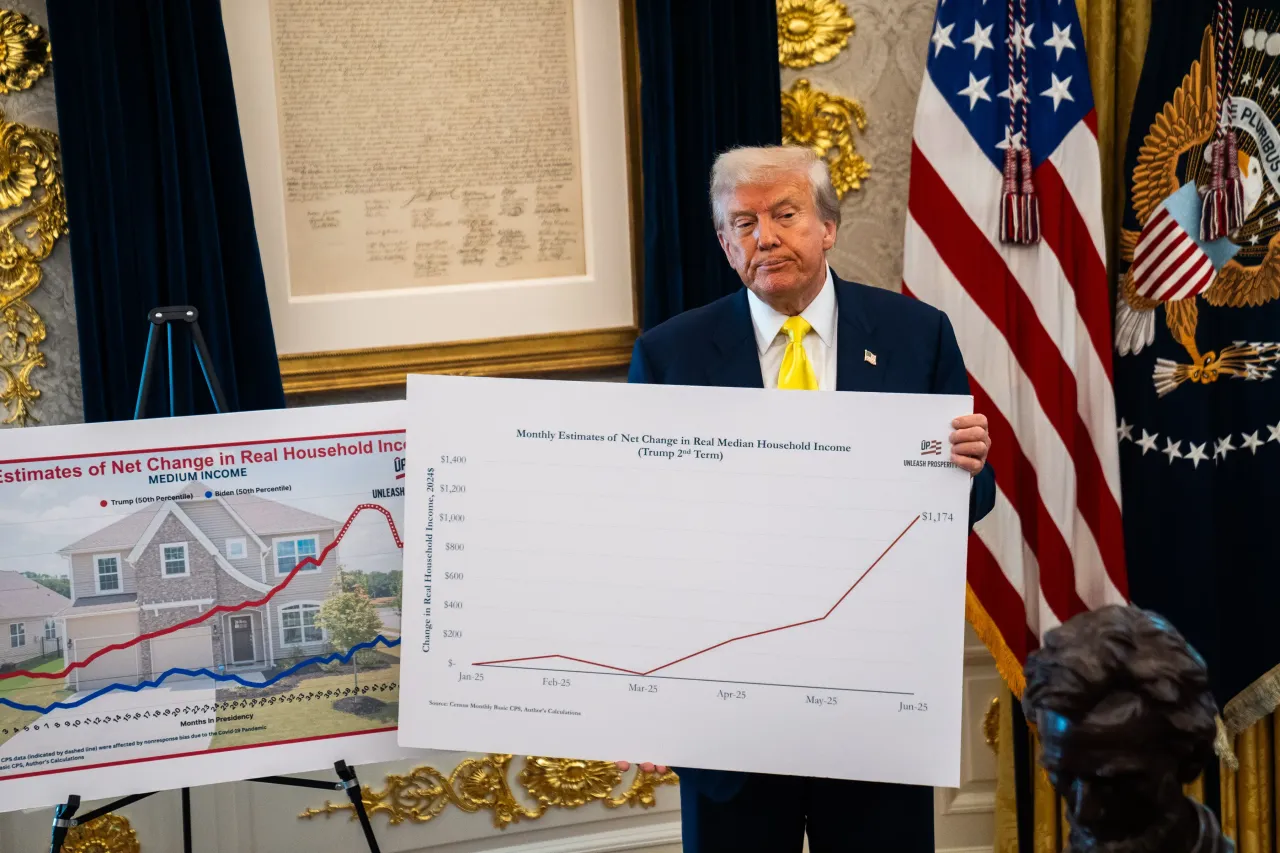
U.S. President Donald Trump on Thursday hailed the latest economic data showing a sharp narrowing of the country’s trade deficit, calling it “a direct result of the tariffs,” ahead of a keenly watched Supreme Court ruling on his move that took markets by storm in April last year.
The U.S. trade gap narrowed 39% to $29.4 billion in October, the lowest level since June 2009, the Commerce Department's Bureau of Economic Analysis and Census Bureau said on Thursday. The figure – markedly lower than the $58 billion economists expected in a Reuters poll – shows that the U.S. is relying less on imports than on exports, which can support domestic production, jobs, and economic growth.

Chart source: Trading Economics
“These incredible numbers, and the unprecedented success of our country, are a direct result of tariffs, which have rescued our economy and national security,” Trump said in a Truth Social post.
Advertisement|Remove ads.
“I hope the Supreme Court is aware of these historic, country-saving achievements prior to the issuance of their most important (ever!) decision,” taking a jibe at the ongoing legal challenge against his tariff policies.
In October, imports decreased 3.2% to $331.4 billion. Goods imports declined 4.5% to $255 billion, the lowest level since June 2023, while consumer goods imports decreased $14 billion to the lowest level since June 2020.
The declines could be the result of Trump's sweeping tariffs announced in April and rolled out in a staggered manner over the last year; the trend also signals softening domestic demand.
Advertisement|Remove ads.
Meanwhile, exports rose 2.6% to a record $302 billion in October. Goods exports jumped 3.8% to $196 billion, also an all-time high.
The October data was released after a delay due to a 43-day government shutdown.
What’s At Stake For Trump?
Back in December, Trump warned that an adverse decision by the Supreme Court on his tariffs strategy could leave the U.S. “financially defenseless.” The case questions whether Trump exceeded his authority by using the 1977 International Emergency Economic Powers Act (IEEPA) to impose sweeping tariffs on nearly all imports from U.S. trading partners. Historically, tariffs have been set by Congress, not by the President’s office.
Advertisement|Remove ads.
Latest media reports peg refunds of up to $150 billion to importers by the government if Trump loses the case.
Major companies in various market sectors appear to have largely absorbed the impact of tariffs after widespread disruption in mid-2025. In the last 12 months, the SPDR S&P 500 ETF Trust (SPY) has gained 17.1% while the Invesco QQQ Trust Series 1 (QQQ) has gained 20.5%.
For updates and corrections, email newsroom[at]stocktwits[dot]com.
Advertisement|Remove ads.
Comments posted here will also appear on symbol pages.

Latest News
/filters:format(webp)https://news.stocktwits-cdn.com/large_Getty_Images_2245498698_eb56c3f1cc.jpg)
/filters:format(webp)https://news.stocktwits-cdn.com/Aashika_Suresh_Profile_Picture_jpg_2acd6f446c.webp) Aashika Suresh·7m ago
Aashika Suresh·7m ago/filters:format(webp)https://news.stocktwits-cdn.com/large_Getty_Images_2293856789_e8411c4c70.jpg)
/filters:format(webp)https://news.stocktwits-cdn.com/shivani_photo_jpg_dd6e01afa4.webp) Shivani Kumaresan·29m ago
Shivani Kumaresan·29m ago/filters:format(webp)https://news.stocktwits-cdn.com/large_Anthropic_27a8549cef.jpg) Aashika Suresh·51m ago
Aashika Suresh·51m ago/filters:format(webp)https://news.stocktwits-cdn.com/large_jason_calacanis_fa7fd11c8b.jpg)
/filters:format(webp)https://news.stocktwits-cdn.com/IMG_8805_JPG_6768aaedc3.webp) Deepti Sri·1h ago
Deepti Sri·1h ago/filters:format(webp)https://news.stocktwits-cdn.com/large_Getty_Images_2276989723_eb8b10972a.jpg)
/filters:format(webp)https://news.stocktwits-cdn.com/IMG_9209_1_d9c1acde92.jpeg) Yuvraj Malik·1h ago
Yuvraj Malik·1h ago/filters:format(webp)https://news.stocktwits-cdn.com/large_Blackberry_resized_jpg_a0a7071fd3.webp) Shivani Kumaresan·2h ago
Shivani Kumaresan·2h ago