


Advertisement|Remove ads.
Trump’s Venezuela Oil Deal Sounds Huge, But It Won’t Slash Gas Prices Anytime Soon — Analyst Explains Why


- The analyst said it would take “billions of investment” to source the oil from Venezuela.
- De Haan also pointed out that while Venezuela has vast proven oil reserves, the 65 billion refers to estimates, which is significantly different from actual oil reserves like the U.S. SPR.
- The analyst also noted that at present, global oil refining capacity is constrained, and even with the additional oil, it won’t “translate the lower oil prices in lower fuel prices.”
Advertisement|Remove ads.
U.S. President Donald Trump is billing his administration's new agreement with Venezuela as the "BIGGEST OIL DEAL IN HISTORY,” struck with the same country where the U.S. intervened militarily and ousted Nicolás Maduro earlier this year.
Trump said Venezuelan crude secured under the deal will replenish the U.S. Strategic Petroleum Reserve and lower gasoline prices for American consumers, a move political observers are reading as a pre-midterm affordability play ahead of November's elections. Analysts, however, are cautioning that any relief at the pump is unlikely to materialize anytime soon.
Strategic Petroleum Reserve Plunges To Multi-Year Lows
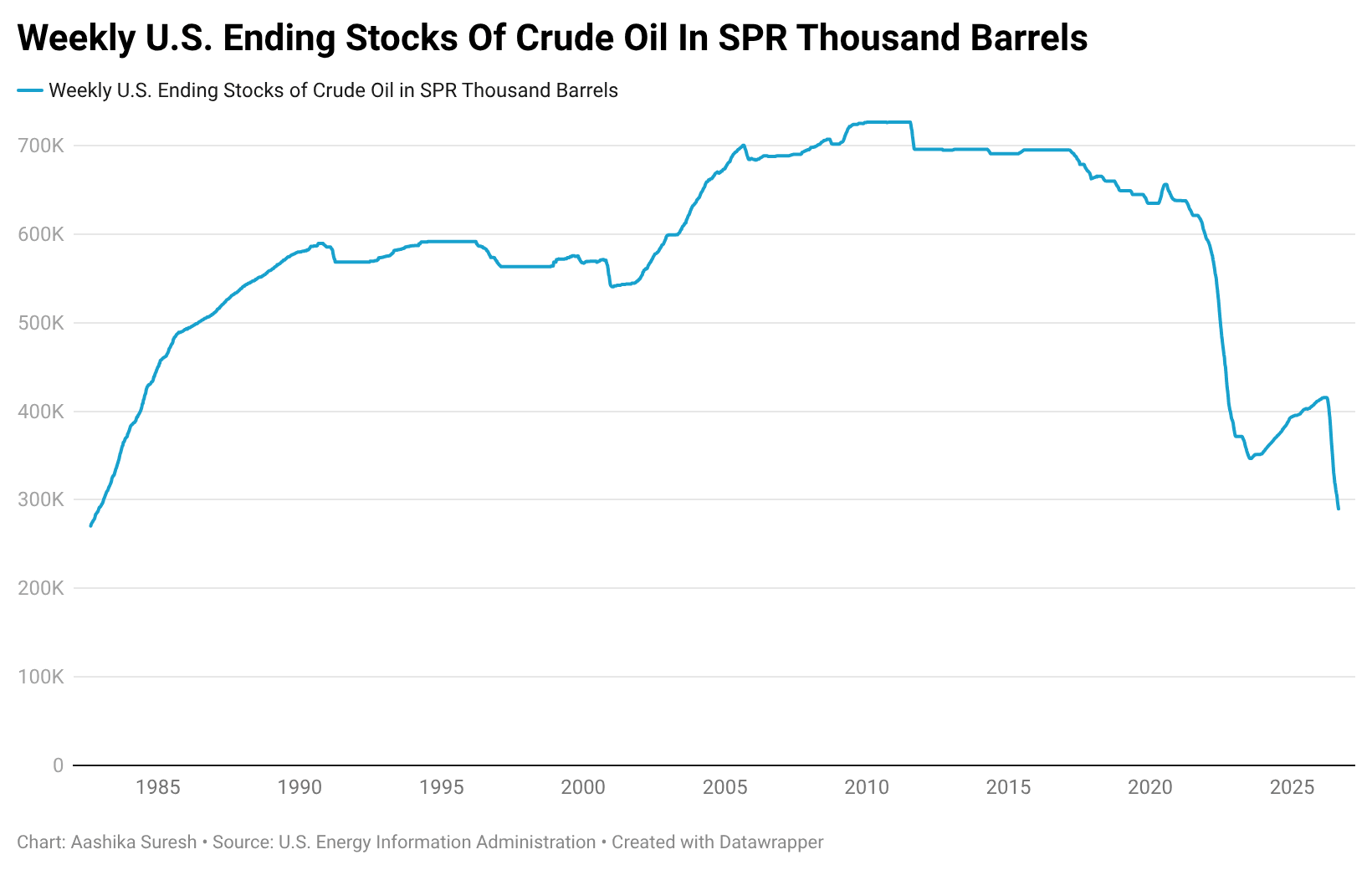
The SPR plunged to a 44-year low this month, dropping below 300 million barrels for the first time since the 1980s, with reserves holding about 289.7 million barrels of crude oil at the end of August. Trump blamed former president Joe Biden for the plummet in reserves, noting that it “has been virtually emptied.”
Advertisement|Remove ads.
Trump said that the “topping out” process under the deal with Venezuela would more than double American oil reserves and increase the country’s supply while substantially lowering gas prices for all Americans “long into the future.”
Why De Haan Thinks US-Venezuela Deal Won’t Alter Energy Prices Anytime Soon
De Haan said in a post on X that while “the hope of lower gas prices sounds promising,” he outlined three reasons why “nothing changes overnight or even in months.” The analyst said it would first take “billions of investment” to source oil from Venezuela. Trump had claimed in a post on Truth Social that the 65 billion barrels of crude oil reserves in Venezuela would be accessible to the U.S. “at no cost to the American Taxpayer.”
De Haan also pointed out that while Venezuela has vast proven oil reserves, the 65 billion refers to estimates, which is significantly different from actual oil reserves like the U.S. SPR.
Advertisement|Remove ads.
“The 65 bil the prez refers to is what geologists estimate VZ *may* have, but drilling/pumping that oil will take a very long time- changes to fuel prices won’t happen overnight or even in months,” he said.
The analyst also noted that at present, global oil refining capacity is constrained, and even with the additional oil, it won’t “translate the lower oil prices in lower fuel prices.” De Haan additionally questioned the validity of the deal, asking how the U.S. can “lay claim to a sovereign country’s natural resources.”
Other analysts are questioning the legal and financial basis for U.S. government investment in Venezuelan resources under the South American’s country’s constitutional framework, per a Reuters report.
Advertisement|Remove ads.
What Is the US-Venezuela Oil Deal?
Trump said over the weekend that the U.S. had entered into “THE BIGGEST OIL DEAL IN WORLD HISTORY” with Venezuela, whereby, through a partnership with private business, America has secured a majority control of the South American country’s 65 billion proven oil reserves. “This Historic Transaction MORE THAN DOUBLES American Oil Reserves, greatly increases our Oil Supply, and will substantially lower Gas Prices for all Americans, long into the future, while helping to continue to set Venezuela on a course toward Tremendous Success and Great Prosperity. This Transaction will greatly strengthen the already growing relationship between Venezuela and the United States!”
Venezuelan interim President Delcy Rodriguez, who took over the reins of the country after U.S. special forces captured former President Nicolás Maduro earlier this year, said over the weekend that the country’s energy agreement with the U.S. will remain in effect for 25 years, with an initial goal of increasing crude production to more than 1.5 million barrels per day (bpd).
Speaking on state broadcaster VTV, Rodriguez said the bilateral project covers the development of 17 strategic oilfields and would preserve Venezuela’s sovereignty over its natural resources. She stressed that the 1.5 million-bpd target applies specifically to the U.S.-Venezuela bilateral agreement.
Advertisement|Remove ads.
Rodriguez said the 1.5 million bpd figure is only an initial production target. The broader energy expansion plan also calls for developing eight greenfield oil blocks, alongside further investment across Venezuela’s energy sector.
“The great energy agreement with the United States follows our path to transform Venezuela, from a country with great reserves, into an oil-producing power, for the benefit and happiness of the Venezuelan people,” Rodriguez said in a post on X.
Meanwhile, The Kobeissi Letter noted in a post on X that at current WTI oil prices of about $83 a barrel, “those reserves have a gross market value of ~$5.4 trillion,” adding that the U.S. “will receive 55% effective output, along with an ownership stake and rights to purchase oil at cost. At 55%, that would correspond to ~35.8 billion barrels of effective output.”
Advertisement|Remove ads.
Oil Prices Have Been Surging Amid The Ongoing U.S.-Iran War
Since the war between the U.S. and Iran started in February earlier this year, a chokehold in the critical Strait of Hormuz has disrupted global energy supplies and sent oil prices soaring to near 2022 levels.
Late Sunday, the U.S. attacked two Iranian rocket launchers at Larak Island in Iran in the Strait of Hormuz, the first known strikes since late July, re-escalating tensions between the two countries that are yet to negotiate a peace deal.
"Looks like we are in another escalation phase. How long that lasts is impossible to determine. Could be days, could be weeks," IG market analyst Tony Sycamore reportedly told Reuters.
Advertisement|Remove ads.
At the time of writing, global oil prices were climbing higher. Brent crude futures expiring in November topped $90 a barrel and were up about 2.35% at the time of writing. Meanwhile, WTI crude futures expiring in October were trading at $85.10 per barrel.
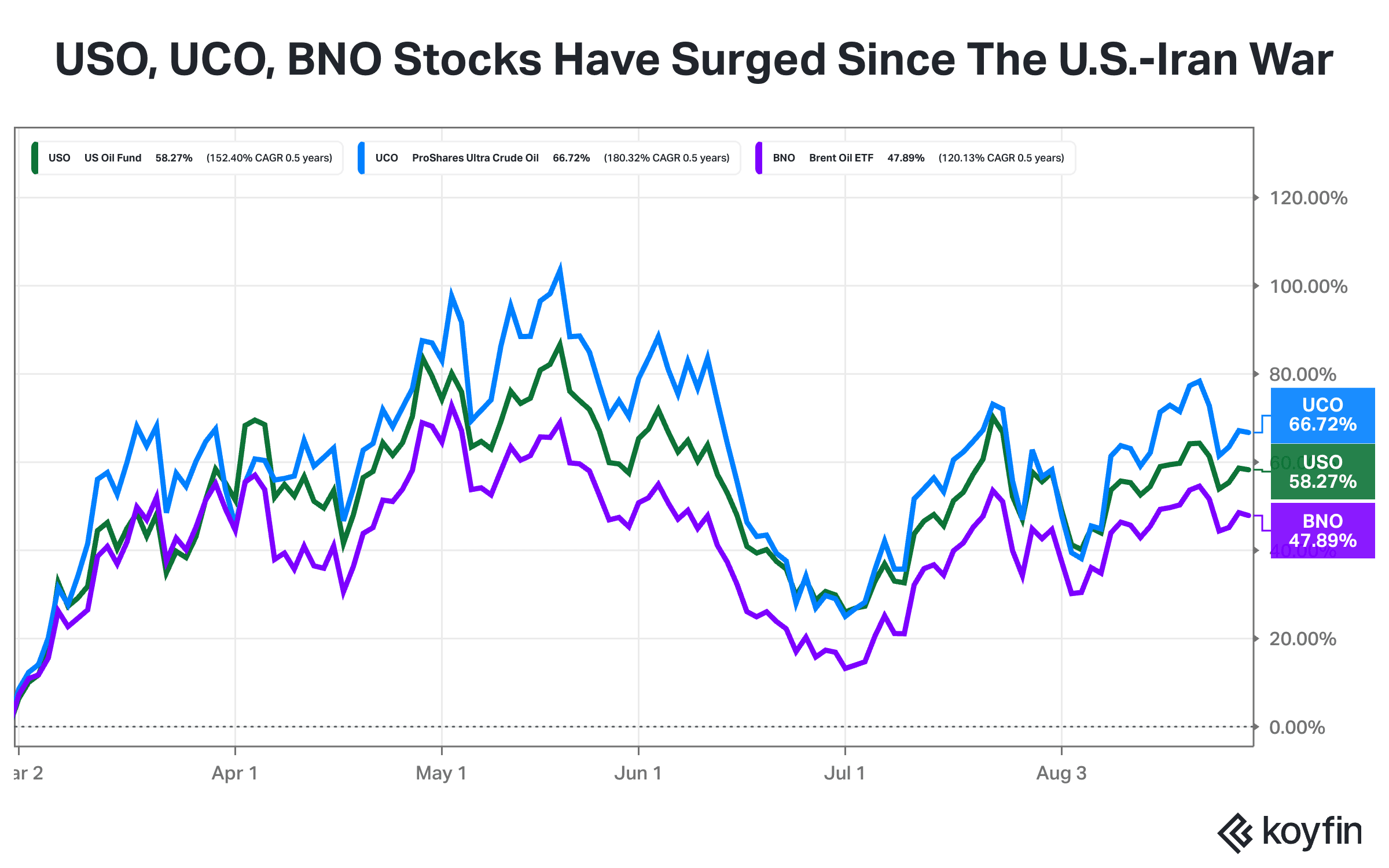
The United States Oil Fund (USO), which tracks the daily price movements of West Texas Intermediate (WTI) light, sweet crude oil, has soared more than 58% since the end of February when the war began, while the ProShares Ultra Bloomberg Crude Oil (UCO) is up nearly 67%.
The United States Brent Oil Fund LP (BNO), an exchange-traded fund that tracks the price movements of Brent crude oil, has risen nearly 48% in the same time.
Advertisement|Remove ads.
USO, UCO, BNO: What’s Retail Saying?
On Stocktwits, retail sentiment around USO, UCO and BNO stocks was ‘bearish’ at the time of writing.
One user said, “$USO Trump’s Venezuela oil deal won’t solve the Iran-driven oil crisis in the short term because Venezuela lacks the infrastructure to rapidly increase production, and its heavy crude takes more effort to extract and process. Even a major Venezuelan production increase would take years and couldn’t quickly replace the millions of barrels disrupted by the Iran conflict. Its all smoke ans mirrors.”
Another user said, “$USO that oil wont hit the market for 3-5 years. and will only be increasing the volume from 1.2 million to 3 million barrels per day. It's not that big of a deal Trump makes it out to be.”
Advertisement|Remove ads.
For updates and corrections, email newsroom[at]stocktwits[dot]com
Comments posted here will also appear on symbol pages.

Latest News
/filters:format(webp)https://news.stocktwits-cdn.com/large_arthur_hayes_2026_OG_jpg_9f3524f8b1.webp)
/filters:format(webp)https://news.stocktwits-cdn.com/Anushka_Basu_make_me_smile_in_the_picture_b92832aa_af59_4141_aacc_4180d2241ba8_1_2_png_1086e0ed8c.webp) Anushka Basu·22m ago
Anushka Basu·22m ago/filters:format(webp)https://news.stocktwits-cdn.com/large_Tom_Lee_BMNR_64157a5786.webp) Anushka Basu·2h ago
Anushka Basu·2h ago/filters:format(webp)https://news.stocktwits-cdn.com/large_Getty_Images_2194650023_jpg_2af2244b5a.webp)
/filters:format(webp)https://st-everywhere-cms-prod.s3.us-east-1.amazonaws.com/i_OS_App_Icon_1_8054f2a2fe.png) Stocktwits News Desk·3h ago
Stocktwits News Desk·3h ago/filters:format(webp)https://news.stocktwits-cdn.com/large_Getty_Images_1569415620_1ad6cfc5c6.jpg) Anushka Basu·4h ago
Anushka Basu·4h ago/filters:format(webp)https://news.stocktwits-cdn.com/large_Getty_Images_2295245703_1237d2403d.jpg) Stocktwits News Desk·4h ago
Stocktwits News Desk·4h ago/filters:format(webp)https://news.stocktwits-cdn.com/large_new_york_stock_exchange_jpg_e1f85c0d8c.webp) Stocktwits News Desk·6h ago
Stocktwits News Desk·6h ago