


Advertisement|Remove ads.
Ethereum Co-founder Vitalik Buterin Wants Elon Musk And Mark Zuckerberg To Broker AI Peace Deals — Not Just Host The Debate
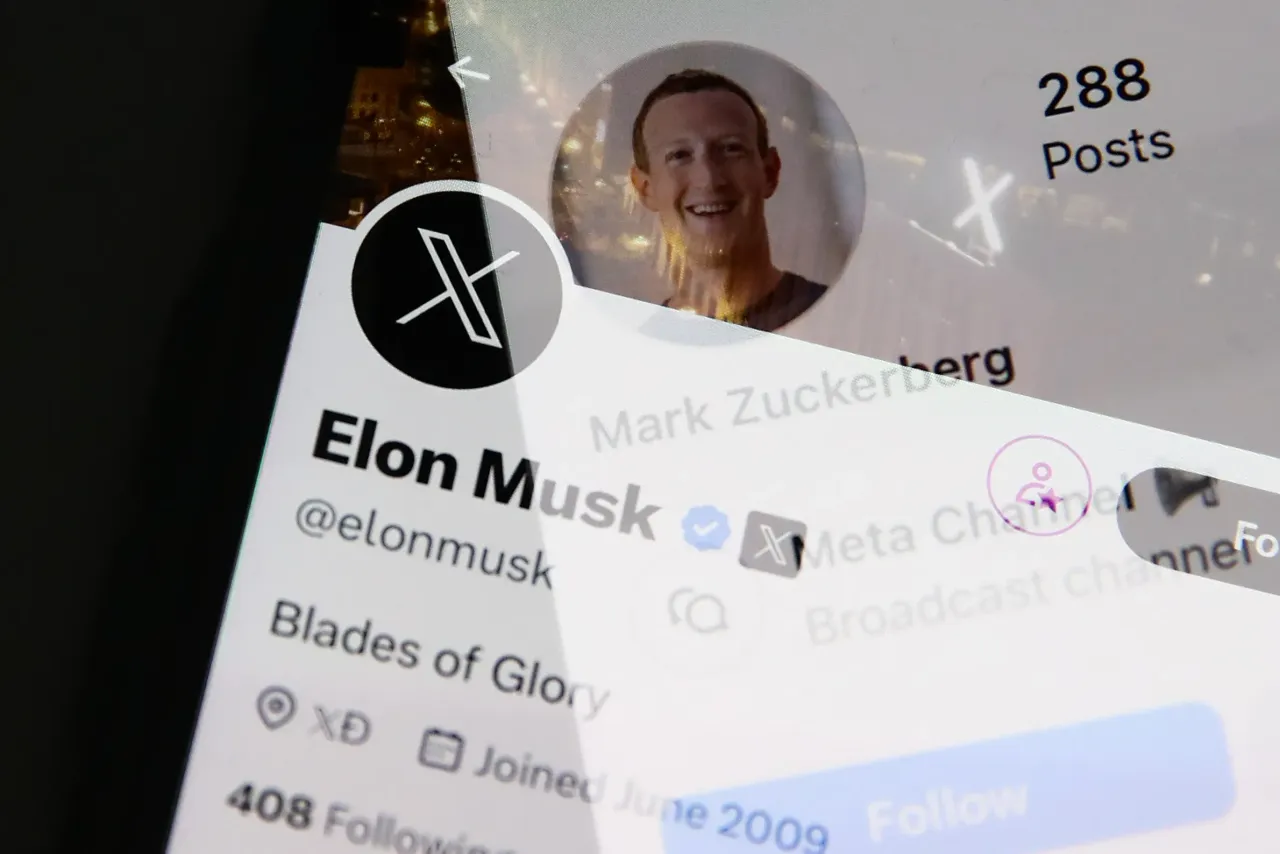

- Vitalik Buterin said on Saturday that leaders like Elon Musk and Mark Zuckerberg are well-positioned to facilitate "win-win" AI agreements.
- Buterin reiterated support for Ethereum's "d/acc" framework, including investments in cryptography, secure hardware and biosecurity.
- His comments follow the release of the AI Futures Project's "AI 2040" proposal, which calls for a U.S.-China pact to delay superintelligence.
Advertisement|Remove ads.
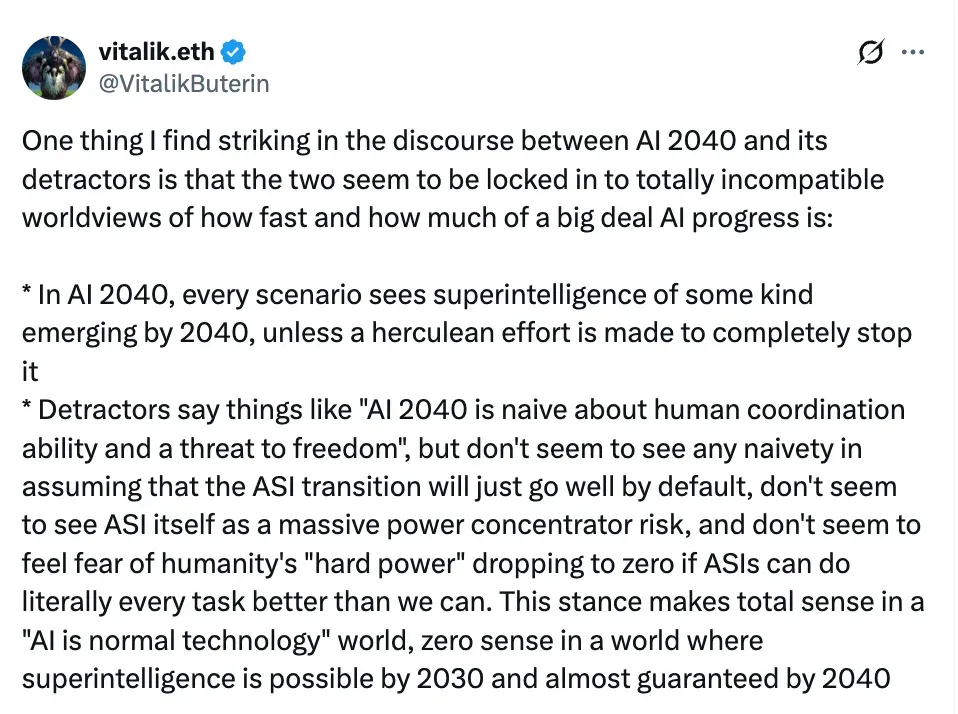
Ethereum (ETH) co-founder Vitalik Buterin said Saturday that social media sites like X may be more useful in the discussion on artificial intelligence (AI) by mediating practical concessions between opposing sides rather than increasing ideological confrontation.
Buterin said in a post on X that platform owners such SpaceX (SPCX) and Tesla (TSLA) CEO Elon Musk and Meta (META) founder Mark Zuckerberg are in a unique position to broker "win-win" deals between proponents of rapid AI research and those asking for more prudence. “It's possibly one of the best things that social media could do for humanity if it wanted to,” he added.

His comments come as Ethereum trades more than 63% below its all-time high reached in August of last year. However, in terms of daily gains, Ethereum’s price was up over 0.4% during the past 24 hours. On Stocktwits, the retail sentiment around ETH remained in the ‘bullish’ zone, while chatter around it stayed in the ‘normal’ levels over the past day.
Advertisement|Remove ads.
AI Debate Driven By Competing Views
Buterin’s piece framed the larger discussion between “AI 2040” proponents and opponents as a conflict of “totally incompatible worldviews” about how quickly and how far AI would go, and noted that his own perspective rests on assumptions he can’t definitively prove.
The Ethereum co-founder said he remained open-minded to AI slowdowns or pauses given his uncertainty about which scenario was correct, while pushing back on arguments he said concentrate power in the hands of a small number of major AI labs or governments.
Ethereum's ‘d/acc’ Framework Remains Central
He returned to his original stance of connecting to Ethereum's 'd/acc' architecture, investing in cryptography, formal verification, secure hardware and biosecurity, arguing that these investments are worthwhile regardless of what AI scenario unfolds.
Advertisement|Remove ads.
Buterin said his own proposal to retool the platform "is also naive" but that he currently sees "zero plans" for managing an AI transition that are not naive in some way.
AI 2040 Proposal Sparks Industry Debate
The comments come days after "AI 2040: Plan A," a report published by former OpenAI (OPEAZZX) researcher Daniel Kokotajlo's AI Futures Project, proposed that the U.S. and China cooperate to delay the arrival of superintelligence to 2040 deliberately. The plan calls for full research transparency between the two countries and a verification framework it terms "mutually assured compute destruction," modeled loosely on nuclear deterrence logic.
The report has drawn criticism from AI researchers, including Richard Ngo, who argued that it overestimates how imminent superintelligence really is and underestimates the domestic political disruption AI will cause well before any US-China "race" plays out.
Advertisement|Remove ads.
For updates and corrections, email newsroom[at]stocktwits[dot]com
Comments posted here will also appear on symbol pages.

Latest News
/filters:format(webp)https://news.stocktwits-cdn.com/large_Getty_Images_2278385049_0f9707f535.jpg)
/filters:format(webp)https://news.stocktwits-cdn.com/1707726834303_jpg_11f20a9aa9.webp) Shashank Nayar·33m ago
Shashank Nayar·33m ago/filters:format(webp)https://news.stocktwits-cdn.com/large_starship_51f6e6b7f8.jpg)
/filters:format(webp)https://news.stocktwits-cdn.com/unnamed_jpg_9dff551b50.webp) Anan Ashraf·39m ago
Anan Ashraf·39m ago/filters:format(webp)https://news.stocktwits-cdn.com/large_kroger_resized_jpg_df58ccdaf5.webp) Shashank Nayar·2h ago
Shashank Nayar·2h ago/filters:format(webp)https://news.stocktwits-cdn.com/large_Getty_Images_2271872828_24a8400504.jpg) Anan Ashraf·2h ago
Anan Ashraf·2h ago/filters:format(webp)https://news.stocktwits-cdn.com/large_Seagate_jpg_50a56724b4.webp) Shashank Nayar·3h ago
Shashank Nayar·3h ago/filters:format(webp)https://news.stocktwits-cdn.com/large_Getty_Images_2128530471_1b79e1b428.jpg) Anan Ashraf·4h ago
Anan Ashraf·4h ago