


Advertisement|Remove ads.
Why Tech Stocks Rule The Market, Even As Their Revenue Trails Consumer And Banking Giants



- Nvidia generates more than 8X Walmart’s profit on less than half the revenue, highlighting the enormous profitability gap between AI-focused tech and traditional businesses.
- High margins and faster growth are driving investor interest in tech.
- AI is giving Big Tech another earnings boost, with Amazon, Alphabet, Nvidia and Microsoft booking more than $160 billion in gains from AI-related investments last quarter.
Advertisement|Remove ads.
The biggest revenue-generating companies are in the consumer, banking, healthcare and airline sectors, which continue to deliver steady top-line growth; yet, technology companies such as Nvidia and Apple remain the most sought-after stocks. But why? The answer lies not just in how much money companies make but in how much they manage to retain after all sorts of expenses.
Over the last couple of decades, Big Tech has grabbed more attention with eye-popping margins that make other sectors’ profit retention look like rounding errors.
For this analysis, Stocktwits picked leading companies across consumer, banking, pharmaceuticals, and airlines — Walmart, JPMorgan & Chase, Eli Lilly, and Delta Air Lines — and compared them with Nvidia across their latest quarterly revenue, net profit, profit margin, year-to-date stock performance, and forward price-to-earnings ratios.
Advertisement|Remove ads.
Why Tech Reigns Supreme
The numbers show why investors are pulled into tech. Not only are technology companies growing revenue at a much faster pace, but a far larger portion of that revenue is flowing through to the bottom line.
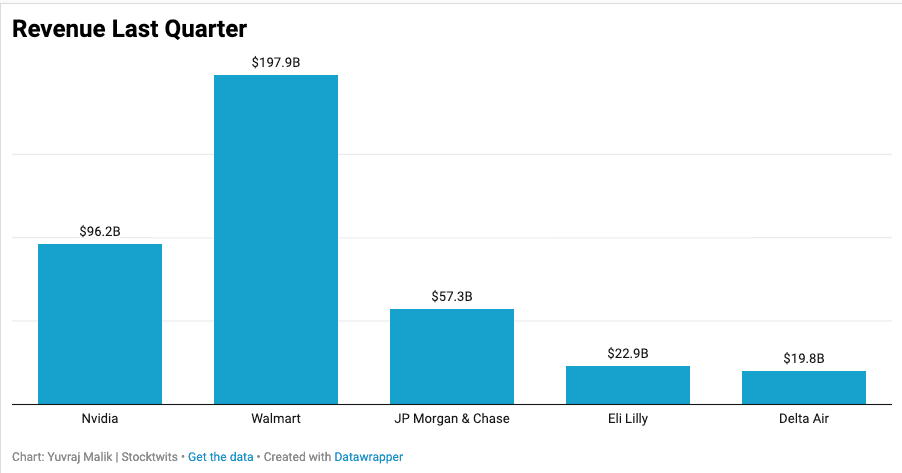
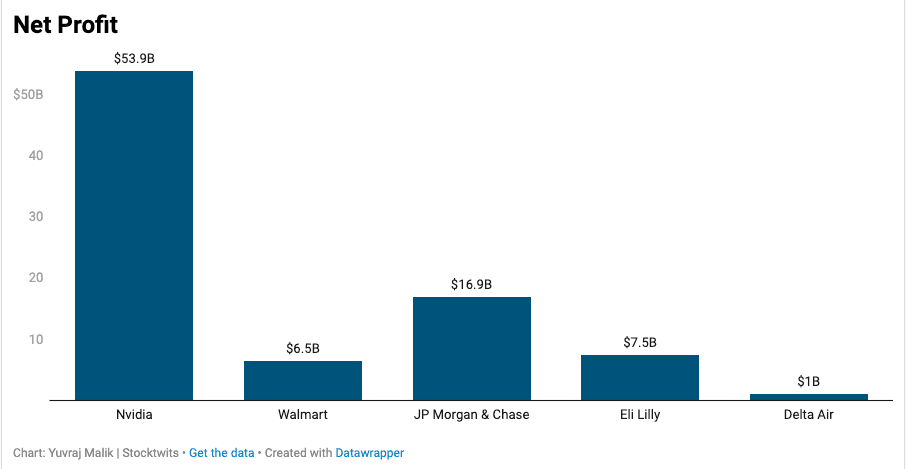
Nvidia is the clearest example. The chipmaker generated $96.2 billion in quarterly revenue, less than half of Walmart’s $197.9 billion. Yet Nvidia produced $53.9 billion in net profit, compared with just $6.5 billion for Walmart.
That means Nvidia generated more than eight times Walmart’s quarterly profit despite producing less than half its revenue.
Advertisement|Remove ads.
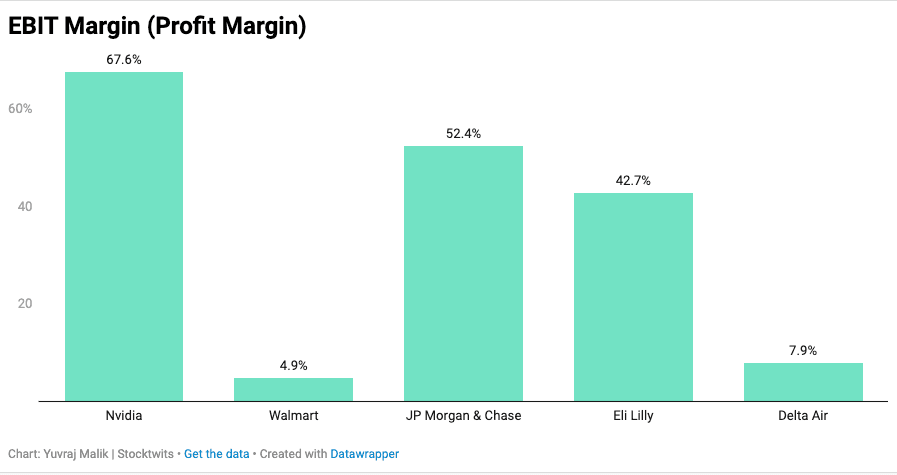
The divergence becomes even more striking when looking at margins. Nvidia’s 67.6% EBIT margin towers over Walmart’s 4.9%, meaning the chipmaker retains far more of each dollar of revenue as operating profit.
Eli Lilly, another high-margin business, generated $22.9 billion in quarterly revenue and $7.5 billion in net profit, with a 42.7% EBIT margin. JPMorgan Chase, meanwhile, generated a massive $57.3 billion in revenue and $16.9 billion in profit, translating into a 52.4% EBIT margin.
Airlines tell the other side of the story. Delta Air Lines generated $19.8 billion in quarterly revenue but just $1 billion in profit, with a 7.9% EBIT margin.
Advertisement|Remove ads.
A dollar of revenue simply isn’t worth the same across industries. U.S. system-and-application software companies generate a 32.6% after-tax operating margin, compared with 5.9% for general retailers and just 4.5% for airlines, according to a January 2026 analysis by NYU Stern School of Business professor Aswath Damodaran.
Advertisement|Remove ads.
Advertisement|Remove ads.
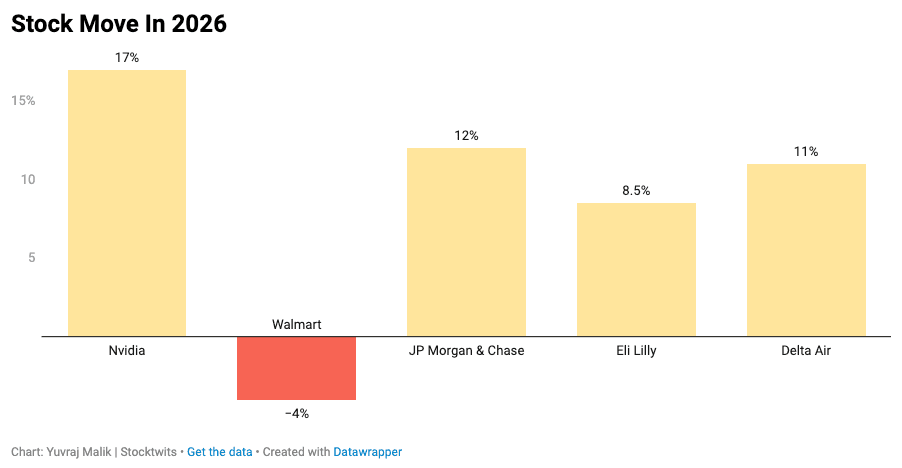
The market is also rewarding the expectation that technology companies can continue expanding at a rapid pace. Nvidia’s stock is up 17% year-to-date, compared with a 4% decline for Walmart, despite Walmart generating more than twice Nvidia’s revenue. JPMorgan is up 12%, while Eli Lilly has gained 8.5% and Delta 11%.
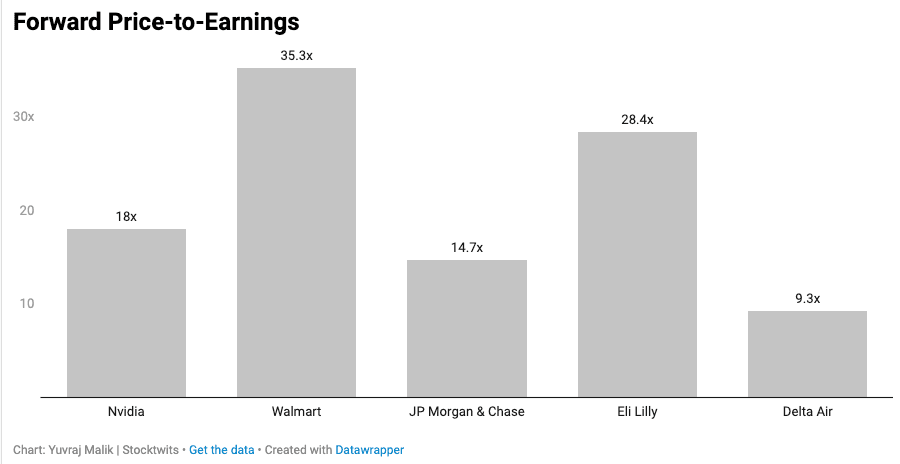
Investors are willing to pay for that growth, but the valuation picture is more nuanced. Nvidia trades at about 18 times forward earnings, below Walmart’s 35.3 times and Eli Lilly’s 28.4 times. JPMorgan trades at 14.7 times and Delta at just 9.3 times.
That underscores the bigger point: the tech stock premium exists precisely because of high margins, rapid growth, and the expectation that those profits can compound for years to come.
Advertisement|Remove ads.
For companies such as Walmart and Delta, enormous revenue does not necessarily translate into enormous profits. For Nvidia and other AI-linked technology companies, it increasingly does.
Big Tech Soaring On AI Holdings
In the ongoing quarterly results season, Big Tech showed it had another trump card up its sleeve. Amazon, Alphabet, Nvidia and Microsoft combined booked a more than $160 billion windfall last quarter from investments in other AI companies, more than double the $69 billion recorded a quarter earlier, adding a major boost to S&P 500 earnings growth.
Alphabet’s other income hit $97.9 billion, while Amazon’s more than tripled to $53.4 billion, driven by mark-to-market gains on investments in companies including Anthropic and SpaceX.
Advertisement|Remove ads.
However, these one-off valuation boosts in AI holdings, driven largely by enthusiasm around AI, risk distorting the financial picture at a time when investors are closely scrutinizing tech earnings to gauge the health of the AI ecosystem, The Financial Times reported.
The rising valuations of tech companies over the years have raised another issue: market concentration. As of last month, the top 10 holdings of the S&P 500 accounted for roughly 38.4% of the index, with Nvidia alone at 7.81%, Apple at 6.89% and Microsoft at 5.53%.
For updates and corrections, email newsroom[at]stocktwits[dot]com.
Advertisement|Remove ads.
Comments posted here will also appear on symbol pages.

Latest News
/filters:format(webp)https://news.stocktwits-cdn.com/large_Getty_Images_2251310812_298ead049b.jpg)
/filters:format(webp)https://news.stocktwits-cdn.com/IMG_9209_1_d9c1acde92.jpeg) Yuvraj Malik·29m ago
Yuvraj Malik·29m ago/filters:format(webp)https://news.stocktwits-cdn.com/large_Getty_Images_2227552702_jpg_918b3cfb42.webp)
/filters:format(webp)https://news.stocktwits-cdn.com/Anushka_Basu_make_me_smile_in_the_picture_b92832aa_af59_4141_aacc_4180d2241ba8_1_2_png_1086e0ed8c.webp) Anushka Basu·36m ago
Anushka Basu·36m ago/filters:format(webp)https://st-everywhere-cms-prod.s3.us-east-1.amazonaws.com/large_Git_Lab_resized_49b70b74d0.jpg)
/filters:format(webp)https://news.stocktwits-cdn.com/shivani_photo_jpg_dd6e01afa4.webp) Shivani Kumaresan·44m ago
Shivani Kumaresan·44m ago/filters:format(webp)https://news.stocktwits-cdn.com/large_Getty_Images_2230137832_jpg_1de3e68131.webp)
/filters:format(webp)https://news.stocktwits-cdn.com/Revised_Profile_JPG_0e0afdf5e2.webp) Preeti Ayyathurai·1h ago
Preeti Ayyathurai·1h ago/filters:format(webp)https://st-everywhere-cms-prod.s3.us-east-1.amazonaws.com/large_five_below_resized_jpg_25612994e1.webp) Shivani Kumaresan·1h ago
Shivani Kumaresan·1h ago/filters:format(webp)https://news.stocktwits-cdn.com/large_Getty_Images_2076701879_jpg_f4058bfd98.webp) Yuvraj Malik·1h ago
Yuvraj Malik·1h ago