


Advertisement|Remove ads.
Are Stablecoins Keeping Liquidity Alive In The Crypto Market? New Data Suggests They Might



- Total crypto market capitalization fell 10.4% in 2025 to $3.0 trillion, marking the industry’s first annual decline since 2022, according to CoinGecko.
- A $19 billion liquidation event in October last year accelerated a sharp fourth-quarter correction, even as reading volumes hit record highs.
- Stablecoin market capitalization surged 48.9% year-on-year to a record $311 billion, while perpetual trading volumes hit all-time highs across centralized and decentralized exchanges.
Advertisement|Remove ads.
The global crypto market shrank in 2025, despite record trading activity, according to CoinGecko’s Annual Crypto Industry Report published last week. But stablecoins surged nearly 50%, reinforcing their growing role as crypto’s primary liquidity layer.
Stablecoins were among the strongest performers in 2025. CoinGecko reported that total stablecoin market capitalization climbed by $102.1 billion or 48.9%, to a record $311 billion. Growth was led by USDT and USDC, while PayPal’s PYUSD emerged as the fifth-largest stablecoin by market cap during the year.

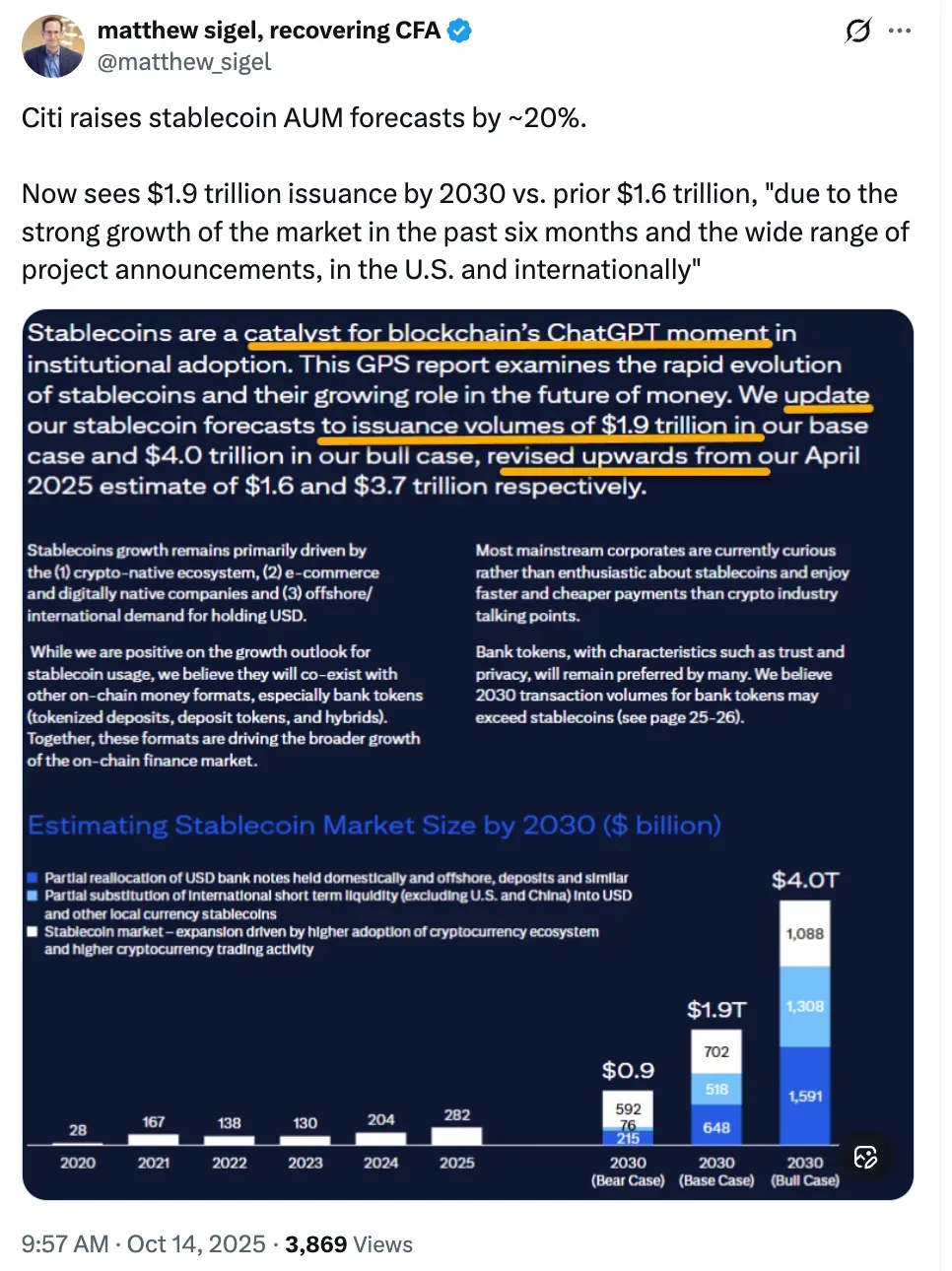
In its annual crypto industry report, CoinGecko said total crypto market capitalization fell by 10.4% year on year to $3.0 trillion. This marked the sector’s first annual decline since 2022, when aggressive Federal Reserve tightening and the collapse of major firms like Terra and FTX triggered a prolonged bear market. With stablecoins accounting for 10.37% of the $3 trillion market cap in 2025, the crypto market would be $2.689 trillion without them. Previously, Vaneck’s Matthew Sigel cited Citi, which called stablecoins the ChatGPT moment for the blockchain industry.
Advertisement|Remove ads.
Why This Matters To Crypto Investors?
As Wall Street has warmed up to crypto with the passage of the GENIUS Act, its new focus with the CLARITY Act could position America as a leader, said Wyoming Senator Cynthia Lummis. For retail investors, stablecoins offer an option to park money, especially during volatile market conditions. Moreover, stablecoins also enable users to earn yield, helping retail investors grow their portfolios rather than sitting on fiat currencies.
Tether (USDT) holds over 61% of the stablecoin supply. On Stocktwits, retail sentiment around Tether improved from ‘bearish’ to ‘neutral’ territory, accompanied by ‘high’ chatter levels over the past day.
Crypto Market’s $19B Liquidation Shock Was Brutal
The market briefly reached an all-time high of $4.4 trillion earlier in 2025, but a sharp correction in the fourth quarter erased gains. CoinGecko attributed the drawdown in part to a $19 billion in leveraged positions that were liquidated in 24 hours in October. This was triggered by President Trump’s announcement of 100% US tariffs on Chinese imports, sparking global tensions. After the liquidation shock, Bitcoin (BTC) fell to $106,560, from its all-time high of $126,080 only a few days ago.
Advertisement|Remove ads.
Despite the price decline, trading activity accelerated, according to the report. Average daily trading volume reached a yearly high of $161.8 billion in Q4, driven by elevated volatility around the liquidation event. Over the full year, perpetual future trading volume on centralized exchanges rose 47.4% to a record $86.2 trillion, while decentralized exchange volume surged 346% to an all-time high of $6.7 trillion.
Read also: Crypto Social Protocol Farcaster Founder Faces Allegations Over LA Property Purchase – But Never Went $FAR With A Token
For updates and corrections, email newsroom[at]stocktwits[dot]com.
Comments posted here will also appear on symbol pages.

Latest News
/filters:format(webp)https://news.stocktwits-cdn.com/large_Getty_Images_2294264991_a1d08b075d.jpg)
/filters:format(webp)https://news.stocktwits-cdn.com/Anushka_Basu_make_me_smile_in_the_picture_b92832aa_af59_4141_aacc_4180d2241ba8_1_2_png_1086e0ed8c.webp) Anushka Basu·14h ago
Anushka Basu·14h ago/filters:format(webp)https://news.stocktwits-cdn.com/large_Getty_Images_1925090359_f160f05588.jpg) Anushka Basu·14h ago
Anushka Basu·14h ago/filters:format(webp)https://news.stocktwits-cdn.com/large_Getty_Images_2213700296_87303c323b.jpg) Anushka Basu·15h ago
Anushka Basu·15h ago/filters:format(webp)https://news.stocktwits-cdn.com/large_franklin_templeton_OG_jpg_4b3a7330d9.webp) Anushka Basu·17h ago
Anushka Basu·17h ago/filters:format(webp)https://news.stocktwits-cdn.com/large_Getty_Images_1445160636_5780a5fdde.jpg) Anushka Basu·18h ago
Anushka Basu·18h ago/filters:format(webp)https://news.stocktwits-cdn.com/Getty_Images_540198451_jpg_3e5f3d8ee7.webp) Anushka Basu·19h ago
Anushka Basu·19h ago