


Advertisement|Remove ads.
Bitcoin's Correlation With Nasdaq Hits 2018 Lows, Analysts Clash Over Whether BTC Is Already In A Bear Market



- Bitcoin remained under pressure near $78,000 despite bullish industry developments, deepening debate over whether BTC is stabilizing or extending a broader bear market.
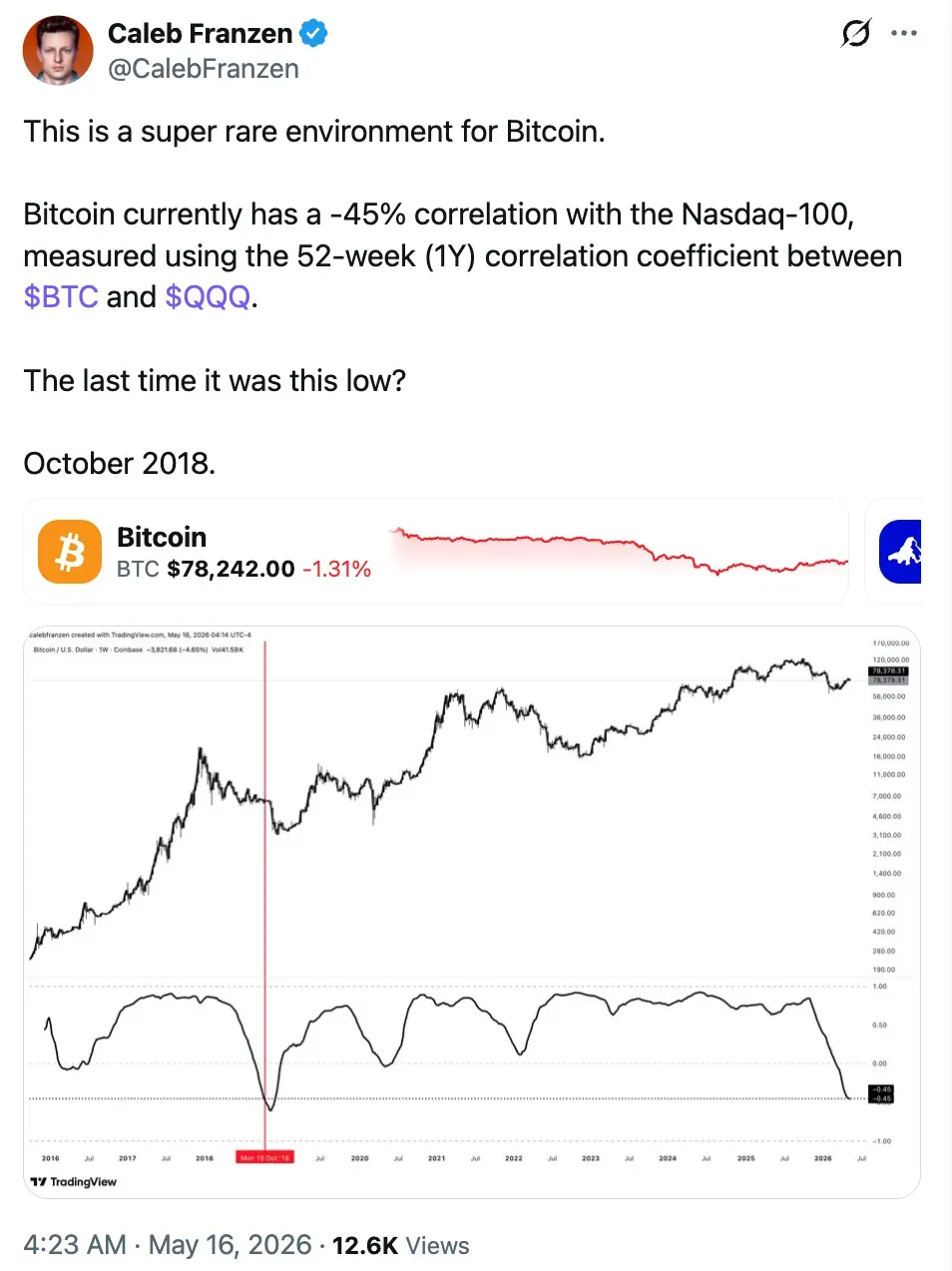
- Analyst Caleb Franzen said Bitcoin’s 52-week correlation with the Nasdaq-100 dropped to negative 45%, the lowest level since October 2018, calling it a “super rare environment” for BTC.
- On-chain analysts pointed to continued long-term holder accumulation and Bitcoin’s “extremely oversold” positioning relative to gold as signs of underlying structural strength.
Advertisement|Remove ads.
Bitcoin is flashing a market signal not seen since October 2018, a near-perfect decoupling from the Nasdaq-100 even as its price hovers near $78,000 and traders are deeply divided on whether the worst is over.
Crypto analyst CryptoBullet pointed out similarities to the 2018 cycle, claiming that Bitcoin’s current pattern is very similar to the period around 220 days after the last cycle top — when BTC tested its 200-day moving average multiple times before finally breaking lower.
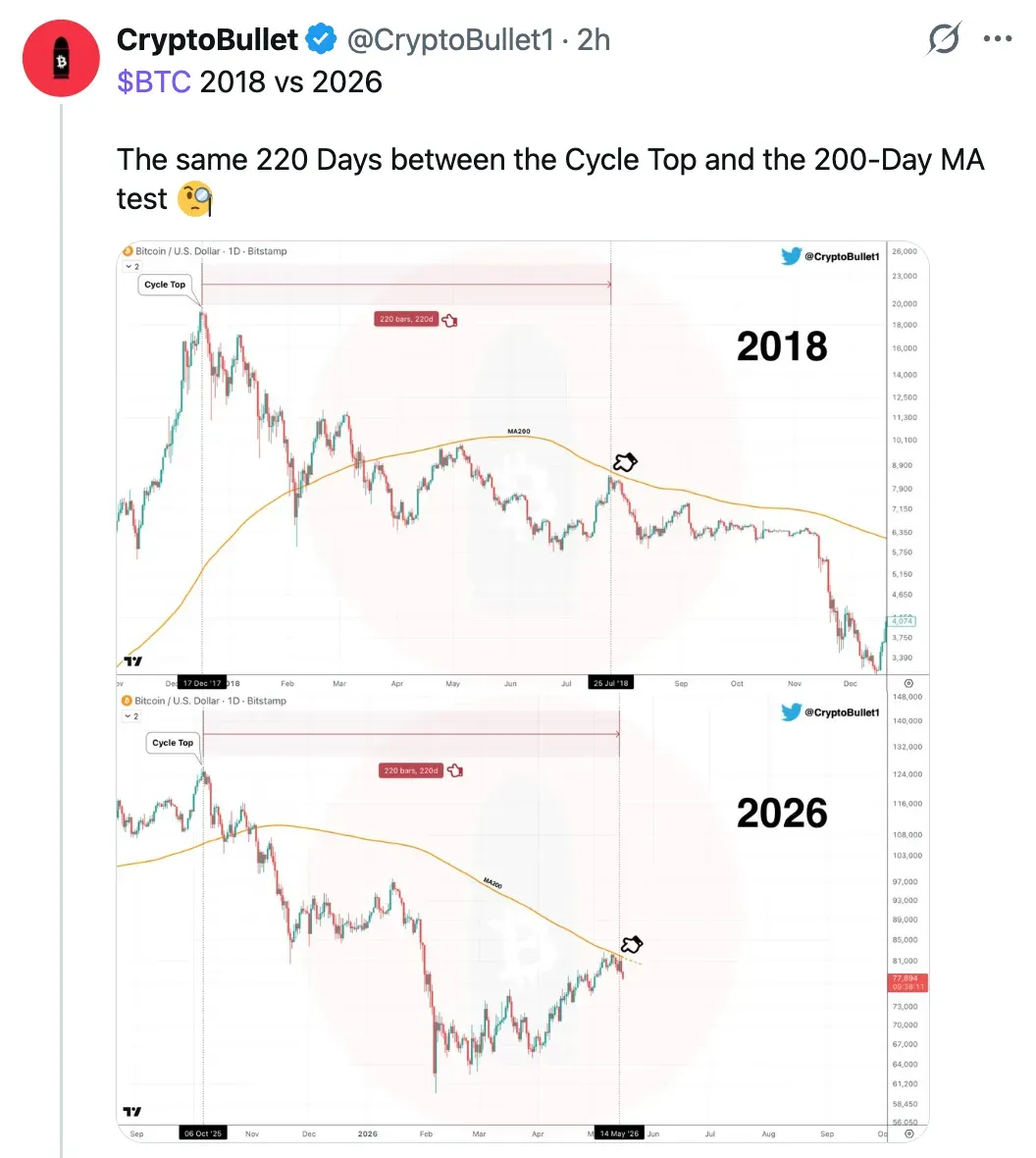
At the same time, several analysts argued that underlying structural indicators continue pointing toward improving long-term conditions beneath the recent weakness.
Advertisement|Remove ads.
Market analyst Caleb Franzen said Bitcoin’s 52-week correlation with the Nasdaq-100 (NSDAQ) had fallen by 45%, the lowest since October 2018. “This is a super rare environment for Bitcoin,” Franzen wrote, noting that BTC had sharply decoupled from US technology stocks despite continued volatility across broader markets.
CLARITY Act Didn’t Pump Bitcoin
Crypto trader Ivan on Tech argued that Bitcoin has remained in a bear market since October 2025, citing lower highs and lower lows across longer timeframes. “Bullish news don’t pump the market in the bear just like bad news don’t dump the market in a bull,” he wrote, arguing that recent catalysts like the CLARITY Act passing with a bipartisan vote had failed to reverse Bitcoin’s broader trend.
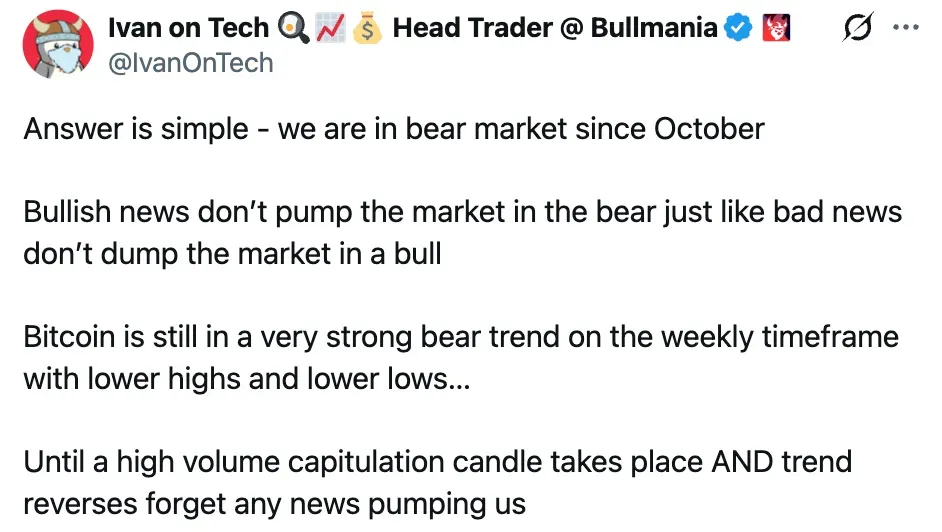
However, Bitcoin’s price remained under pressure, trading at $78,140, posting a single-day drop of more than 1%. On Stocktwits, retail sentiment around BTC remained in the ‘bullish’ zone, while chatter stayed at ‘normal’ levels over the past day.
Advertisement|Remove ads.
Improving Conditions
Additional macro indicators also pointed toward improving positioning relative to hard assets. Data from Bitbo showed Bitcoin stabilizing against gold after a sharp multi-month decline earlier this year, while market observer Julius noted that Bitcoin remained “extremely oversold relative to gold.”
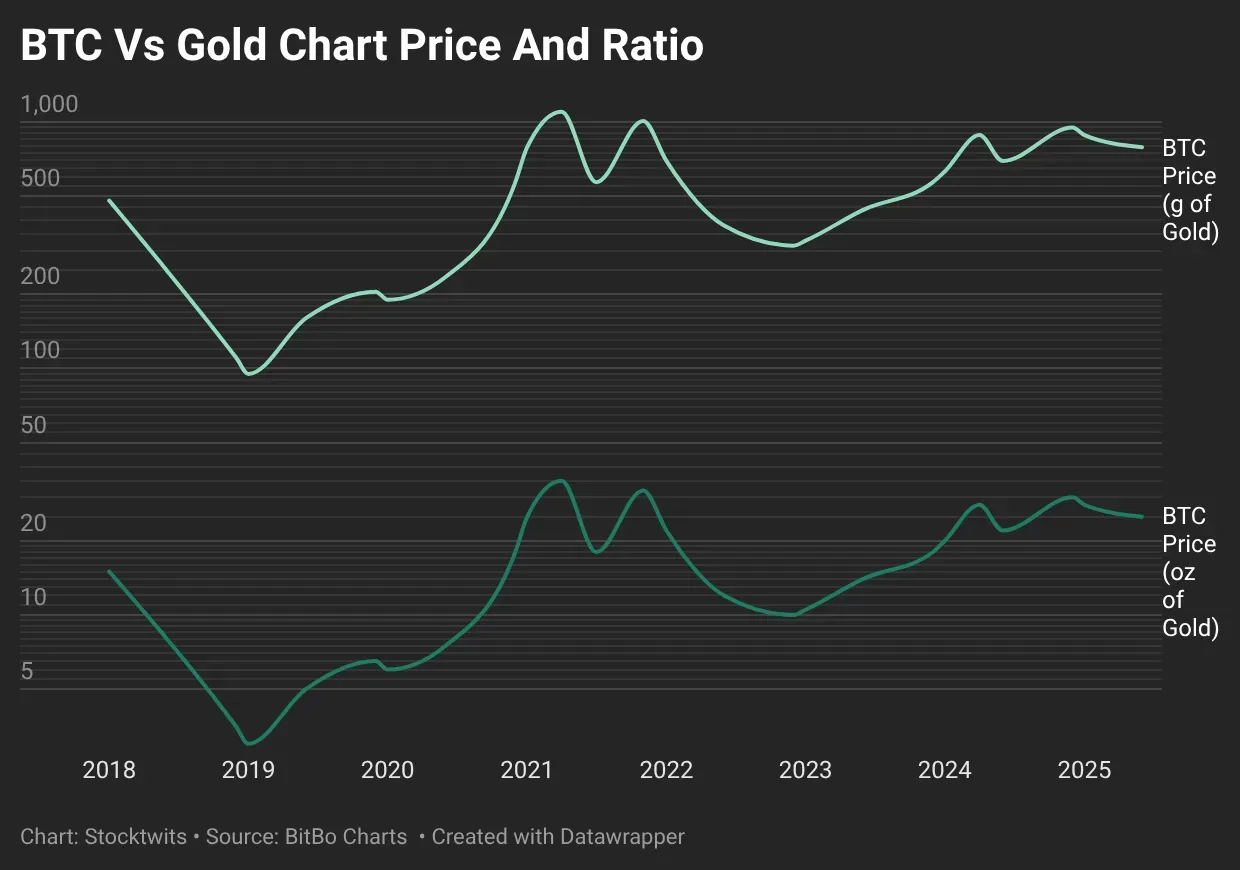
According to Julius, the BTC-to-gold liquidity ratio improved from negative 2.8 standard deviations three months ago to negative 2.0 standard deviations more recently, though the analyst argued Bitcoin still remained below fair value relative to gold markets.
Long-Term Holders Continue Accumulating
On-chain analyst CryptoCon also pointed to continued accumulation among long-term Bitcoin holders, defined as wallets that have held BTC for more than 1 year. “The more interested they get in buying, the more interested I get,” the analyst wrote, arguing that long-term holder positioning remains well below historical cycle-top extremes.
Advertisement|Remove ads.
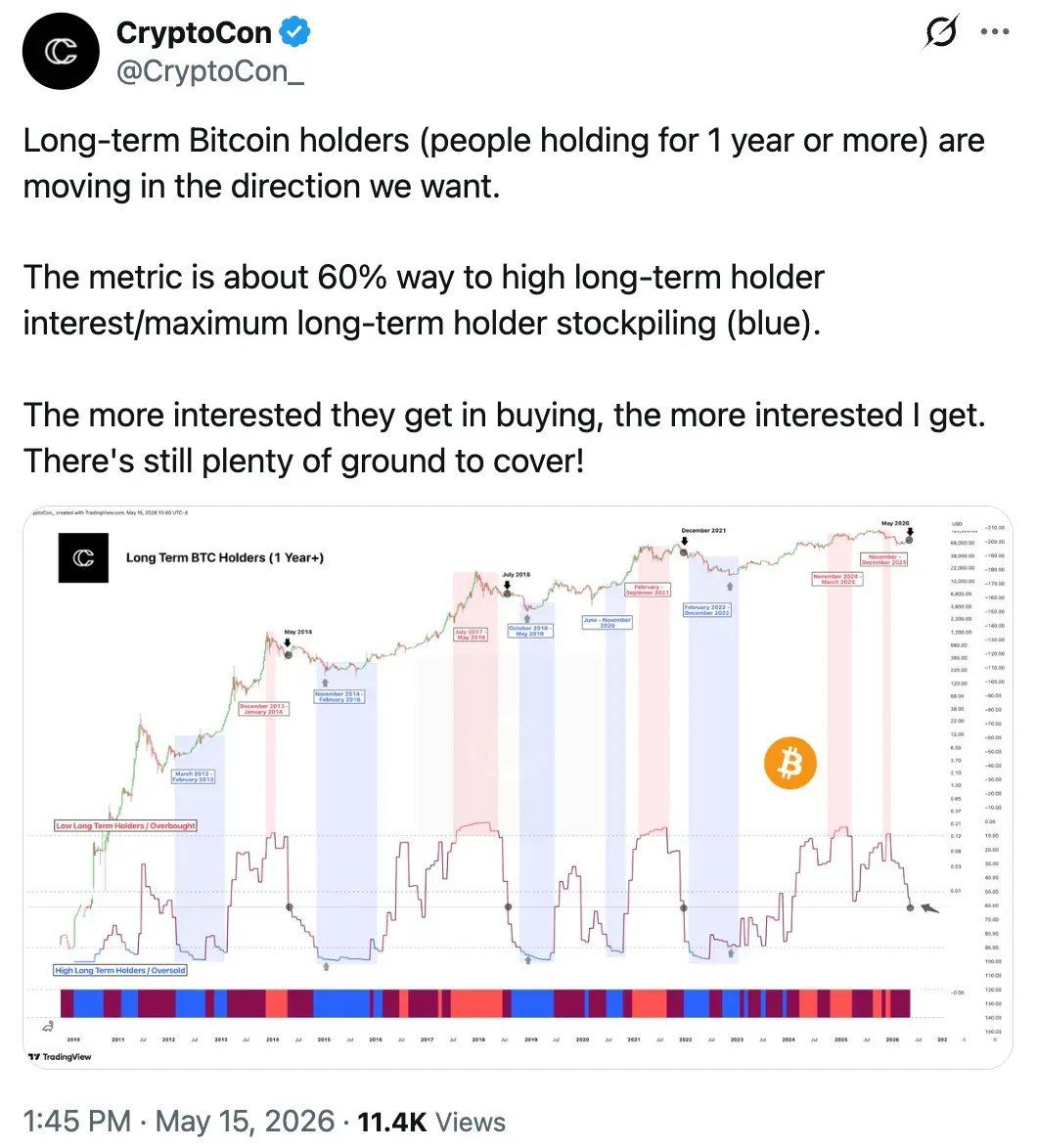
For now, the market remains split between those viewing Bitcoin’s recent weakness as part of a longer-term accumulation structure and others who believe the asset has yet to experience the type of capitulation historically associated with durable cycle bottoms.
Read also: Cathie Wood, Robinhood CFO Agree Current IPO System Has Failed Retail — And Point To SpaceX As Proof
For updates and corrections, email newsroom[at]stocktwits[dot]com.
Advertisement|Remove ads.
Comments posted here will also appear on symbol pages.

Latest News
/filters:format(webp)https://news.stocktwits-cdn.com/large_rocket_lab_peter_beck_jpg_4d8fc790a1.webp)
/filters:format(webp)https://news.stocktwits-cdn.com/unnamed_jpg_9dff551b50.webp) Anan Ashraf·13m ago
Anan Ashraf·13m ago/filters:format(webp)https://news.stocktwits-cdn.com/large_Federal_Reserve_a31f9e5606.jpg)
/filters:format(webp)https://news.stocktwits-cdn.com/1707726834303_jpg_11f20a9aa9.webp) Shashank Nayar·39m ago
Shashank Nayar·39m ago/filters:format(webp)https://news.stocktwits-cdn.com/gettyimages_2296214136_594x594_1_ed9bb6d607.jpg) Anan Ashraf·1h ago
Anan Ashraf·1h ago/filters:format(webp)https://news.stocktwits-cdn.com/large_Getty_Images_2169449321_719241c1ea.jpg) Anan Ashraf·2h ago
Anan Ashraf·2h ago/filters:format(webp)https://news.stocktwits-cdn.com/large_Getty_Images_1688507143_jpg_27b19431c5.webp) Shashank Nayar·2h ago
Shashank Nayar·2h ago/filters:format(webp)https://news.stocktwits-cdn.com/large_Getty_Images_1477909777_206162a09d.jpg) Anan Ashraf·3h ago
Anan Ashraf·3h ago