


Advertisement|Remove ads.
Bitcoin Crashes Below $68K, Triggering $1.23B Crypto Liquidations — Analyst Flags 6 Reasons Why 'BTC Is Playing Its Own Game'


- Crypto analyst Lark Davis identified six factors weighing on Bitcoin, including ETF outflows, Strategy's recent Bitcoin sale, and Mt. Gox distributions.
- He also pointed to a possible rotation into AI stocks, a technical breakdown, and the ongoing influence of the four-year market cycle.
- Davis added that the growing divergence between Bitcoin and technology stocks challenges the popular view that Bitcoin simply trades as a high-beta version of the Nasdaq.
Advertisement|Remove ads.
Bitcoin (BTC) fell below $68,000 in midday trading Tuesday, triggering more than $1.23 billion in crypto liquidations and extending a selloff that has left the cryptocurrency over 45% below its record high.
According to crypto analyst Lark Davis, the selloff is being driven by six separate factors. He stated that while most of them are short-term, the dominant driving force remains Bitcoin's historical four-year market cycle. “Bitcoin’s playing its own game,” he wrote in a newsletter.

Bitcoin’s price fell nearly 5% in the last 24 hours, trading at around $67,700 at the time of writing. The cryptocurrency was the top trending ticker on Stocktwits on Tuesday, with retail sentiment trending in ‘extremely bearish’ territory over the past day while chatter rose to ‘high’ from ‘normal’ levels.
Advertisement|Remove ads.
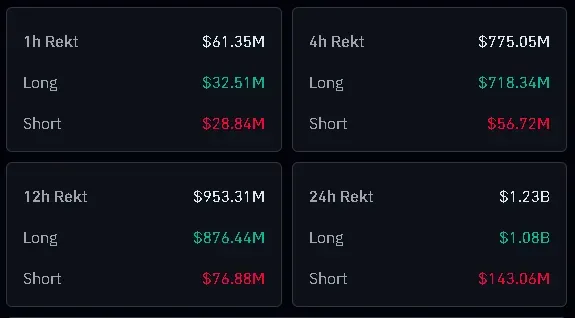
The drop in Bitcoin’s price dragged the overall cryptocurrency market lower by nearly 4% to $2.42 trillion. CoinGlass data showed over $1.23 billion in crypto liquidations, with $1.09 billion of the forced unwinds just from long bets.
Why Is Bitcoin Falling Below $68K?
According to Davis, the drop in Bitcoin’s price is nothing more than the four-year cycle playing itself out. Historically, Bitcoin has experienced large drawdowns after major bull-market peaks, and Davis stated that cycle timing continues to exert the greatest influence on price action.
Beyond the cycle dynamics, he pointed to five secondary factors that are adding pressure, including Strategy’s (MSTR) recent sale of 32 Bitcoin for $2.5 million. The sale marked Strategy's first Bitcoin disposal since 2022. On Stocktwits, retail traders pointed to executive chairman Michael Saylor’s decision to sell as the primary reason for Bitcoin’s fall.
Advertisement|Remove ads.
The second factor Davis noted was the overhang from now defunct cryptocurrency exchange Mt. Gox transferring roughly 10,400 Bitcoin. According to him, it has fueled concerns that additional creditor distributions could create fresh selling pressure since many of the creditors acquired their Bitcoin before 2014 and remain deeply profitable even at current prices.
At the same time, Bitcoin spot ETFs have recorded 11 consecutive days of net outflows, the longest redemption streak since the products launched. Davis stated that the persistent withdrawals have removed a major source of demand that helped drive prices higher earlier in the cycle. He also noted signs that some investors may be rotating capital away from Bitcoin and toward artificial intelligence-related equities.
Finally, on the technical side, Davis stated Bitcoin recently broke below an ascending channel support line that had been in place since February, creating an additional headwind.
Advertisement|Remove ads.
Bitcoin Still Outperforming Tech Stocks Since 2022
Despite the recent weakness, Davis pointed out that Bitcoin's longer-term performance remains stronger than many investors realize.
From the lows reached in late 2022 through today, Bitcoin has gained approximately 333%, compared with a 237% gain for the Technology Select Sector SPDR Fund (XLK), a technology ETF heavily weighted toward companies such as Nvidia (NVDA), Advanced Micro Devices (AMD) and Micron (MU).
Davis pointed out that the gap is even wider when comparing cycle peaks. From trough to peak, Bitcoin rose roughly 683%, while XLK gained 237%.
Advertisement|Remove ads.
Read also: After Three Winning Calls, Arthur Hayes Is Betting Big On Sam Altman’s Crypto Project
For updates and corrections, email newsroom[at]stocktwits[dot]com
Comments posted here will also appear on symbol pages.

Latest News
/filters:format(webp)https://news.stocktwits-cdn.com/Getty_Images_2228900888_jpg_338103de79.webp)
/filters:format(webp)https://news.stocktwits-cdn.com/Anushka_Basu_make_me_smile_in_the_picture_b92832aa_af59_4141_aacc_4180d2241ba8_1_2_png_1086e0ed8c.webp) Anushka Basu·7h ago
Anushka Basu·7h ago/filters:format(webp)https://news.stocktwits-cdn.com/large_Getty_Images_1767602875_jpg_db2e050c08.webp) Anushka Basu·8h ago
Anushka Basu·8h ago/filters:format(webp)https://news.stocktwits-cdn.com/large_new_york_stock_exchange_jpg_e1f85c0d8c.webp)
/filters:format(webp)https://st-everywhere-cms-prod.s3.us-east-1.amazonaws.com/i_OS_App_Icon_1_8054f2a2fe.png) Stocktwits News Desk·8h ago
Stocktwits News Desk·8h ago/filters:format(webp)https://news.stocktwits-cdn.com/large_grayscale_OG_jpg_c35dc5b1a2.webp) Anushka Basu·9h ago
Anushka Basu·9h ago/filters:format(webp)https://news.stocktwits-cdn.com/large_Google_Office_in_New_York_City_2ff844002a.jpg) Stocktwits News Desk·9h ago
Stocktwits News Desk·9h ago/filters:format(webp)https://news.stocktwits-cdn.com/large_mark_rubio_original_jpg_1e75e0c7f2.webp) Stocktwits News Desk·9h ago
Stocktwits News Desk·9h ago