


Advertisement|Remove ads.
DeFi Hack Shakes Crypto Confidence, But Standard Chartered Says The System ‘Is Bent Not Broken’



- Standard Chartered said the $292 million decentralized finance exploit triggered a “bank run,” with about $17 billion withdrawn from Aave.
- The report described the system as “bent, not broken,” noting protocols remained functional despite severe liquidity stress.
- Hack involved roughly 116,500 restaked Ethereum used as collateral, exposing risks tied to complex assets and cross-protocol leverage.
Advertisement|Remove ads.
Standard Chartered said on Wednesday that a $292 million exploit that rippled across decentralized finance (DeFi) triggered a system-wide liquidity shock, but the ecosystem remained operational under pressure.
The multinational bank explained that the attack triggered a DeFi-wide “bank run,” with roughly $17 billion withdrawn from Aave (AAVE), the largest lending protocol, as users rushed to exit positions amid concerns about collateral quality.
Despite the scale of the outflows, Standard Chartered described the system as “bent, not broken,” noting that protocols continued to function even as liquidity tightened sharply. The report framed the episode as a stress test rather than a failure of core infrastructure.
Advertisement|Remove ads.
AAVE’s price rose by 0.3% over the past 24 hours. On Stocktwits, the retail sentiment around AAVE remained in the ‘bearish’ zone, while chatter around it stayed ‘extremely high’ over the past day.
System Tested By Liquidity Shock
The disruption followed a cyberattack on KelpDAO earlier this month, in which attackers siphoned roughly 116,500 rsETH, a restaked Ethereum (ETH) token, via a cross-chain bridge, resulting in losses of nearly $290 million. The stolen assets were then deposited into Aave as collateral to borrow other tokens, amplifying concerns over collateral quality.
Standard Chartered said the reaction resembled a traditional bank run, but noted that DeFi protocols behaved as designed, with market-driven mechanisms adjusting rates and liquidity in real time.
Advertisement|Remove ads.
Structural Gaps Remain
Standard Chartered said conditions on Aave have begun to normalize following the shock, with yields easing and deposits recovering, even as structural weaknesses remain.
The report highlighted risks associated with complex collateral, such as restaked assets, as well as mismatches between deposits and loans. Cross-protocol exposure and leveraged strategies also amplified the shock, allowing risks to spread quickly across platforms.
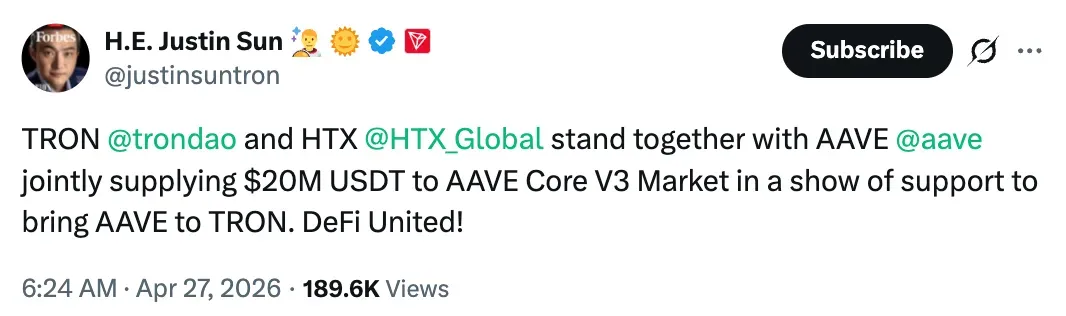
A coordinated industry response helped stabilize conditions. DeFi United, a relief effort led by Aave after the exploit, brought together ecosystem participants to support liquidity. Separately, TRON founder Justin Sun said TRON and HTX supplied $20 million in USDT, Tether’s dollar-pegged stablecoin, to Aave’s core market as part of the recovery effort.
Advertisement|Remove ads.
Standard Chartered said the episode showed both the fragility and resilience of DeFi, showing the system can absorb shocks but will require stronger safeguards as it evolves.
Read also: Dogecoin Jumps Amid SpaceX IPO Hype – Retail Crowns It ‘Best Proof-Of–Work’
For updates and corrections, email newsroom[at]stocktwits[dot]com.
Advertisement|Remove ads.
Comments posted here will also appear on symbol pages.

Latest News
/filters:format(webp)https://news.stocktwits-cdn.com/large_Getty_Images_2240705289_c6a2c346cc.jpg)
/filters:format(webp)https://news.stocktwits-cdn.com/unnamed_jpg_9dff551b50.webp) Anan Ashraf·20m ago
Anan Ashraf·20m ago/filters:format(webp)https://news.stocktwits-cdn.com/large_stock_chart_falling_resized_jpg_c0ce61eff2.webp)
/filters:format(webp)https://news.stocktwits-cdn.com/1707726834303_jpg_11f20a9aa9.webp) Shashank Nayar·23m ago
Shashank Nayar·23m ago/filters:format(webp)https://news.stocktwits-cdn.com/large_skydance_decde45b1e.jpg) Shashank Nayar·50m ago
Shashank Nayar·50m ago/filters:format(webp)https://news.stocktwits-cdn.com/large_omeros_jpg_4769b8d291.webp) Anan Ashraf·1h ago
Anan Ashraf·1h ago/filters:format(webp)https://news.stocktwits-cdn.com/gettyimages_2300173669_612x612_7f6f3c187e.jpg)
/filters:format(webp)https://news.stocktwits-cdn.com/Prabhjote_DP_67623a9828.jpg) Prabhjote Gill·3h ago
Prabhjote Gill·3h ago/filters:format(webp)https://news.stocktwits-cdn.com/large_exxon_jpg_55190ae0a4.webp) Anan Ashraf·3h ago
Anan Ashraf·3h ago