


Advertisement|Remove ads.
Why Bitcoin Is Falling Today: BTC Selloff Tracks Tech Correction, Analysts Call It A Credit Unwind


- Bitcoin's slide toward $59,000 coincided with capital rotating out of Bitcoin and gold exchange-traded funds into semiconductor funds.
- Analysts linked the sell-off to a broader technology and AI sector correction rather than crypto-specific weakness.
- Capital Flows described the move as a "credit unwind," arguing Bitcoin is reacting to broader market dynamics rather than leading them.
Advertisement|Remove ads.
Bitcoin (BTC) extended its 2026 decline toward the $59,000 mark this week, a move that flow data and analyst commentary suggested was driven less by anything crypto-native than by a rotation of capital out of digital assets and into the semiconductor trade.
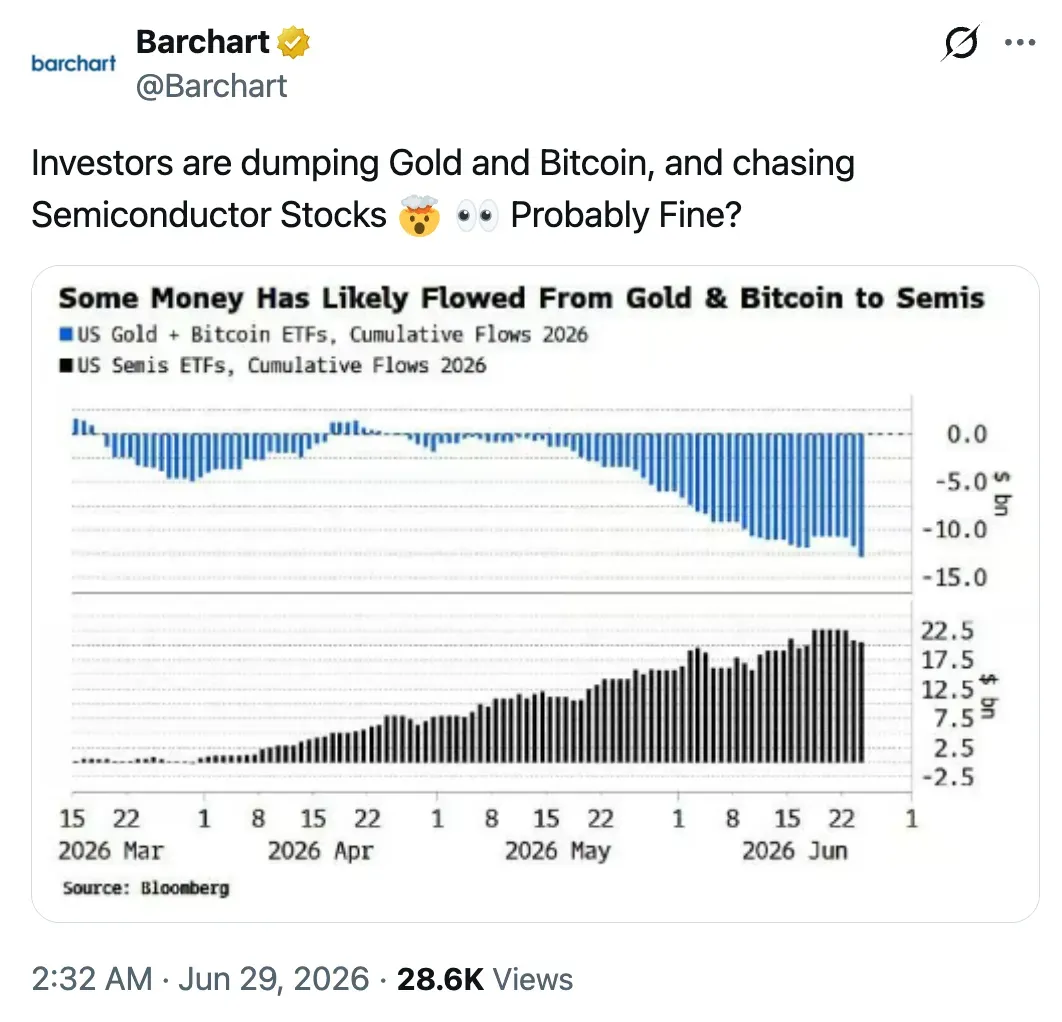
Cumulative fund flows for 2026 through late June showed money flowing out of US Gold and Bitcoin exchange-traded funds (ETFs) and into US semiconductor ETFs, according to Barchart, citing Bloomberg data. The Gold-plus-Bitcoin line turned sharply negative, while the Semiconductor line continued to climb. The pattern supported a reading of Bitcoin’s slide as a high-beta expression of risk appetite rather than an isolated breakdown in crypto fundamentals.
A Risk-Off Move That Started in Chips
The immediate trigger was a semiconductor correction that started in Seoul, where the KOSPI tumbled by around 10% and triggered circuit breakers before spilling over into the Nasdaq (NDAQ). Mike McCluskey, co-founder of a tokenization platform tx, said in an email to Stocktwits that traders are watching the tape as Bitcoin’s slide appears largely a function of its correlation with tech equities, with AI and chip leaders, including Nvidia (NVDA), seeing pullbacks.
Advertisement|Remove ads.
Funding rates were mostly neutral through the drop, suggesting that leverage wasn’t too front-run and that spot ETF outflows were less than the aggressive de-risking seen earlier in the month.
This divergence stemmed from the digital credit channel: at that time, bank credit issuance still hit an all-time high, while Strive (ASST) and Strategy (MSTR) seized the opportunity to buy the dip and accumulate hundreds of BTC when Bitcoin’s price neared its long-standing support level, the 200-week moving average, said McCluskey.
'Not the Source of Truth'
Research firm Capital Flows said in a report that a falling Bitcoin is "not the source of truth that everyone treats it as," framing the drawdown as a credit unwind distinct from macro liquidity. The firm said Bitcoin led on the upside in 2025 but, during the 2026 downturn, underperformed even the lowest-quality names in the Russell, a divergence tied to the credit channel, noting banks were issuing credit at all-time highs even as the market insisted liquidity was contracting.
Advertisement|Remove ads.
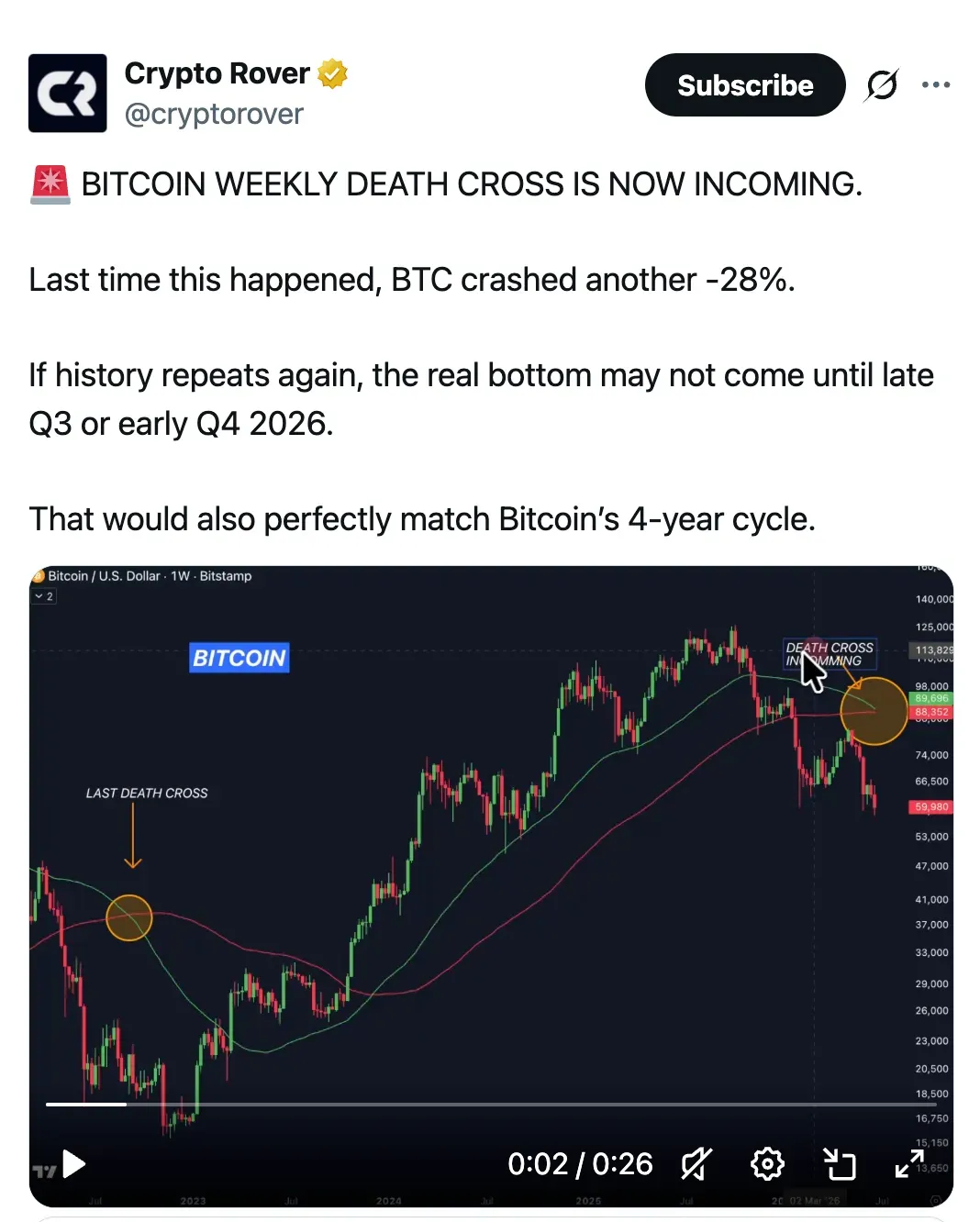
From a bearish technical perspective, crypto analyst Crypto Rover highlighted an impending weekly “death cross” for Bitcoin, in which the 50-week moving average dips below the 200-week moving average, a pattern often interpreted as an indicator of prolonged downward momentum. The analyst noted that the last time the formation appeared, Bitcoin fell another 28% and argued that if the pattern repeats, the cycle low may not arrive until late in the third quarter or early in the fourth quarter of 2026, a timeline the analyst said would align with Bitcoin’s roughly four-year halving cycle.
Bitcoin’s price was down by 0.8% during the past 24 hours. On Stocktwits, the retail sentiment around BTC remained in the ‘neutral’ zone, while chatter around it stayed at ‘normal’ levels over the past day.
Advertisement|Remove ads.
For updates and corrections, email newsroom[at]stocktwits[dot]com.
Comments posted here will also appear on symbol pages.

Latest News
/filters:format(webp)https://news.stocktwits-cdn.com/large_Getty_Images_2297721644_7ea2def172.jpg)
/filters:format(webp)https://news.stocktwits-cdn.com/Ram_83262cba1d.jpg) Ramakrishnan M·23m ago
Ramakrishnan M·23m ago/filters:format(webp)https://news.stocktwits-cdn.com/large_Getty_Images_2267825783_jpg_1b90bf709b.webp)
/filters:format(webp)https://news.stocktwits-cdn.com/IMG_8805_JPG_6768aaedc3.webp) Deepti Sri·47m ago
Deepti Sri·47m ago/filters:format(webp)https://news.stocktwits-cdn.com/large_Exxon_may_30_jpg_3829e5a106.webp)
/filters:format(webp)https://news.stocktwits-cdn.com/shivani_photo_jpg_dd6e01afa4.webp) Shivani Kumaresan·49m ago
Shivani Kumaresan·49m ago/filters:format(webp)https://news.stocktwits-cdn.com/large_Getty_Images_2299257316_ebdab0e9aa.jpg)
/filters:format(webp)https://news.stocktwits-cdn.com/IMG_9209_1_d9c1acde92.jpeg) Yuvraj Malik·1h ago
Yuvraj Malik·1h ago/filters:format(webp)https://news.stocktwits-cdn.com/large_big_pharma_577fb207eb.jpg) Deepti Sri·1h ago
Deepti Sri·1h ago/filters:format(webp)https://news.stocktwits-cdn.com/large_Getty_Images_2245498698_eb56c3f1cc.jpg) Yuvraj Malik·2h ago
Yuvraj Malik·2h ago