


Advertisement|Remove ads.
AI Spending Surge Could Add 3% To US GDP, And That May Be Just The Start: David Sacks


- Morgan Stanley also significantly increased its capital expenditure forecast for major hyperscalers, projecting a combined $805 billion in capex spends from the top five.
- “Polls may show that AI is not popular, but economic growth is. At this point, stopping progress in AI would be equivalent to halting the U.S. economy,” David Sacks said in a post on X.
- Sacks also said in his post that despite the significant numbers reported, the figures may still understate AI’s true economic impact.
Advertisement|Remove ads.
Artificial intelligence has become a core driver of economic growth in the U.S., and slowing or stopping its progress can have serious implications for the country, according to a member of the President's Council of Advisors on Science and Technology, David Sacks.
“Polls may show that AI is not popular, but economic growth is. At this point, stopping progress in AI would be equivalent to halting the U.S. economy,” the Former White House Crypto and AI Czar said in a post on X on Sunday.
Last week, the Bureau of Economic Analysis released data that showed that the U.S. economy grew at a 2% annualized pace in the first quarter of 2026, rebounding from 0.5% in the prior quarter, boosted primarily by a large AI-driven increase in business investment.
Advertisement|Remove ads.
AI’s Impact On US GDP
Sacks said in his post on X that AI-related capex has already been a significant tailwind to GDP, and is likely to be an even bigger contributor than anticipated.
“I’ve been saying for awhile that AI capex will be a 2% tailwind to GDP growth this year. In fact, according to a new report from Morgan Stanley, the numbers are even stronger — more like 2.5% this year and over 3% next year,” he said, resharing a post from German editor and market analyst Holger Zschaepitz.
Earlier on Sunday, Morgan Stanley significantly increased its capital expenditure forecast for major hyperscalers, projecting a combined capital expenditure of $805 billion from Amazon (AMZN), Alphabet (GOOG), Meta Platforms (META), Microsoft (MSFT) and Oracle (ORCL) for 2026. This is nearly double the levels anticipated for 2025 and about three times what was spent in 2024. For 2027, the analyst has lifted its forecast to $1.1 trillion.
Advertisement|Remove ads.
Zschaepitz put that into perspective in his post, noting that the projected 2026 spending by these five companies alone could rival the total capex of all non-tech firms in the S&P 500 just a year earlier.
“In Q1, AI was already 75% of GDP growth. That trend is likely to continue. Technology leadership has always been America’s great strength, and it’s driving the economy forward,” Sacks said.
Is AI’s Influence Understated?
Sacks also said in his post that despite the significant numbers reported, the figures may still understate AI’s true economic impact.
Advertisement|Remove ads.
Firstly, the capex figures were only for the top five hyperscalers and “doesn’t include all the startups and other companies investing in AI,” he said.
Secondly, Sacks argued that capex only accounts for building the infrastructure, but not the other productivity gains. “Capex is the investment to create the token factories; it doesn’t count the economic activity resulting from what happens inside the token factories. Those tokens are now being used to generate code (bespoke software) that will increase productivity throughout the economy. The ROI on capex is likely to dwarf the capex itself, which is why investment continues to grow,” he said.
AI ETFs Soar Past S&P 500
Even as investors remain skeptical of AI-driven capex spending and its sustainability, AI-focused exchange-traded funds have far outperformed broader benchmark indexes this year.
Advertisement|Remove ads.
The Global X Artificial Intelligence & Technology ETF (AIQ), which invests in both hardware- and software-linked AI plays, has gained more than 49% in the past year, and the Roundhill Generative AI & Technology ETF (CHAT), another fund that tracks AI companies, has rallied 110% over the same period. Meanwhile, the SPDR S&P 500 ETF (SPY), which tracks the S&P 500 index, has risen about 28% over the same period.
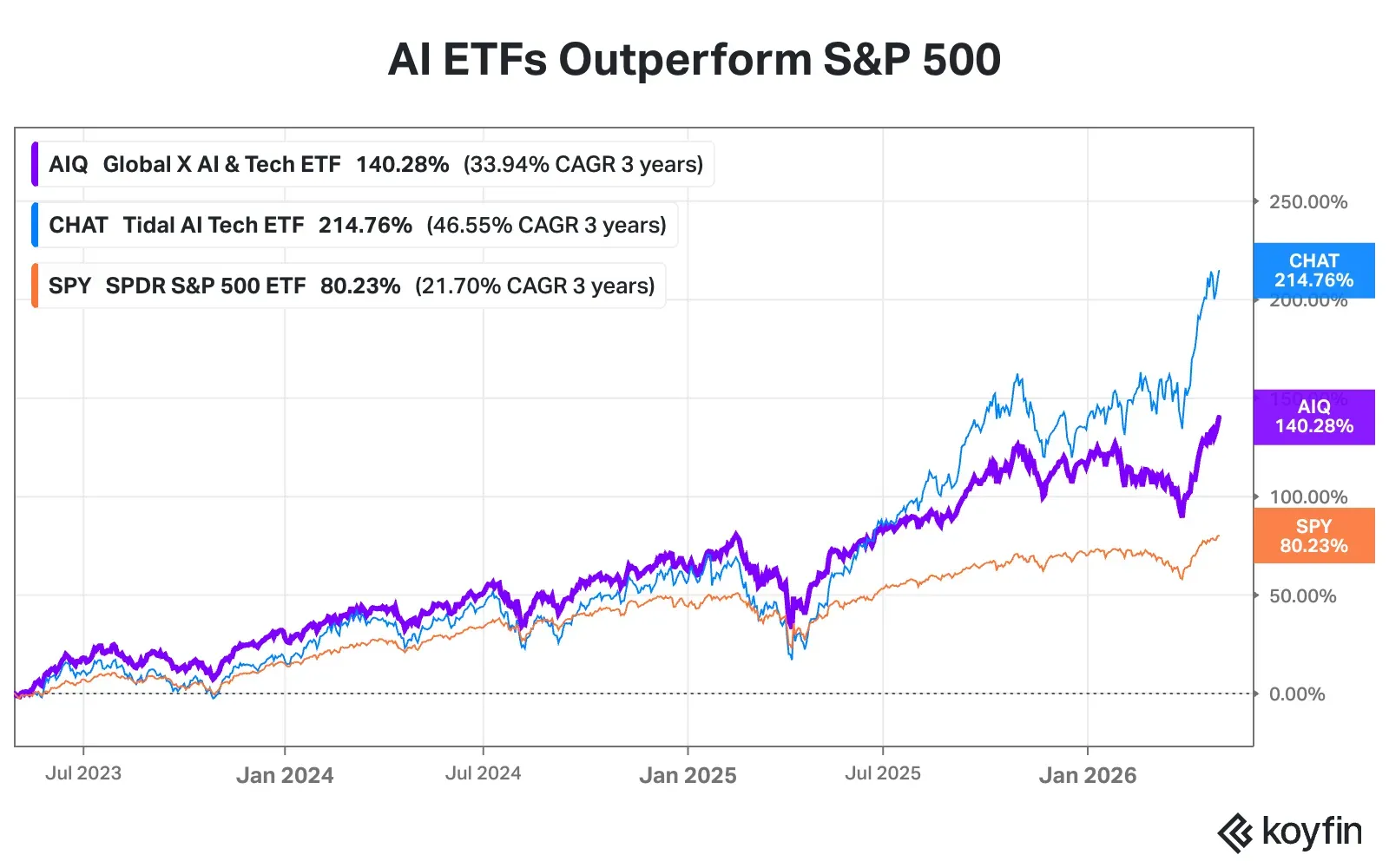
However, note that AIQ's top two holdings are South Korean tech giants SK Hynix and Samsung Electronics, while Nvidia (NVDA) and Alphabet are the top holdings in CHAT.
Advertisement|Remove ads.
On Stocktwits, retail sentiment around AIQ was in the 'neutral' territory at the time of writing, while it was 'bullish' for CHAT, and ‘extremely bullish’ for SPY.
For updates and corrections, email newsroom[at]stocktwits[dot]com.
Comments posted here will also appear on symbol pages.

Latest News
/filters:format(webp)https://news.stocktwits-cdn.com/large_Trending_stock_resized_may_jpg_bc23339ae7.webp)
/filters:format(webp)https://news.stocktwits-cdn.com/vivekkrishnanphotography_58_jpg_0e45f66a62.webp) Arnab Paul·7m ago
Arnab Paul·7m ago/filters:format(webp)https://news.stocktwits-cdn.com/large_Getty_Images_2277711579_jpg_fe4dcf249b.webp)
/filters:format(webp)https://news.stocktwits-cdn.com/unnamed_jpg_9dff551b50.webp) Anan Ashraf·23m ago
Anan Ashraf·23m ago/filters:format(webp)https://news.stocktwits-cdn.com/large_Getty_Images_2267825774_jpg_de378639d2.webp)
/filters:format(webp)https://news.stocktwits-cdn.com/Whats_App_Image_2026_05_11_at_09_45_43_1_jpeg_a08c0cf251.webp) Aveek Bhowmik·28m ago
Aveek Bhowmik·28m ago/filters:format(webp)https://news.stocktwits-cdn.com/large_Getty_Images_2197091362_jpg_1ce8fc175a.webp)
/filters:format(webp)https://news.stocktwits-cdn.com/1707726834303_jpg_11f20a9aa9.webp) Shashank Nayar·32m ago
Shashank Nayar·32m ago/filters:format(webp)https://news.stocktwits-cdn.com/large_Getty_Images_2184668221_ceaeac5172.jpg)
/filters:format(webp)https://news.stocktwits-cdn.com/Anushka_Basu_make_me_smile_in_the_picture_b92832aa_af59_4141_aacc_4180d2241ba8_1_2_png_1086e0ed8c.webp) Anushka Basu·39m ago
Anushka Basu·39m ago/filters:format(webp)https://news.stocktwits-cdn.com/large_spacex_81af9a3176.jpg) Arnab Paul·49m ago
Arnab Paul·49m ago