


Advertisement|Remove ads.
AI Trade Risk: What Happens When One Theme Dominates Markets Like Never Before?


- The Kobeissi Letter said that a record 15.4% of investment-grade debt is also tied to AI, making it the largest sector in the U.S. credit market.
- Marko Kolanovic, former chief global market strategist at JPMorgan Chase, said in a post on X that the thematic concentration is a massive market risk.
- The Roundhill Generative AI & Technology ETF has surged 119% over the last year, while the SPDR S&P 500 ETF, which tracks the S&P 500 index, has risen 29.6% over the same period.
Advertisement|Remove ads.
When OpenAI's now-ubiquitous bot ChatGPT launched four years ago and sparked early hype around artificial intelligence, AI-linked stocks accounted for only about a quarter of the S&P 500.
Now, that share has nearly doubled, unnerving many on Wall Street even as several exchange-traded funds riding the hot theme have outperformed the benchmark indexes.
The 'Massive' AI Risk
According to research from Goldman Sachs, AI-linked stocks now account for nearly 45% of the S&P 500, up from about 25% in 2022 when OpenAI rolled out ChatGPT for the public.
Advertisement|Remove ads.
Currently, the top holdings in the S&P 500 by weight are all considered AI plays to varying degrees, with most belonging to the "Magnificent Seven" group.
| Number | Company | Symbol | Weight |
| 1 | NVIDIA Corp. | NVDA | 7.52% |
| 2 | Apple Inc. | AAPL | 6.22% |
| 3 | Microsoft Corp. | MSFT | 4.78% |
| 4 | Amazon.com Inc. | AMZN | 4.25% |
| 5 | Alphabet Inc. | GOOGL | 3.29% |
| 6 | Broadcom Inc. | AVGO | 3.08% |
| 7 | Alphabet Inc. | GOOG | 3.06% |
| 8 | Meta Platforms Inc. | META | 2.59% |
| 9 | Tesla Inc. | TSLA | 2.17% |
| 10 | Walmart Inc. | WMT | 1.63% |
In March 2026 alone, S&P Dow Jones Indices added three companies directly tied to the AI infrastructure boom to the S&P 500: Vertiv Holdings Co. (VRT), which specializes in power and cooling systems for data centers and AI servers; Lumentum Holdings Inc. (LITE), which produces advanced optical components and lasers for high-speed AI data center networking; and Coherent Corp. (COHR), which focuses on photonics and silicon photonics for AI computing clusters.
The Kobeissi Letter, which provides industry-leading market commentary, noted in a post on X that the record concentration comes even as investment-grade debt linked to AI is surging to record levels and called it a “shocking" statistic.
"Never before has a single theme dominated both U.S. equity and credit markets to this magnitude," The Kobeissi Letter said.
Advertisement|Remove ads.
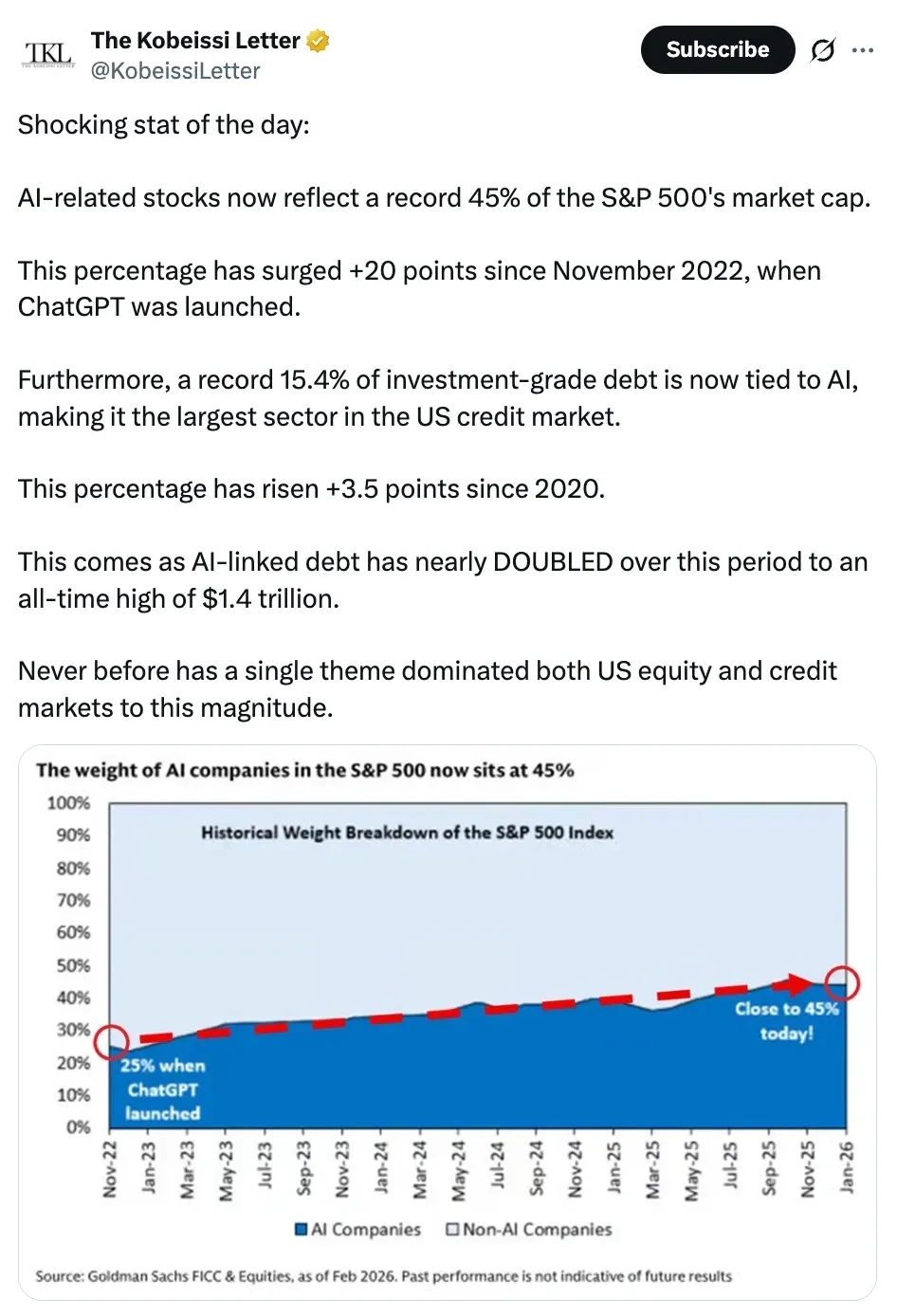
A record 15.4% of investment-grade debt is now tied to AI, making it the largest sector in the U.S. credit market, according to the commentator. Meanwhile, AI-linked debt has nearly doubled since 2020 to an all-time high of $1.4 trillion, it added.
Big Tech AI Capex Is Ballooning
These numbers come amid record capital expenditure spending from hyperscalers in 2026, expected to reach nearly $700 billion. "So let's say it turns out AI can't be profitably monetized near term to justify ongoing spend, or there is a capex cut due to cyclical downturn (advertising, consumer, energy). This 45% thematic concentration represents a massive market risk," said Marko Kolanovic, former chief global market strategist at JPMorgan Chase, in a post on X.
Advertisement|Remove ads.
AI ETFs Are Leaving S&P 500 In The Dust
The Global X Artificial Intelligence & Technology ETF (AIQ), which invests in both hardware- and software-linked AI plays, has gained more than 47% over the past year, and the Roundhill Generative AI & Technology ETF (CHAT), another fund that tracks AI companies, surged 119% over the same period. Meanwhile, the SPDR S&P 500 ETF (SPY), which tracks the S&P 500 index, has risen 29.6% over the same period.
It should be noted, however, that AIQ's top two holdings are South Korean tech giants SK Hynix and Samsung Electronics, while CHAT's are Nvidia and Alphabet. Stocktwits sentiment for AIQ was last in the 'neutral' zone, while it was 'bullish' for CHAT.
Is There An AI Bubble Or Not?
Many Wall Street analysts and investors have increasingly warned about a potential AI bubble. "The Big Short" investor Michael Burry has repeatedly cautioned that the current boom mirrors the dot-com era, driven by unsustainable data center spending, rising leverage, and accounting risks that could mask underlying financial strain.
Advertisement|Remove ads.
Meanwhile, Citrini Research outlined a more structural risk, arguing that while AI may boost corporate margins in the near term, widespread job displacement and weakening consumer demand could ultimately trigger a negative economic feedback loop, leading to a broader market downturn.
Martin Varsavsky, Google-backed serial entrepreneur, noted late Thursday that a massive repricing was around the corner. "This is what bubbles look like when narrative outruns cash flow. AI will transform everything, but when one theme dominates both equity and credit markets, the setup for violent repricing is obvious," he said in a post.
Earlier this year, Goldman Sachs reportedly launched an S&P ex-AI index that allows investors to access the S&P 500 benchmark index without AI-related exposure.
Advertisement|Remove ads.
For updates and corrections, email newsroom[at]stocktwits[dot]com.
Comments posted here will also appear on symbol pages.

Latest News
/filters:format(webp)https://news.stocktwits-cdn.com/Getty_Images_2229019709_jpg_f82a27a246.webp)
/filters:format(webp)https://news.stocktwits-cdn.com/Prabhjote_DP_67623a9828.jpg) Prabhjote Gill·28m ago
Prabhjote Gill·28m ago/filters:format(webp)https://news.stocktwits-cdn.com/AMD_s_Lisa_Su_1200pi_gettyimages_resized_jpg_2b6947251d.webp)
/filters:format(webp)https://news.stocktwits-cdn.com/Rounak_Author_Image_7607005b05.png) Rounak Jain·34m ago
Rounak Jain·34m ago/filters:format(webp)https://news.stocktwits-cdn.com/large_Biocryst_jpg_b280b34e5c.webp)
/filters:format(webp)https://news.stocktwits-cdn.com/vivekkrishnanphotography_58_jpg_0e45f66a62.webp) Arnab Paul·40m ago
Arnab Paul·40m ago/filters:format(webp)https://news.stocktwits-cdn.com/large_Getty_Images_2272863239_jpg_ed937b18d0.webp)
/filters:format(webp)https://news.stocktwits-cdn.com/Anushka_Basu_make_me_smile_in_the_picture_b92832aa_af59_4141_aacc_4180d2241ba8_1_2_png_1086e0ed8c.webp) Anushka Basu·1h ago
Anushka Basu·1h ago/filters:format(webp)https://news.stocktwits-cdn.com/large_fubo_OG_jpg_94b8004cca.webp) Rounak Jain·2h ago
Rounak Jain·2h ago/filters:format(webp)https://news.stocktwits-cdn.com/large_dave_ricks_OG_jpg_23b46fa74b.webp) Arnab Paul·2h ago
Arnab Paul·2h ago