


Advertisement|Remove ads.
Michael Burry Cites This Interesting Thought Experiment From Citrini Research On AI – Says, 'And You Think I’m Bearish'


- Burry, who has warned about an AI bubble in the past, shared the thought experiment on an X post on Monday.
- The Substack post from Citrini Research and Alap Shah, Co-Founder and CEO at Littlebird, outlined potential ways in which agentic AI could negatively impact the economy over the next two years.
- Dated as a post from June 2028, the experiment proposed that the unemployment rate would rise to 10.2% and the S&P 500 would fall 38% from its Oct. 2026 highs.
Advertisement|Remove ads.
“The Big Short” investor Michael Burry, best known for spotting and betting against the subprime mortgage crisis, shared a post from Citrini Research about a thought experiment detailing how artificial intelligence agents would impact the world economy in the future.
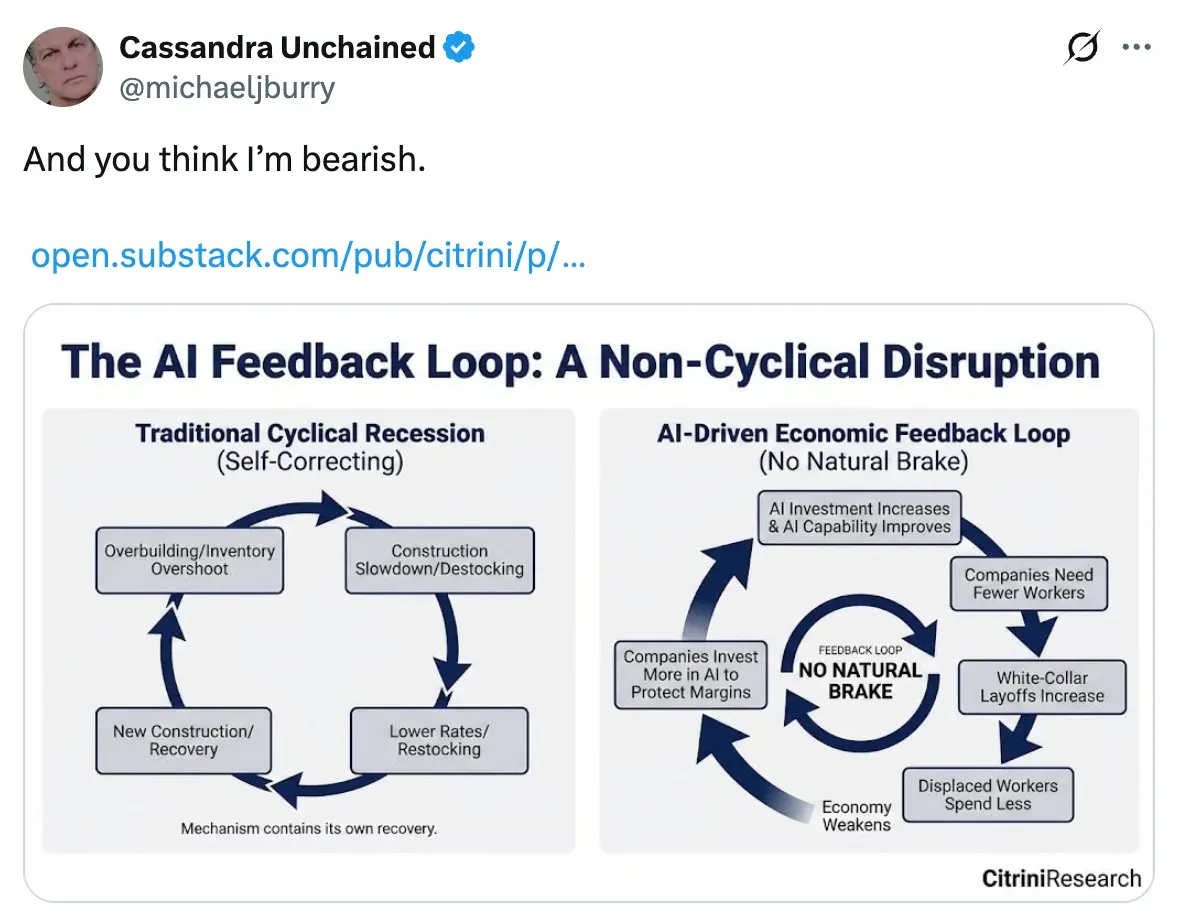
Sharing the research on an X post on Monday, Burry said, “And you think I’m bearish.”
Advertisement|Remove ads.
The Substack post from Citrini Research, titled The 2028 Global Intelligence Crisis, posed an interesting experiment into the future, outlining potential ways in which agentic AI could negatively impact the economy over the next two years, specifically employment and the stock market.
“What if our AI bullishness continues to be right...and what if that’s actually bearish?” the report noted.
The Big Predictions
The thought experiment, co-authored by Citrini Research and Alap Shah, Co-Founder and CEO at Littlebird as well as Managing Partner at Lotus Technology Management, is dated June 2028, when the experiment proposed that unemployment rate had risen to 10.2% and the S&P 500 had fallen 38% from its Oct. 2026 highs.
Advertisement|Remove ads.
The experiment went on to suggest that while initial human layoffs and AI-led replacement led to margin expansion, higher earnings, and a boost in stocks, even as headline numbers were strong, real wage growth collapsed and white-collar workers lost jobs to machines, eventually leading to “cracks” in the consumer economy.
The report suggested that agentic AI could trigger a structural downturn, starting with a collapse in white-collar hiring, eventually leading to reduced consumption, pushing yields lower, and culminating in a systemic shock of “a negative feedback loop with no natural brake” that would result in falling markets, a recession in 2027, and eventual collapse of private credit and the housing market.
Citrini said that “the human intelligence displacement spiral” would result in the AI economy continuing to improve while the broader economy would deteriorate.
Advertisement|Remove ads.
The experiment comes at a time when stock markets are nearing all-time highs and the AI boom is accelerating. Citrini noted that the negative feedback loops have not yet begun, while also adding that some of the scenarios outlined in their experiment would not materialize.
Burry’s Stance
Michael Burry has warned about an AI bubble on multiple occasions, flagging parallels to the 2000 dot-com buildout, and cautioning about overstated asset lives, slowing cloud growth, and widening capex gaps.
Burry has also said that massive data-center spending is draining cash flow and forcing big tech firms to rely on debt or creative accounting to protect reported earnings.
Advertisement|Remove ads.
Meanwhile, U.S. equities declined on Monday. The SPDR S&P 500 ETF (SPY), which tracks the S&P 500 index, was down by 1.08% at the time of writing, the Invesco QQQ Trust ETF (QQQ) fell 1.24%, and the SPDR Dow Jones Industrial Average ETF Trust (DIA) declined 1.46%. The tech-heavy Nasdaq-100 (NDX) fell 1.25% at the time of writing.
Retail sentiment around the S&P 500 ETF on Stocktwits was in the ‘bearish’ territory.
For updates and corrections, email newsroom[at]stocktwits[dot]com.
Advertisement|Remove ads.
Also Read: Nvidia Gets Backing From DA Davidson, JPMorgan Ahead Of Q4 Earnings And AI Growth Surge
Comments posted here will also appear on symbol pages.

Latest News
/filters:format(webp)https://news.stocktwits-cdn.com/large_Getty_Images_2294264991_a1d08b075d.jpg)
/filters:format(webp)https://news.stocktwits-cdn.com/Anushka_Basu_make_me_smile_in_the_picture_b92832aa_af59_4141_aacc_4180d2241ba8_1_2_png_1086e0ed8c.webp) Anushka Basu·2h ago
Anushka Basu·2h ago/filters:format(webp)https://news.stocktwits-cdn.com/large_Getty_Images_1925090359_f160f05588.jpg) Anushka Basu·3h ago
Anushka Basu·3h ago/filters:format(webp)https://news.stocktwits-cdn.com/large_Getty_Images_2213700296_87303c323b.jpg) Anushka Basu·4h ago
Anushka Basu·4h ago/filters:format(webp)https://news.stocktwits-cdn.com/large_franklin_templeton_OG_jpg_4b3a7330d9.webp) Anushka Basu·5h ago
Anushka Basu·5h ago/filters:format(webp)https://news.stocktwits-cdn.com/large_Getty_Images_1445160636_5780a5fdde.jpg) Anushka Basu·7h ago
Anushka Basu·7h ago/filters:format(webp)https://news.stocktwits-cdn.com/Getty_Images_540198451_jpg_3e5f3d8ee7.webp) Anushka Basu·8h ago
Anushka Basu·8h ago