


Advertisement|Remove ads.
Americans Bear The Brunt Of Trump’s Tariffs, As Per NY Fed Report


- The report noted that in 2025, the average tariff rate on U.S. imports rose from 2.6% to 13% through the year.
- The report drew on evidence from Trump’s first term, noting that foreign exporters did not cut prices in response to tariffs.
- The higher costs also pushed companies to adjust and reorganize their supply chains.
Advertisement|Remove ads.
U.S. businesses and consumers bear the majority of the burden of President Donald Trump’s tariffs, according to the Federal Reserve Bank of New York.
In a report published on Thursday, the New York Fed said that almost 90% of the economic weight of the import tax was shouldered by Americans.
The report noted that in 2025, the average tariff rate on U.S. imports rose from 2.6% to 13% through the year.
Advertisement|Remove ads.
Tariff Impact
As per the report, the average tariff rate increased over the year. While it was low at the beginning of 2025, coming in at 2.6%, the rate jumped in April and May by 125 percentage points, when Trump imposed tariffs on Chinese goods to 125% before lowering them back to 113%. By the end of the year, the average tariff rate was 13%, the report noted.
Illustrating through an example, the report said that if a foreign seller charges $100 for a product and a 25% tariff is imposed, the tax adds $25, raising the total cost to $125 if the exporter doesn’t lower the price.
“In this case, the tariff incidence falls entirely on the importer; in other words, there is 100 percent pass-through from tariffs to import prices, and therefore on U.S. consumers and firms,” the report said.
Advertisement|Remove ads.
Analysis Rationale
The report drew on evidence from Trump’s first term, noting that foreign exporters did not cut prices in response to tariffs. As a result, the full burden fell on the U.S., with tariffs fully passed through to import prices.
It estimated that for 2025, Americans absorbed 94% of tariff costs from January to August, easing to 92% in September and October, and 86% in November.
With the average tariff at 13% in December, the report suggested that import prices on affected goods rose about 11%. The higher costs also pushed companies to adjust and reorganize their supply chains.
Advertisement|Remove ads.
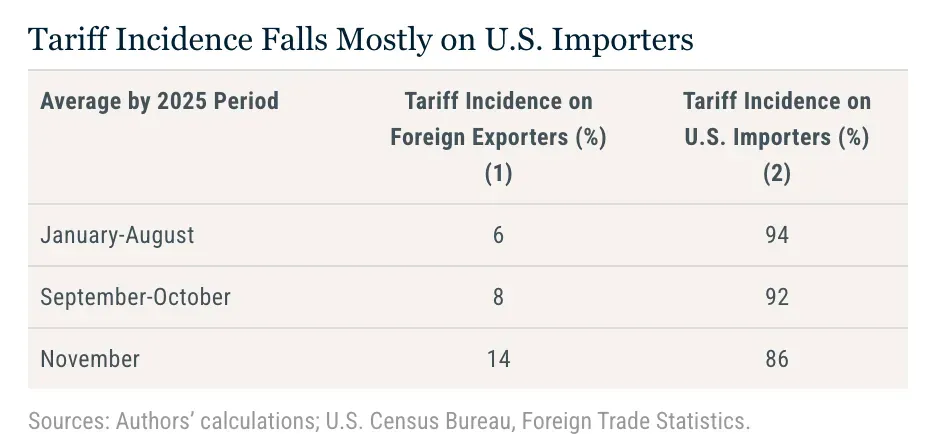
“In sum, U.S. firms and consumers continue to bear the bulk of the economic burden of the high tariffs imposed in 2025,” the report concluded.
Market Status
Meanwhile, U.S. equities declined on Thursday. At the time of writing, the SPDR S&P 500 ETF (SPY), which tracks the S&P 500 index, was down by 1.28%, the Invesco QQQ Trust ETF (QQQ) fell 1.79%, while the SPDR Dow Jones Industrial Average ETF Trust (DIA) declined 1.27%.
Advertisement|Remove ads.
Retail sentiment around the S&P 500 ETF on Stocktwits was in the ‘bearish’ territory.
The iShares 20+ Year Treasury Bond ETF (TLT) was up by 0.65% at the time of writing, while the iShares 7-10 Year Treasury Bond ETF (IEF) rose 0.45%.
For updates and corrections, email newsroom[at]stocktwits[dot]com.
Advertisement|Remove ads.
Also Read: LUNR Stock Is Reportedly A ‘Buy’ At Deutsche Bank Despite Retail Doubt — Here’s Why
Comments posted here will also appear on symbol pages.

Latest News
/filters:format(webp)https://news.stocktwits-cdn.com/large_Starship_jpg_4bb315140a.webp)
/filters:format(webp)https://news.stocktwits-cdn.com/1707726834303_jpg_11f20a9aa9.webp) Shashank Nayar·12m ago
Shashank Nayar·12m ago/filters:format(webp)https://news.stocktwits-cdn.com/large_Wells_Fargo_resized_1_jpg_eaad5a1875.webp)
/filters:format(webp)https://news.stocktwits-cdn.com/vivekkrishnanphotography_58_jpg_0e45f66a62.webp) Arnab Paul·23m ago
Arnab Paul·23m ago/filters:format(webp)https://news.stocktwits-cdn.com/large_Getty_Images_2076701879_jpg_f4058bfd98.webp)
/filters:format(webp)https://news.stocktwits-cdn.com/Prabhjote_DP_67623a9828.jpg) Prabhjote Gill·34m ago
Prabhjote Gill·34m ago/filters:format(webp)https://news.stocktwits-cdn.com/large_Drug_Representative_Image_jpg_b7b43151ec.webp)
/filters:format(webp)https://news.stocktwits-cdn.com/Heera_1_1c30cb0170.PNG) Heera Hari·42m ago
Heera Hari·42m ago/filters:format(webp)https://news.stocktwits-cdn.com/large_Getty_Images_2287298723_67960e9982.jpg)
/filters:format(webp)https://news.stocktwits-cdn.com/Anushka_Basu_make_me_smile_in_the_picture_b92832aa_af59_4141_aacc_4180d2241ba8_1_2_png_1086e0ed8c.webp) Anushka Basu·1h ago
Anushka Basu·1h ago/filters:format(webp)https://st-everywhere-cms-prod.s3.us-east-1.amazonaws.com/large_Bio_N_Tech_m_RNA_based_vaccine_manufacturing_site_in_Kigali_2_4fd2e38342.jpg) Arnab Paul·2h ago
Arnab Paul·2h ago