


Advertisement|Remove ads.
RoboStrategy CEO Explains Why He Shifted Focus From Crypto To Physical AI – Calls RoboStrategy The ‘MicroStrategy Of Robotics’


- Mechanism Capital founder and early DeFi investor Andrew Kang said that he was focusing on robotics and physical AI.
- RoboStrategy, a closed-end fund, announced on May 11 that it had a committed equity facility of up to $2 billion from Roth Principal Investments.
- RoboStrategy, the "MicroStrategy for Robotics," used Strategy's premium-harvesting strategy on robotics stock.
Advertisement|Remove ads.
Andrew Kang, the crypto investor known for early bets on DeFi protocols, says robotics and physical AI now represent the biggest opportunity in technology, shifting away from his earlier crypto bet. He outlined his bullish robotics thesis and compared the firm's strategy to Strategy's Bitcoin playbook. The company has secured a $2 billion equity facility and holds stakes across several robotics startups.
Why Andrew Kang Is Moving Beyond Crypto
Kang, the co-founder of crypto venture firm Mechanism Capital, said in an interview with Anthony Pompliano, describing a timeline for humanoids entering everyday life, "It's not a 50-year thing, it's not a 20-year thing, this is probably more like a three to five-year thing."
Kang has been in Decentralized finance (DeFi) since 2018-2020, investing in top protocols like MakerDAO (MKR), Synthetix (SNX), and Thorchain (RUNE), which has put him ahead of the curve as the sector exploded. He is currently the CEO and co-founder of RoboStrategy (BOT).
Advertisement|Remove ads.
The closed-end fund launched trading on May 11 and has secured a committed equity facility of up to $2 billion from Roth Principal Investments. The fund has stakes in Figure AI, Apptronik, Dyna Robotics, Dexmate, Standard Bots, and Path Robotics, said Kang.
The Figure AI Bet That Changed His Mind
Kang said his belief is based on late 2023, when he started to study Figure AI. "I went out to a bunch of my traditional VC network, and I asked them, 'Hey, look, what do you think about this company?' All of them told me not to invest," he said. But he came to believe that physical AI had cracked the intelligence bottleneck. He said he raised his own position from an initial $1 million to about $19 million.
Kang ran the numbers on adoption, figuring a robot could do the work of three humans for about $2 an hour all-in, compared with $35 to $40 for a U.S. worker. Selling tens of millions of units, he pointed out, could mean trillions of dollars in revenue.
Advertisement|Remove ads.
RoboStrategy On Strategy Playbook
RoboStrategy called themselves on X “MicroStrategy for Robotics,” using the same capital-markets approach that Strategy (MSTR) employed to buy Bitcoin (BTC). This is a model in which a publicly traded company issues new shares at a premium to its net asset value and then uses the proceeds to buy more of the underlying asset, which the fund calls “premium harvesting.” Any issuance is accretive so long as the shares are sold at a premium to Net Asset Value (NAV), which enhances the value of assets per share even if the underlying asset hardly moves.
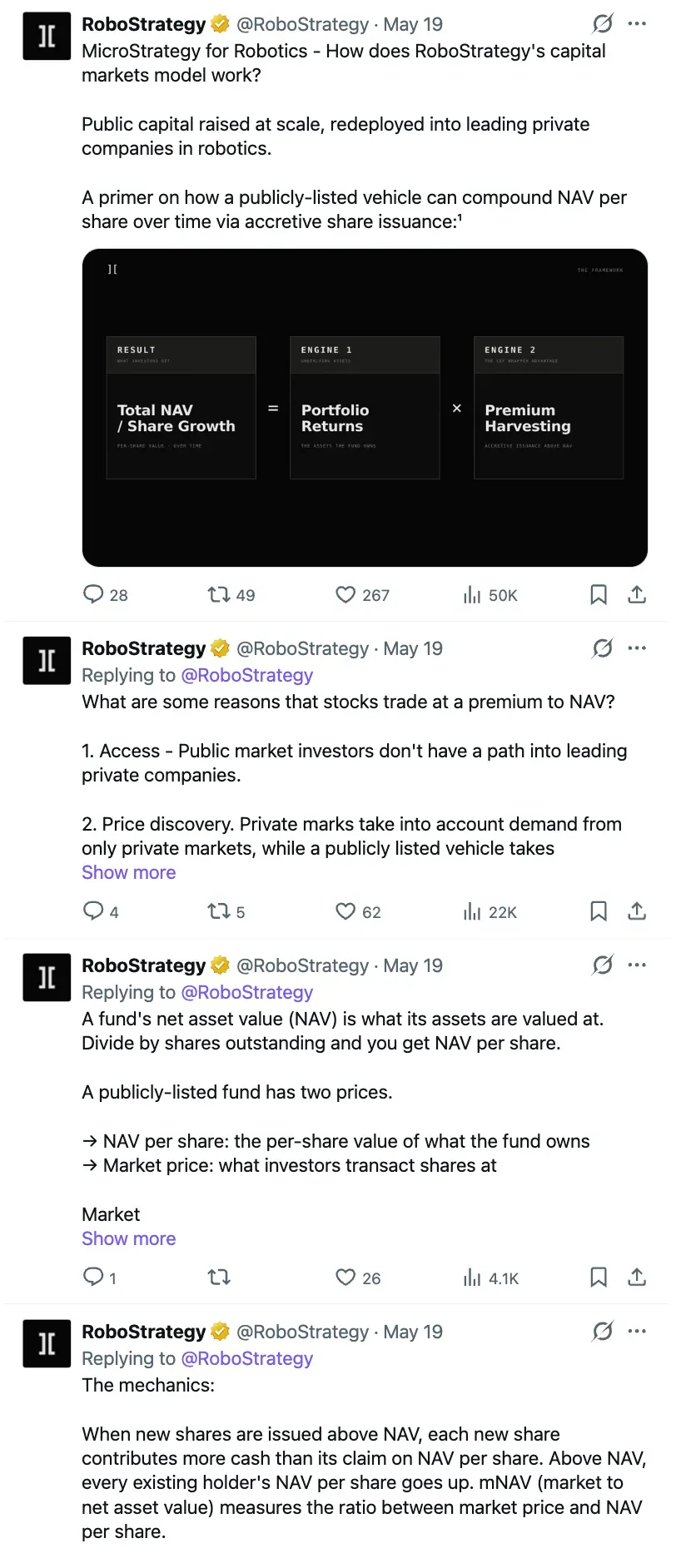
RoboStrategy made this case in a thread stating that this mechanism was behind the 55x growth in Bitcoin value per share for Strategy since 2020. The fund said that about 97% of that gain was due to issuing shares at a premium to net asset value, and only about 3% to Bitcoin appreciation, with repeated issuance cycles rather than the asset being the compounding engine. RoboStrategy seeks to bring that same structure to robotics equity.
However, it comes at a time when the broader crypto market capitalization is down over 3% in the last 24 hours, and Strategy announced that it sold 32 BTC, with many critics like Peter Schiff saying that “When Bitcoin breaks $50K, it should be a quick fall below $20K, which should be a big enough drop to shake the conviction of long-term HODLers”.
Advertisement|Remove ads.
BOT’s stock closed up over 10% on Tuesday, and is down 1% in the pre-market trade. On Stocktwits, retail sentiment around BOT remained in the ‘extremely bearish' zone, while chatter stayed at ‘extremely low’ levels over the past day.
For updates and corrections, email newsroom[at]stocktwits[dot]com
Advertisement|Remove ads.
Comments posted here will also appear on symbol pages.

Latest News
/filters:format(webp)https://news.stocktwits-cdn.com/large_Getty_Images_2294264991_a1d08b075d.jpg)
/filters:format(webp)https://news.stocktwits-cdn.com/Anushka_Basu_make_me_smile_in_the_picture_b92832aa_af59_4141_aacc_4180d2241ba8_1_2_png_1086e0ed8c.webp) Anushka Basu·2h ago
Anushka Basu·2h ago/filters:format(webp)https://news.stocktwits-cdn.com/large_Getty_Images_1925090359_f160f05588.jpg) Anushka Basu·2h ago
Anushka Basu·2h ago/filters:format(webp)https://news.stocktwits-cdn.com/large_Getty_Images_2213700296_87303c323b.jpg) Anushka Basu·3h ago
Anushka Basu·3h ago/filters:format(webp)https://news.stocktwits-cdn.com/large_franklin_templeton_OG_jpg_4b3a7330d9.webp) Anushka Basu·5h ago
Anushka Basu·5h ago/filters:format(webp)https://news.stocktwits-cdn.com/large_Getty_Images_1445160636_5780a5fdde.jpg) Anushka Basu·6h ago
Anushka Basu·6h ago/filters:format(webp)https://news.stocktwits-cdn.com/Getty_Images_540198451_jpg_3e5f3d8ee7.webp) Anushka Basu·7h ago
Anushka Basu·7h ago