


Advertisement|Remove ads.
Apple At 50: How A Product That Disrupted Nokia And BlackBerry Surprised Even An Early Insider
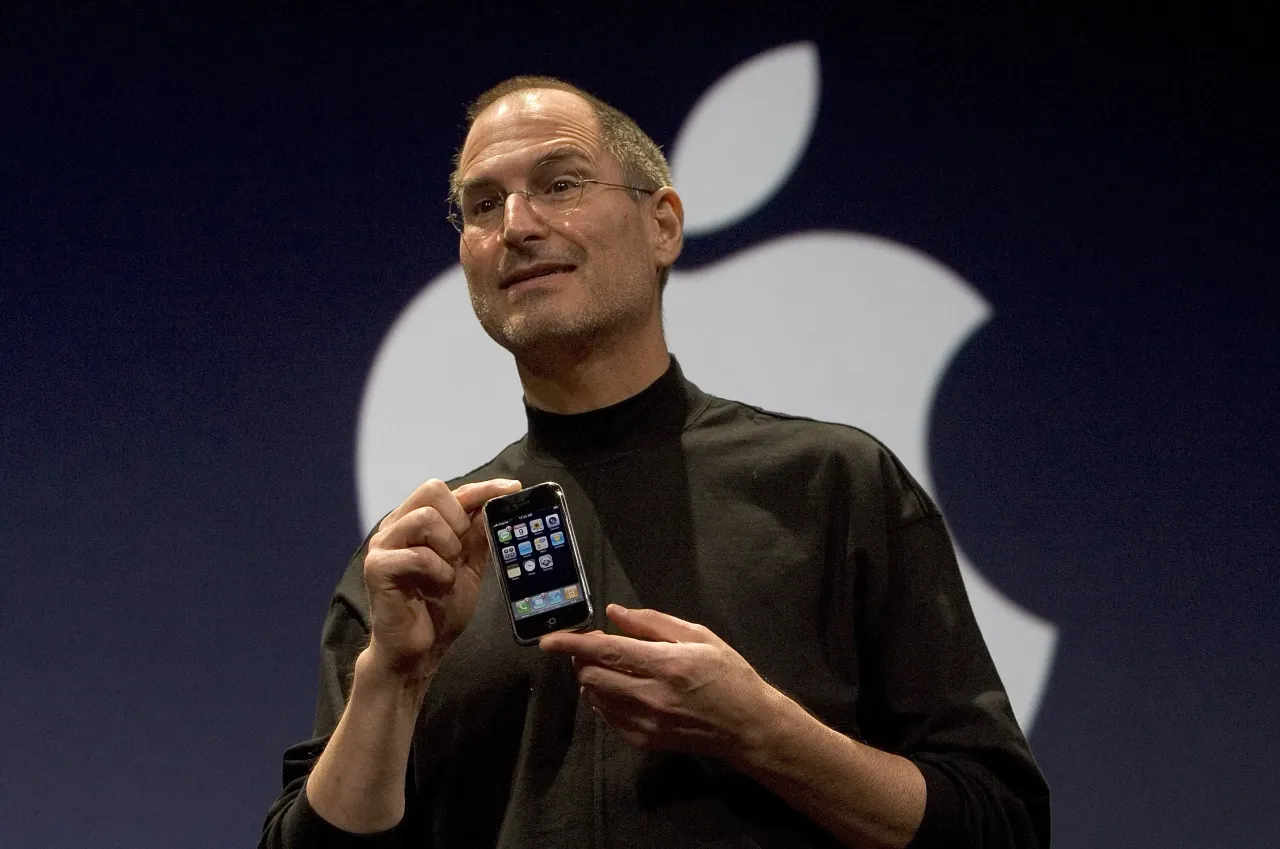


- The crown jewel in Apple’s five-decade-long history is the iPhone, which accounted for more than 59% of the company’s total revenue during the first quarter ended Dec. 27, 2025.
- iPhone revenue in Q1 stood at $85.3 billion, while the company’s total revenue came in at $143.8 billion.
- According to Counterpoint Research, iPhone accounted for 60% of the global smartphone industry’s revenue in the fourth quarter of 2025.
Advertisement|Remove ads.
April 1 marks one of the biggest days in the world of technology, with Apple Inc. (AAPL) turning 50 on Wednesday.
Founded in a garage by Steve Jobs, Steve Wozniak, and Ronald Wayne on April 1, 1976, the iPhone maker is a $3.7 trillion tech titan today and the second-most valued company in the world.
Apple has a storied past, from its founding to all the peaks and troughs the company has gone through. At one point, Apple was on the verge of bankruptcy, and Jobs brought it back from the brink, revamping the product lineup and putting it on the path to becoming one of the most valuable companies in the world.
Advertisement|Remove ads.
The crown jewel in Apple’s five-decade-long history is the iPhone, which accounted for more than 59% of the company’s total revenue during the first quarter (Q1) ended Dec. 27, 2025. iPhone revenue in Q1 stood at $85.3 billion, while the company’s total revenue came in at $143.8 billion.
Apple’s shares were up nearly 0.5% in Wednesday morning’s trade. Retail sentiment on Stocktwits around the company trended in the ‘extremely bullish’ territory, with message volumes at ‘high’ levels at the time of writing.
iPhone’s Success Stumped Even Apple Insiders
The most interesting aspect of iPhone’s success is not just that it toppled industry giants like Nokia, BlackBerry, and Motorola, but that it took even Apple insiders by surprise.
Advertisement|Remove ads.
During an interview with CNN, former senior Apple manager Andy Grignon said that the iPhone was expected to be a higher-end luxury product.
“If you talk to pretty much anybody, you’ll find that there’s a common theme of: ‘Did you know the phone was going to be as big of a deal as it is?’ And the answer is none of us did,” said Grignon, who worked on the first iPhone.
He added that those at Apple were “pretty surprised” by the reception that the first iPhone witnessed.
Advertisement|Remove ads.
Launched in 2007, the first iPhone was a marked departure from the smartphones popular at the time, which featured small screens and keyboards. Some of the most well-known smartphones in 2007 were the BlackBerry Pearl, the Nokia N95, and the Motorola Razr, all of which featured small displays and flip-phone designs with T9 keypads.
On the other hand, the iPhone sported a slab design and a large (at the time) 3.5-inch capacitive touchscreen. The touch technology was essential for the iPhone’s success, since it was distinctively responsive when compared to resistive touchscreens that Nokia used in its phones later.
The Downfall Of Industry Giants
The original iPhone did not immediately hurt Nokia, BlackBerry, and other industry incumbents. However, in nearly two years of the iPhone’s launch, Nokia’s market share fell from 50.9% to 40.8%.
Advertisement|Remove ads.
A little over four years after the iPhone’s launch, Nokia’s then-CEO, Stephen Elop, penned the “burning platform” memo, highlighting the company’s struggles. A year later, in 2011, Nokia forged a partnership with Microsoft and switched to the Windows Phone operating system.
In June 2011, Apple outpaced Nokia, producing more smartphones than Nokia, forcing the Finnish tech giant to restructure its business and lay off thousands of employees.
In 2014, seven years after the launch of the iPhone, Nokia sold its smartphone business to Microsoft, marking the end of an iconic brand’s journey in an industry that would propel Apple to the top of the world years later.
Advertisement|Remove ads.
BlackBerry’s track record was similar, too, with the company topping the U.S. charts in 2009 with a 56% market share. It eventually stopped making its own phones in 2016, shifting to a software-focused cybersecurity model.
Motorola, too, had a rocky ride after the launch of the iPhone — the company’s smartphone division was sold to Google in 2012, which later sold it to Lenovo.
Since the launch of the iPhone on Jan. 9, 2007, Apple’s shares have soared about 8,129%, adjusted for stock splits and other corporate actions.
Advertisement|Remove ads.
iPhone Continues To Dominate
According to data from Counterpoint Research, the iPhone held a 25% global market share at the end of 2025, up from 23% a year ago. It also accounted for 60% of the global smartphone industry’s revenue during the quarter, rising from 54% a year ago.
Apple also became the world’s largest smartphone maker in 2025, following four consecutive quarters of growth.
What Lies Ahead For Apple?
Apple is expected to launch the next iteration of its smartphone, the iPhone 18 series, later this year.
Advertisement|Remove ads.
Earlier this month, the company launched a low-cost MacBook Neo that starts at $499, taking on affordable notebooks powered by Windows and Google’s Chrome OS.
AAPL stock is down 6% year-to-date, but up 14% over the past 12 months. The S&P 500 ETF Trust (SPY) is up 17% over the past 12 months, while the Invesco QQQ Trust ETF (QQQ) is up 24%.
Also See: INTC Stock Gains As Intel Strikes A Massive $14.2B Deal To Fuel Its AI Ambitions
Advertisement|Remove ads.
For updates and corrections, email newsroom[at]stocktwits[dot]com.
Comments posted here will also appear on symbol pages.

Latest News
/filters:format(webp)https://news.stocktwits-cdn.com/large_Getty_Images_2297774918_96e1886d74.jpg)
/filters:format(webp)https://news.stocktwits-cdn.com/unnamed_jpg_9dff551b50.webp) Anan Ashraf·20m ago
Anan Ashraf·20m ago/filters:format(webp)https://news.stocktwits-cdn.com/large_Getty_Images_2223153016_1bf446ab0c.jpg) Anan Ashraf·27m ago
Anan Ashraf·27m ago/filters:format(webp)https://st-everywhere-cms-prod.s3.us-east-1.amazonaws.com/large_beth_hammack_resized_645b41c5a8.jpg)
/filters:format(webp)https://news.stocktwits-cdn.com/1707726834303_jpg_11f20a9aa9.webp) Shashank Nayar·2h ago
Shashank Nayar·2h ago/filters:format(webp)https://news.stocktwits-cdn.com/large_Getty_Images_2245369615_jpg_bc439cb4c1.webp)
/filters:format(webp)https://news.stocktwits-cdn.com/Heera_1_1c30cb0170.PNG) Heera Hari·3h ago
Heera Hari·3h ago/filters:format(webp)https://news.stocktwits-cdn.com/gettyimages_2296214136_594x594_1_ed9bb6d607.jpg) Shashank Nayar·3h ago
Shashank Nayar·3h ago/filters:format(webp)https://st-everywhere-cms-prod.s3.us-east-1.amazonaws.com/boeing_777x_6236952182.jpeg) Heera Hari·3h ago
Heera Hari·3h ago