


Advertisement|Remove ads.
Apple At 50: Steve Jobs Built The Dream, Tim Cook Took It Higher — But Which CEO Delivered Better Stock Returns?
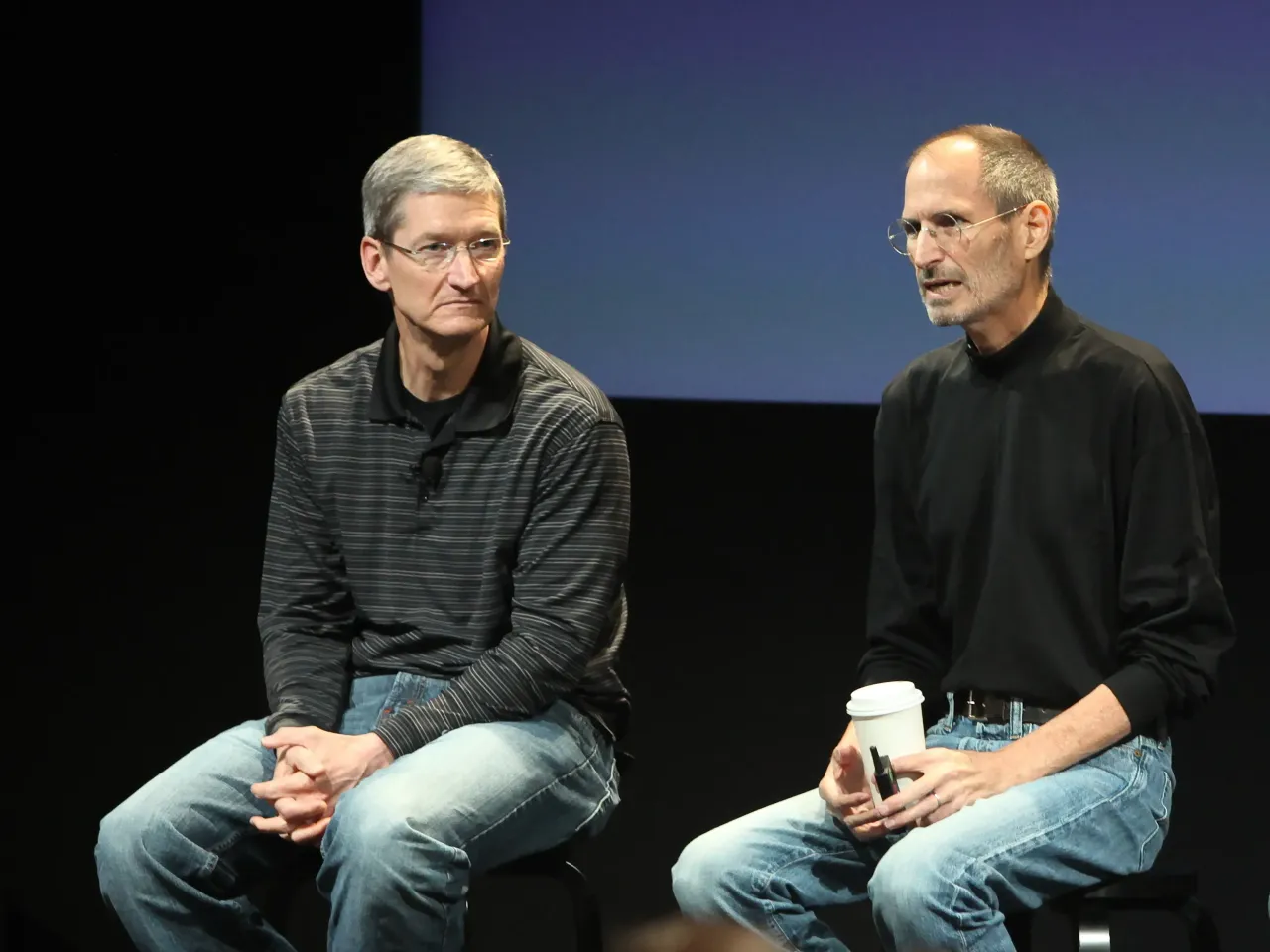


- While Steve Jobs is praised for reinventing Apple, with flagship products like the iPhone and MacBooks, Tim Cook expanded the company into wearables and services.
- Apple’s market capitalization hit $1 trillion in August 2018 and $4 trillion in Oct. 2025.
- Lately, the company has faced pressure as its generative AI strategy has lagged behind peers, and consumers are beginning to question the slower pace of upgrades across its phones and computers.
Advertisement|Remove ads.
Apple, Inc. is in a league of its own — and the iPhone maker turns 50 today.
The iconic consumer electronics company has grown into a $3.8 trillion dollar whale, with its products currently in use by a fourth of the world’s population. Its track record features landmark products such as the Macintosh, iPod, iPhone, and Apple Watch, as well as a remarkable turnaround from near bankruptcy in the late 1990s. But which CEO has delivered the best returns for shareholders?
While co-founder Steve Jobs is praised for reinventing Apple – with defining moments like the 2007 debut of the iPhone and unveiling the MacBook Air from a Manila envelope – CEO Tim Cook has taken the company deeper into wearables and services, while also pushing into new frontiers like the Vision Pro.
Advertisement|Remove ads.
Apple, however, now appears to be on the back foot. Its generative AI strategy has lagged peers, and consumers are beginning to question the slower pace of upgrades across its phones and computers — even as some investors take comfort in the company not pouring hundreds of billions into the AI hype cycle.
Ahead of the Golden Jubilee, Cook wrote an anniversary letter titled '50 Years of Thinking Different.' “At Apple, we’re more focused on building tomorrow than remembering yesterday,” he wrote, thanking Apple employees and customers and crediting Apple’s success to its values of chasing excellence laid down by Jobs.
Cook is in his 15th year as CEO, the highest tenure by any Apple chief executive. Stocktwits dug deeper to check how Apple’s business fared under three prominent CEOs, and the answer is no surprise. It’s Jobs.
Advertisement|Remove ads.
*Jobs became interim CEO in September 1997 and permanent CEO in January 2000.
Here’s an overview of key product and business milestones under Sculley, Jobs, and Cook:
Advertisement|Remove ads.
John Sculley (1983–1993)
1984 – Macintosh launch: First mass-market GUI computer; iconic but expensive
1985 – Jobs exits Apple: Internal power struggle reshapes company direction
Advertisement|Remove ads.
Late 1980s – Desktop publishing boom: Mac + LaserWriter + PageMaker dominate publishing
1987–1991 – Macintosh II, PowerBook: Expands into business and portable computing
1993 – Newton MessagePad: Early PDA; visionary but commercially weak
Advertisement|Remove ads.
Steve Jobs (1997–2011)
1997 – Returns as interim CEO
1998 – iMac: Revives brand
Advertisement|Remove ads.
2001 – iPod + iTunes
2007 – iPhone: Redefines smartphones; Apple pivots to mobile
2008 – App Store: Platform model unlocks developer economy
Advertisement|Remove ads.
2010 – iPad: Creates tablet category
Tim Cook (2011–Present)
2014 – Apple Pay: Push into fintech
Advertisement|Remove ads.
2015 – Apple Watch: Wearables category becomes a major revenue driver
2016 – AirPods
2017–present – Services push: Apple Music, iCloud, App Store scale; later Apple TV+, Arcade, Fitness+
Advertisement|Remove ads.
2018 – $1 trillion valuation (then $2T, $3T): Capital markets milestone
2020 – M1 chip: Shift to in-house silicon
2023 – Vision Pro: Entry into spatial computing (early-stage bet)
Advertisement|Remove ads.
Apple shares are down 6.6% year-to-date.
For updates and corrections, email newsroom[at]stocktwits[dot]com.
Read Next: Opendoor Bull Eric Jackson Shorts CRM, DOCU, TEAM, FIVE, ASAN – Here’s Why
Advertisement|Remove ads.
Comments posted here will also appear on symbol pages.

Latest News
/filters:format(webp)https://news.stocktwits-cdn.com/large_Getty_Images_2276204850_jpg_d3bee2e775.webp)
/filters:format(webp)https://news.stocktwits-cdn.com/unnamed_jpg_9dff551b50.webp) Anan Ashraf·55m ago
Anan Ashraf·55m ago/filters:format(webp)https://news.stocktwits-cdn.com/large_Getty_Images_1406494095_158e6a57ac.jpg) Anan Ashraf·1h ago
Anan Ashraf·1h ago/filters:format(webp)https://news.stocktwits-cdn.com/Getty_Images_2128605808_jpg_59de698b48.webp)
/filters:format(webp)https://news.stocktwits-cdn.com/1707726834303_jpg_11f20a9aa9.webp) Shashank Nayar·1h ago
Shashank Nayar·1h ago/filters:format(webp)https://news.stocktwits-cdn.com/large_kroger_resized_jpg_df58ccdaf5.webp) Shashank Nayar·2h ago
Shashank Nayar·2h ago/filters:format(webp)https://news.stocktwits-cdn.com/large_Getty_Images_2295226888_dcdb8e346d.jpg) Shashank Nayar·2h ago
Shashank Nayar·2h ago/filters:format(webp)https://news.stocktwits-cdn.com/large_Getty_Images_1445160636_jpg_9759816169.webp) Anan Ashraf·3h ago
Anan Ashraf·3h ago