


Advertisement|Remove ads.
ASTS Stock Eyes Worst Month Since 2024: Bulls Cheer Director’s Dip Buy And Bet On A Launch-Fueled Comeback



- Additional purchases by her trust-owned company and spouse brought the total to $1.03 million.
- The recent filing covered four times as many shares as August’s at less than half the price.
- Three BlueBirds await a SpaceX launch date. The next three are slated for a Blue Origin flight in early 2027.
Advertisement|Remove ads.
Shares of AST SpaceMobile (ASTS) are headed for their worst month since January 2024. But a filing after Tuesday’s close revealed that director Adriana Cisneros had bought $500,000 of stock in a move that encouraged retail bulls awaiting a SpaceX launch date for the next three BlueBird satellites.
ASTS shares fell 8% to $23.60 on Tuesday, deepening their November decline to 42% and putting the stock on track for a third straight monthly loss.

ASTS Exec Discloses 4x The Shares At Less Than Half Price
Cisneros bought 21,250 shares in her own name at an average of $23.54 last Friday. An investment company held by her trust, 1979 Edendale Investments Ltd., bought another 21,250 shares at the same price. Her spouse, Nicholas Griffin, bought 1,064 shares at $23.45, bringing the total purchase to 43,564 shares worth about $1.03 million.
Advertisement|Remove ads.
The same investment company had paid $57 a share in August. Including purchases by Griffin and an adult child, Cisneros disclosed 10,822 shares bought at an average of $57.22 on Aug. 31. The November filing covered about four times as many shares at less than half the price.
AST Awaits SpaceX Launch Date For Next 3 Satellites
AST SpaceMobile’s next step toward giving ordinary smartphones coverage beyond the reach of cell towers depends on three satellites already in Florida. BlueBirds 14, 15 and 16 reached Cape Canaveral in September. When CEO Abel Avellan updated investors on its earnings call, the company was still waiting for SpaceX to confirm a launch date.
“14, 15 and 16 were shipped to the Cape and they're awaiting SpaceX launch date confirmation,” Avellan said. The next three BlueBirds are slated to fly with Blue Origin. AST is expected to ship them by the end of November for a launch early in 2027.
Advertisement|Remove ads.
Each launch would shorten the time users have to wait for a satellite to pass overhead. AST aims to offer intermittent coverage through wireless carriers in the U.S., Canada, Japan, Saudi Arabia, and the U.K. by year-end. Consumer trials are planned for early 2027, ideally with about 25 satellites. By mid-2027, AST aims to have about 45 BlueBirds in orbit, the low end of the 45 to 60 it estimates it needs for continuous coverage in key markets.
While AST builds out the network, most of its third-quarter revenue came from delivering ground equipment to wireless carriers and completing work under U.S. government contracts. Revenue totaled $42.3 million, and AST kept its full-year forecast at $150 million to $200 million. B. Riley upgraded the stock to ‘Buy’ from ‘Neutral’ last week, saying the selloff already reflected investors’ concerns about launch delays and the cost of developing AST’s own rocket.
How Do Retail Traders Feel About ASTS?
On Stocktwits, retail sentiment toward ASTS slipped to ‘bearish’ from ‘neutral’ levels a day ago amid ‘normal’ message volumes.
Advertisement|Remove ads.
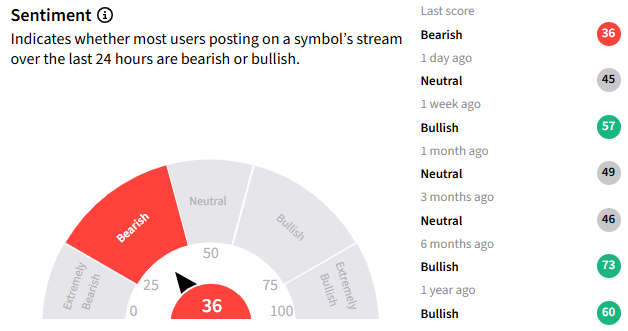
However, several investors welcomed the purchase. “Great sign of confidence. We need it,” one user said. Another user said that they followed Cisneros’ lead and added 166 shares.
A separate user pinned hopes of a recovery to the next few launches: “I reckon we climb back through December and then pop properly in early 2027, or whenever we've got an extra 6 - 9 sats in orbit.”
Advertisement|Remove ads.
Another user said, “They clearly don’t think we’re gonna hit any sort of consistent launch cadence. So we have a huge discount here.”
ASTS stock has declined 68% year-to-date.
Advertisement|Remove ads.
For updates and corrections, email newsroom[at]stocktwits[dot]com.
Read Next: Tesla’s AI Hardware Faces A Cost Challenge As Dell, HP Warn Memory Shortages Could Last Beyond 2027

Latest News

 Yuvraj Malik·6m ago

 Deepti Sri·13m ago

 Aashika Suresh·34m ago

 Anushka Basu·40m ago

 Shivani Kumaresan·42m ago
 Yuvraj Malik·1h ago
Comments posted here will also appear on symbol pages.