


Advertisement|Remove ads.
TSLA Stock Slips Overnight: Dell And HP See No Quick Relief From The AI-Driven Chip Crunch Behind Tesla’s 25% Memory Cut


- Memory and storage rose from 15%-18% of HP’s PC parts bill to nearly 40%. Its PC division ended the quarter with a 3% operating margin.
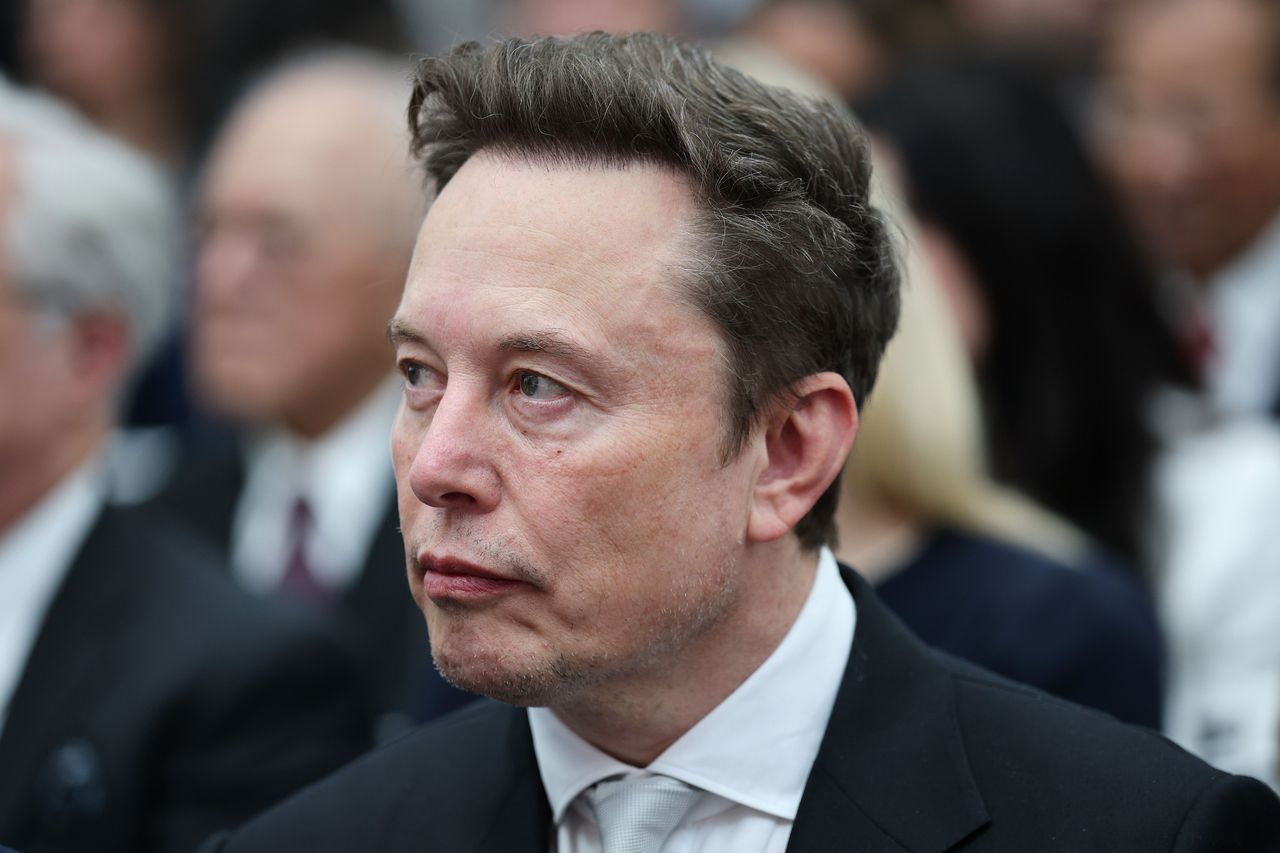
- Musk said higher memory costs prompted Tesla to cut planned AI4.5 memory by 25%, from 32GB to 24GB. Memory and storage price hikes had already doubled the cost of AI4.
- Micron also expects supplies of both working memory and flash storage to remain tight beyond 2027.
Advertisement|Remove ads.
Shares of Tesla, Inc. (TSLA) slipped 0.3% overnight late Tuesday as Dell warned that memory chips would remain scarce into 2027 and HP forecast further price increases, just days after Elon Musk said that rising costs had prompted Tesla to cut the memory planned for its updated driving system by 25%.
TSLA stock dipped 0.2% to $384.68 on Tuesday but is still on-track for its best week in nearly a month. Shares are up more than 3% so far in November.
Dell Sees AI Memory Crunch Lasting Into 2027
On Dell Technologies’ (DELL) earnings call, chief operating officer Jeff Clarke explained why buyers should expect little relief. Chipmakers are devoting more of their factories to high-bandwidth memory, which feeds data to the processors that run AI models. This leaves less capacity for the kinds of memory used in PCs and vehicles.
Advertisement|Remove ads.
“As more DRAM wafer capacity is set forth for GPUs and specifically building HBM, it comes at the expense of all other types of memory. We think that crunch continues clearly into 2027,” Clarke said.
Dell’s order book shows the scale of demand: it booked $60.2 billion in AI orders in the third quarter (Q3) and ended it with a record $132.3 billion AI server backlog. Most new orders were for systems based on Nvidia’s (NVDA) Vera Rubin NVL72, Clarke said. One rack houses 72 graphics processors and 20.7 terabytes of high-bandwidth memory.
Additionally, making these chips takes more silicon too. Micron (MU) estimates that producing a given amount of one generation of high-bandwidth memory, HBM3E, takes three times the wafer capacity needed for the same amount of conventional DDR5 memory. The chipmaker has warned that shortages of both working memory and flash storage could outlast 2027. “We now expect supply-demand conditions for both DRAM and NAND to remain tight beyond calendar 2027,” Micron said in its Q3 call.
Advertisement|Remove ads.
HP Expects Memory Prices To Keep Climbing
At HP (HPQ), memory and storage accounted for $0.15 to $0.18 of every $1 spent on PC parts at the start of its fiscal year. By the fourth quarter, it had risen to nearly $0.40 per dollar, CFO Karen Parkhill said on Tuesday.
Parkhill said she was confident that HP could get the components it needed for the next fiscal year. The harder part was paying for them without pushing prices beyond what customers would accept. “Just starting on commodity costs, we do expect memory and storage costs to continue to increase, but at a lesser rate than what we saw last fiscal year,” she said.
HP adjusted prices and sold more premium devices, yet its PC division ended the quarter with a 3% operating margin, below its long-term range of 5% to 7%. “I would just say in FY 2026, repricing and richer mix supported good revenue growth, but did not fully cover the rapidly rising costs,” Parkhill said.
Advertisement|Remove ads.
Tesla Trims AI4.5 Memory From 32GB To 24GB
For Tesla, higher prices have affected two generations of driving hardware. Musk said rising memory and storage costs had already doubled the cost of AI4, the hardware that runs Tesla’s driver-assistance software. For the AI4.5 update, Tesla decided to install less working memory than it originally planned.
“RAM is super expensive, so we reduced AI4.5 from 32GB to 24GB,” Musk said on Sunday. He said that the limit was how quickly the system could move data, which reduced the benefit of those extra eight gigabytes. “It’s hard to use 32GB anyway, given memory bandwidth constraints.”
When a Tesla owner asked whether to wait for AI5, the next generation of chips, Musk said it was headed for Tesla’s humanoid robot. “It’s going to Optimus. Cars will remain at AI4. That’s enough to solve superhuman driving.” Tesla’s current consumer driving software requires active driver supervision.
Advertisement|Remove ads.
Retail Traders See An Opening For Memory Firms
On Stocktwits, retail sentiment was ‘bullish’ on TSLA amid ‘low’ message volume and ‘extremely bullish’ on both DELL and HPQ, with ‘extremely high’ message volume for DELL and ‘high’ volume for HPQ.
One user said, “$TSLA looks like the V15 fsd team has achieved huge efficiency gains;...the man's past capex decisions is creating a huge sustainable competitive advantage ;...V15/Tesla fsd and its autonomous ecosystem, including the robotaxi suite of products, is likely becoming the de facto operating system in autonomy”
Advertisement|Remove ads.
Another user said, “$SNDK $MU Both Dell and HP warned of continued memory cost pressures, with Dell expecting the memory chip shortage to continue into 2027. Why would a reasonable person believe memory chips are slowing down? It is trading at 6 PE now and forward PE at cash reserve.”
A separate user expected suppliers to sell more memory at higher prices even as they expanded production. “The demand is not fulfillable over the next few years,” the user said.
Advertisement|Remove ads.
So far this year, TSLA is down 15%, while DELL has surged 135% and HPQ has gained 25%.
For updates and corrections, email newsroom[at]stocktwits[dot]com.
Advertisement|Remove ads.
Read Next: Nvidia-Backed Nscale Reportedly Eyes Private Route As AI Market Sell-Off Clouds $35B IPO Plans

Latest News
 Shivani Kumaresan·8m ago
 Deepti Sri·9m ago
 Aashika Suresh·26m ago
 Shashank Nayar·2h ago
 Shashank Nayar·2h ago
 Anan Ashraf·2h ago
Comments posted here will also appear on symbol pages.