


Advertisement|Remove ads.
ASTS Stock Slides After-Hours As SpaceX Snags Grain Spectrum: Analyst Who Called The Deal Says ‘Ligado Is Next’



- Roger Entner, who predicted the Starlink deal in August, said “Ligado is next,” putting AST’s agreements with Ligado for access to up to 45 MHz of spectrum in focus.
- AST had pursued Grain’s frequencies, but SpaceX’s deal leaves AST’s existing spectrum arrangements with AT&T and Verizon intact.
- Entner called the recent AT&T, T-Mobile and Verizon satellite alliance a push for “an open standard, not an Elon standard.”
Advertisement|Remove ads.
Shares of AST SpaceMobile (ASTS) slid 4% after hours on Thursday after SpaceX agreed to acquire nationwide spectrum AST had pursued, prompting telecom analyst Roger Entner, who predicted the Starlink deal in August, to say North American satcom firm Ligado Networks could be next.
ASTS stock fell 6% on Thursday to close at $56.93, its lowest close in over a month. Shares are down nearly 3% for the week, on track for a second consecutive weekly decline. AT&T (T), T-Mobile US (TMUS) and Verizon Communications (VZ) shares also each fell about 6% in overnight trading late Thursday.
SpaceX Closes In On US Carrier Ambitions
Grain Management said on Thursday that SpaceX would acquire its entire nationwide 800 MHz spectrum portfolio, subject to Federal Communications Commission (FCC) approval and other conditions. Financial terms were not disclosed. The portfolio includes up to 14 megahertz of paired low-band spectrum. SpaceX said that the frequencies address a key remaining technical gap in Starlink Mobile’s effort to become a major U.S. mobile carrier.
Advertisement|Remove ads.
In its announcement, SpaceX outlined a hybrid network combining satellites with terrestrial infrastructure. Its 2 GHz mid-band spectrum would supply high-bandwidth capacity, while the low-band frequencies would provide coverage designed to penetrate walls and reach devices inside buildings. Most existing mobile devices already support the band, the company said.
“This is the last critical piece of the spectrum puzzle needed for SpaceX to provide complete phone coverage in America,” Musk said on X. In a separate post, he also said: “To the casual observer, this won’t seem like much. To those who understand the spectrum wars, it’s an earthquake.”
Analyst Who Called Grain Deal Says ‘Ligado Is Next’
Entner, founder of telecommunications research and consulting firm Recon Analytics, had anticipated Grain’s eventual buyer months earlier. “Grain is not a terminal buyer for the 800 MHz it acquired from @TMobile,” he said in August, predicting the portfolio would end up with Starlink as the foundation of a terrestrial voice layer. “We’re talking about 2030, not next year,” he added.
Advertisement|Remove ads.
Entner said Musk wouldn't need to replicate AT&T or T-Mobile’s entire infrastructure, calling a $10 billion to $20 billion terrestrial overlay financially manageable. He placed the broader mobile opportunity around 2030-2032, dependent on standards development and higher-capacity satellites.
After Thursday’s announcement, Entner said: “Ligado is next.” The prediction matters for AST, which has definitive agreements with Ligado for long-term access to up to 45 MHz of lower mid-band spectrum in the U.S. and Canada for satellite direct-to-device services. The agreements call for a $550 million payment contingent on closing and at least $80 million in annual L-band spectrum access payments.
ASTS Misses Grain As Spectrum Race Heats Up
AST had shown interest in Grain’s spectrum before SpaceX secured the deal. The FCC’s July order approving Grain’s acquisition from T-Mobile cited a June 30 AST filing stating that more than 80% of its Block 2 satellite production included 800 MHz capability. AST later received temporary authorization to test the frequencies with unmodified commercial phones.
Advertisement|Remove ads.
SpaceX’s agreement would close off a potential source of additional low-band spectrum for AST, while leaving its existing carrier arrangements intact. Grain’s frequencies sit next to, but are separate from, the cellular spectrum AST accesses through AT&T and Verizon.
The deal also shifted attention to other spectrum holders. Silicon Valley-based satellite communications and wireless spectrum consultant Tim Farrar said on X: “All eyes will now be on Viasat as the last available holder of a substantial block of global spectrum.”
Starlink’s Carrier Push Could Boost ASTS
SpaceX’s deal followed FCC approval for a 15,000-satellite direct-to-device constellation, with the company promising more than 100 times the bandwidth of its current generation.
Advertisement|Remove ads.
Its growing carrier ambitions could boost the case for AST, which expands operators’ coverage while preserving their customer relationships. AT&T, T-Mobile and Verizon recently formalized a satellite joint venture led by interim CEO Paul Roth. Their existing agreements remain intact: T-Mobile uses Starlink, while AT&T and Verizon have commercial deals with AST.
Entner called the alliance “an attempt to stop Elon Musk’s satellite standard from becoming the only standard,” comparing it with Tesla’s rise in EV charging. “The carriers want an open standard, not an Elon standard,” he wrote, adding that Roth’s appointment signals “regulatory navigation is the priority, not just technical harmonization.” As Entner warned in August: “He doesn’t need national scale to force a strategic response.”
How Do Retail Traders Feel About ASTS?
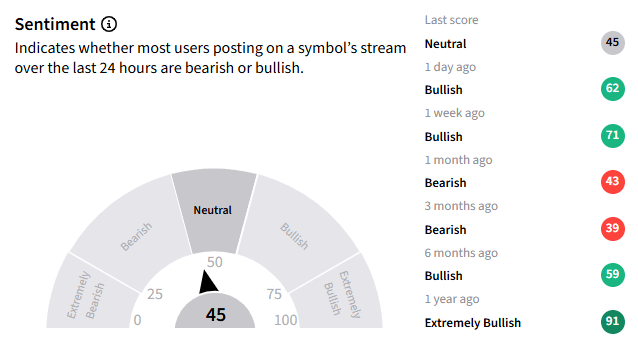
On Stocktwits, retail sentiment for ASTS slipped to ‘neutral’ from ‘bullish’ levels a day ago amid a 121% jump in 24-hour message volumes.
Advertisement|Remove ads.
One user called the agreement a “big blow for AST.” Another user questioned the bullish interpretation after Grain had previously promoted Starlink's spectrum as a potential catalyst. “But we lost,” the user said.
Another user argued that Starlink could undercut carrier prices and attract subscribers, reducing the revenue operators share with AST.
Other investors saw the competitive threat as a reason for carriers to deepen their commitment. One user called AST “a must-have partner for the legacy MNOs,” while another said that “The battle lines have been drawn,” expressing hope for additional funding and help securing launches.
Advertisement|Remove ads.
ASTS stock has declined 22% year-to-date.
For updates and corrections, email newsroom[at]stocktwits[dot]com.
Advertisement|Remove ads.
Comments posted here will also appear on symbol pages.

Latest News
/filters:format(webp)https://news.stocktwits-cdn.com/large_Christopher_Waller_jpg_172aacdad6.webp)
/filters:format(webp)https://news.stocktwits-cdn.com/Aashika_Suresh_Profile_Picture_jpg_2acd6f446c.webp) Aashika Suresh·33m ago
Aashika Suresh·33m ago/filters:format(webp)https://news.stocktwits-cdn.com/large_asts_a3f37696a9.jpg)
/filters:format(webp)https://news.stocktwits-cdn.com/IMG_8805_JPG_6768aaedc3.webp) Deepti Sri·35m ago
Deepti Sri·35m ago/filters:format(webp)https://news.stocktwits-cdn.com/large_Getty_Images_2263491083_jpg_de4fa8fdbd.webp)
/filters:format(webp)https://news.stocktwits-cdn.com/1707726834303_jpg_11f20a9aa9.webp) Shashank Nayar·2h ago
Shashank Nayar·2h ago/filters:format(webp)https://news.stocktwits-cdn.com/large_Getty_Images_1371067806_287869b01e.jpg)
/filters:format(webp)https://news.stocktwits-cdn.com/unnamed_jpg_9dff551b50.webp) Anan Ashraf·2h ago
Anan Ashraf·2h ago/filters:format(webp)https://news.stocktwits-cdn.com/large_Getty_Images_2231114488_889f1b415d.jpg) Shashank Nayar·2h ago
Shashank Nayar·2h ago/filters:format(webp)https://news.stocktwits-cdn.com/large_Getty_Images_2267212526_jpg_eab967c61f.webp) Shashank Nayar·3h ago
Shashank Nayar·3h ago