


Advertisement|Remove ads.
Missed AI, Memory Bull Run? Biotech May Be The Next Breakout Trade — But Retail Sentiment Has Never Been Lower



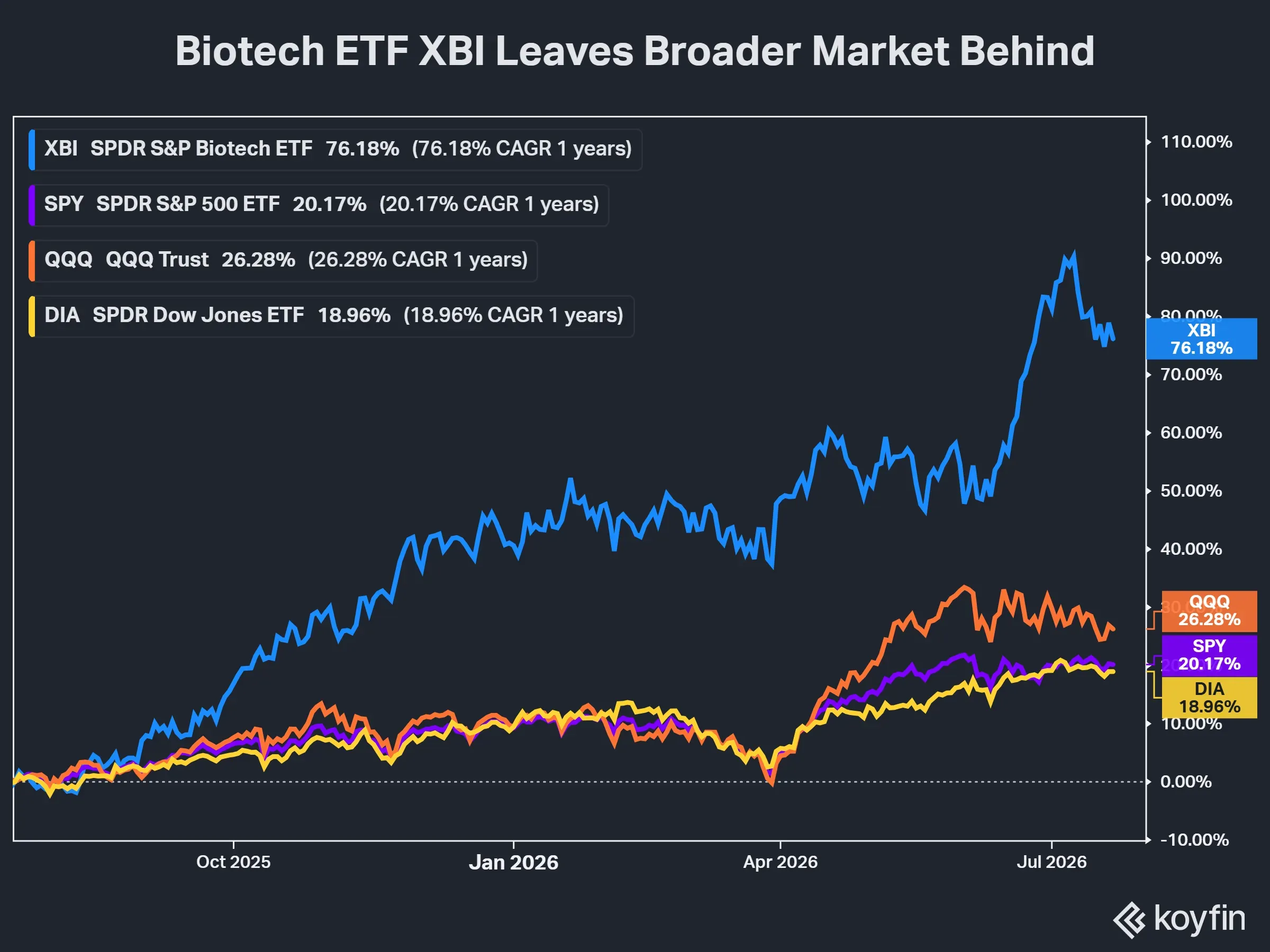
- XBI has gained 25% this year and nearly 80% over the past 12 months, hitting its highest level since February 2021.
- Biotech’s rebound is being driven by Big Pharma’s need to replace revenue threatened by looming patent expirations.
- Vertex, AbbVie and GSK have each struck deals worth about $10 billion or more for late-stage or commercially ready assets.
Advertisement|Remove ads.
The AI and memory-chip rallies may have already minted their biggest winners, but biotech is mounting a breakout of its own, with the XBI biotech ETF sharply outperforming the broader market as cash-rich drugmakers race to buy promising pipelines before blockbuster patent losses begin eroding revenue.
The SPDR S&P Biotech ETF (XBI) has gained 25% this year and nearly 80% over the past 12 months, eclipsing the broader market’s advance. The ETF hit its highest level since February 2021 on July 9, marking a turnaround from the prolonged biotech slump that followed the sector's pandemic-era boom.
Advertisement|Remove ads.
Big Pharma’s Patent Cliff Fuels Biotech M&A
The most powerful force behind the rebound is not simply improving investor sentiment, but it is Big Pharma’s urgent need for new drugs. Pharma companies have acquired 37 biotech businesses valued at $1 billion or more this year, already exceeding the previous annual record of 35, according to Stifel data cited by the Financial Times. Total biotech deal value has reached $216 billion, nearly doubling from $118 billion last year.
The buying spree comes as several industry giants approach a steep patent cliff. Once exclusivity expires, cheaper generic or biosimilar competition can rapidly erode sales from blockbuster medicines.
Morningstar estimates that patent expirations could create a $139 billion revenue headwind for the largest biopharma companies through 2030. Keytruda, Merck’s top-selling cancer drug, and Bristol Myers Squibb’s Opdivo are among the major products facing patent pressure around 2028 and 2029. This leaves large drugmakers with two choices: develop replacements internally and accept years of clinical risk, or acquire companies whose drugs are already nearing approval or commercialization.
Advertisement|Remove ads.
Big Pharma’s Buying Spree Tops $10B
The buying spree has produced a string of multibillion-dollar deals targeting late-stage and commercially ready assets. Vertex Pharmaceuticals agreed to acquire Crinetics Pharmaceuticals for $10 billion, its largest-ever takeover, while AbbVie struck a $10.9 billion deal for Apogee Therapeutics' late-stage immunology pipeline. GSK paid $10.6 billion for Nuvalent to strengthen its oncology portfolio with two FDA-review lung cancer drugs.
Eli Lilly, meanwhile, has emerged as the industry's most aggressive buyer, using obesity-drug windfalls to fund acquisitions across oncology, neuroscience and genetic medicines, most recently agreeing to acquire psychedelic drug developer AtaiBeckley for up to $3.8 billion.
Investors Hunt For Next Biotech Takeover
With several high-profile targets already acquired, investors are looking for the next wave of biotech deals. Viking Therapeutics remains a leading candidate, with injectable and oral versions of obesity drug VK2735 offering buyers exposure to a GLP-1 market that Morningstar expects could approach $200 billion by 2035.
Advertisement|Remove ads.
Other potential targets include Structure Therapeutics, Revolution Medicines, Legend Biotech, Incyte, BioMarin, Ionis Pharmaceuticals and Moderna. Revolution Medicines offers a coveted RAS-targeted oncology pipeline, Legend provides commercial cell-therapy exposure through Carvykti, and Structure offers another route into oral obesity drugs. Syndax Pharmaceuticals and BioCryst Pharmaceuticals may also appeal to buyers seeking more de-risked commercial assets.
Sellas Life Sciences (SLS) sits at the more speculative end of the watchlist. Its appeal hinges on the Phase 3 Regal trial of galinpepimut-S, or GPS, in AML. Sellas has recorded 78 of the 80 events needed to trigger the final analysis, putting it close to a pivotal readout. A positive survival outcome could boost its case as a late-stage oncology target. Its recent changes to executive change-of-control agreements have further fueled buyout speculation.
How Do Retail Traders Feel About XBI?
On Stocktwits, retail sentiment toward XBI fell to a record-low score of 21 out of 100, shifting to ‘extremely bearish’ from ‘bearish’ a day earlier, amid ‘low’ message volume. The ticker’s watcher count has risen a modest 4% over the past year.
Advertisement|Remove ads.

One user said, “time for the $XBI to cool off and build out a handle.”
Another user highlighted an options open interest chart for XBI, suggesting that the heavy concentration of put open interest around the $150 strike could make it a key level to watch heading into the July 31 expiration.
Advertisement|Remove ads.
For updates and corrections, email newsroom[at]stocktwits[dot]com.
Advertisement|Remove ads.
Comments posted here will also appear on symbol pages.

Latest News
/filters:format(webp)https://news.stocktwits-cdn.com/gettyimages_2257971883_594x594_1606ccd0ba.jpg)
/filters:format(webp)https://news.stocktwits-cdn.com/Heera_1_1c30cb0170.PNG) Heera Hari·2h ago
Heera Hari·2h ago/filters:format(webp)https://news.stocktwits-cdn.com/large_Amazon_10819d8d5b.jpg)
/filters:format(webp)https://news.stocktwits-cdn.com/1707726834303_jpg_11f20a9aa9.webp) Shashank Nayar·2h ago
Shashank Nayar·2h ago/filters:format(webp)https://news.stocktwits-cdn.com/gettyimages_2296155088_594x594_e8c6d1d489.jpg)
/filters:format(webp)https://news.stocktwits-cdn.com/Harshita_3cfe02022c.jpg) Harshita Tyagi·2h ago
Harshita Tyagi·2h ago/filters:format(webp)https://news.stocktwits-cdn.com/large_Getty_Images_550274689_9d7f31a128.jpg) Harshita Tyagi·3h ago
Harshita Tyagi·3h ago/filters:format(webp)https://news.stocktwits-cdn.com/large_Palantir_jpg_2306345ec4.webp)
/filters:format(webp)https://news.stocktwits-cdn.com/Prabhjote_DP_67623a9828.jpg) Prabhjote Gill·3h ago
Prabhjote Gill·3h ago/filters:format(webp)https://news.stocktwits-cdn.com/large_Nuclear_power_resized_jpg_5cf5c0d690.webp) Heera Hari·4h ago
Heera Hari·4h ago