


Advertisement|Remove ads.
Bullion Loses Shine Rapidly Despite Iran Crisis — But Analyst Sees ‘Golden Opportunity’ At This Key Level


- GLD recorded its worst week on record, falling about 10% over the past week and more than 15% since the start of the U.S.-Iran conflict.
- The selloff came as tensions escalated around the Strait of Hormuz after Trump issued a 48-hour reopening deadline.
- Priyanka Sachdeva, senior market analyst at Phillip Nova, said the pullback toward the $4,154 200-day moving average could present a “golden opportunity” for staggered long-term entry.
Advertisement|Remove ads.
The SPDR Gold Shares ETF (GLD) recorded its worst week on record as gold slid toward wiping out its gains for the year amid escalating tensions around the Strait of Hormuz, but one analyst said the sharp pullback may offer a “golden opportunity” for long-term buyers of the precious metal.
GLD ETF is down about 10% over the past week and more than 15% since the war began on Feb. 28, with only four sessions finishing in the green since then.
Gold Posts Steepest Weekly Drop Since 1983
Gold fell as much as 3.8% to about $4,320 an ounce early Monday, leaving it less than a dollar above where it ended last year. The metal has now fallen for eight straight sessions and posted its steepest weekly decline since 1983 as investors moved toward the dollar and raised liquidity despite escalating geopolitical tensions.
Advertisement|Remove ads.
The selloff came as the U.S.-Iran conflict entered its fourth week and uncertainty deepened after U.S. President Donald Trump issued a 48-hour deadline for Tehran to reopen the shipping route.
Rising oil risks tied to disruptions around the Strait of Hormuz have also reduced expectations for near-term interest-rate cuts by the Federal Reserve and other major central banks, adding pressure on non-yielding assets such as gold.
Analyst Calls Gold Pullback ‘Golden Opportunity’ For Entry
Priyanka Sachdeva, senior market analyst at Phillip Nova, said the pullback below $4,400 per ounce has opened the door toward support near the 200-day moving average around $4,154, according to a Dow Jones report.
Advertisement|Remove ads.
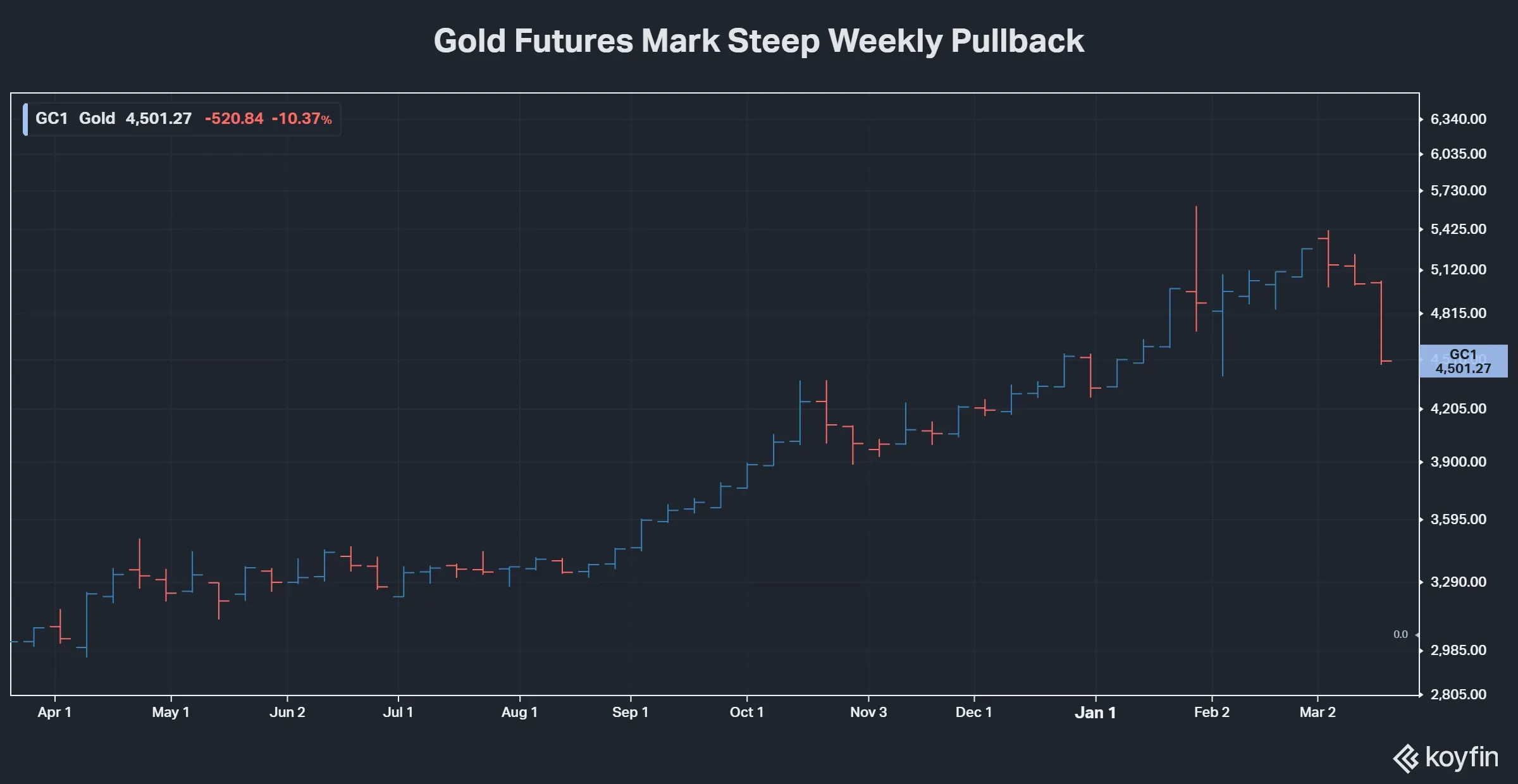
“This correction is a golden opportunity for staggered entry by long-term buyers,” Sachdeva said, adding that the level could act as a “probable downside target before any meaningful stabilization.”
Meanwhile, Goldman Sachs called the conflict-related interruption the largest oil supply shock ever for global crude markets and raised its 2026 forecasts for Brent crude to $85 per barrel from $77 and West Texas Intermediate to $79 from $72. The bank said its revised outlook assumes flows through Hormuz remain constrained for several weeks before gradually recovering.
Advertisement|Remove ads.
Dollar Strength Limits Gold’s Safe-Haven Appeal
Despite escalating geopolitical risks, bullion has struggled to attract defensive inflows as investors prioritized liquidity and currency positioning. Ole Hansen, head of commodity strategy at Saxo Bank, said speculation that some economies may need to raise liquidity, potentially including gold sales, has contributed to the softer tone.
“Gold’s failure to rally despite geopolitical stress highlights the current dominance of higher real yields, a firmer dollar and position adjustment over its traditional safe-haven role,” Hansen said. The benchmark 10-year Treasury yield climbed to around 4.38%, its highest level since late July.
Nicky Shiels, head of metals strategy at MKS PAMP, said “the dominant headline into this week is a rapidly escalating U.S.-Iran confrontation,” adding a key risk to gold’s outlook is that the energy shock from the conflict could be interpreted as demand destruction rather than inflationary.
Advertisement|Remove ads.
How Did Stocktwits Users React?
On Stocktwits, retail sentiment for GLD shifted to ‘bullish’ from ‘extremely bearish’ levels over the past month amid ‘extremely high’ message volume.

One user said, “Horrible price action. Completely correlated with equities. No safe haven bid at all...”
Advertisement|Remove ads.
Another user said GLD “will be back on track in no time. Someone is dropping gold to pay for war.”
GLD ETF has risen about 47% over the past year but is up only around 4% since January.
Advertisement|Remove ads.
For updates and corrections, email newsroom[at]stocktwits[dot]com.
Comments posted here will also appear on symbol pages.

Latest News
/filters:format(webp)https://news.stocktwits-cdn.com/large_Getty_Images_2279869782_8049b29afc.jpg)
/filters:format(webp)https://news.stocktwits-cdn.com/Aashika_Suresh_Profile_Picture_jpg_2acd6f446c.webp) Aashika Suresh·26m ago
Aashika Suresh·26m ago/filters:format(webp)https://news.stocktwits-cdn.com/large_Getty_Images_2300173637_79e4bae290.jpg)
/filters:format(webp)https://news.stocktwits-cdn.com/IMG_9209_1_d9c1acde92.jpeg) Yuvraj Malik·42m ago
Yuvraj Malik·42m ago/filters:format(webp)https://news.stocktwits-cdn.com/large_Getty_Images_2288509244_fc180e6aec.jpg)
/filters:format(webp)https://news.stocktwits-cdn.com/shivani_photo_jpg_dd6e01afa4.webp) Shivani Kumaresan·48m ago
Shivani Kumaresan·48m ago/filters:format(webp)https://news.stocktwits-cdn.com/large_patrick_soon_shiong_jpg_32b8924ac2.webp)
/filters:format(webp)https://news.stocktwits-cdn.com/IMG_8805_JPG_6768aaedc3.webp) Deepti Sri·2h ago
Deepti Sri·2h ago/filters:format(webp)https://news.stocktwits-cdn.com/large_Getty_Images_2203983775_jpg_74bdd5dd43.webp) Aashika Suresh·2h ago
Aashika Suresh·2h ago/filters:format(webp)https://news.stocktwits-cdn.com/gettyimages_1161631184_594x594_0063399eed.jpg)
/filters:format(webp)https://news.stocktwits-cdn.com/1707726834303_jpg_11f20a9aa9.webp) Shashank Nayar·3h ago
Shashank Nayar·3h ago