


Advertisement|Remove ads.
Coinbase Bets On The OCC Route Amid CLARITY Act Stalemate: COIN Stock Slides Amid Crypto Selloff



- The approval brings Coinbase’s institutional custody business under federal supervision.
- The OCC's final approval follows its earlier conditional approval of Coinbase National Trust Company.
- Coinbase is not becoming a full-service commercial bank and will not be able to take ordinary retail deposits or make traditional loans under the trust charter.
Advertisement|Remove ads.
Coinbase (COIN) said on Monday that it had final approval to run a federally chartered trust company, a sign that crypto's push for clear rules is now being won at the agencies rather than in Congress.
The Office of the Comptroller of the Currency (OCC) approved Coinbase National Trust Company on Friday, which brings the firm's institutional custody business under a single federal regulator.

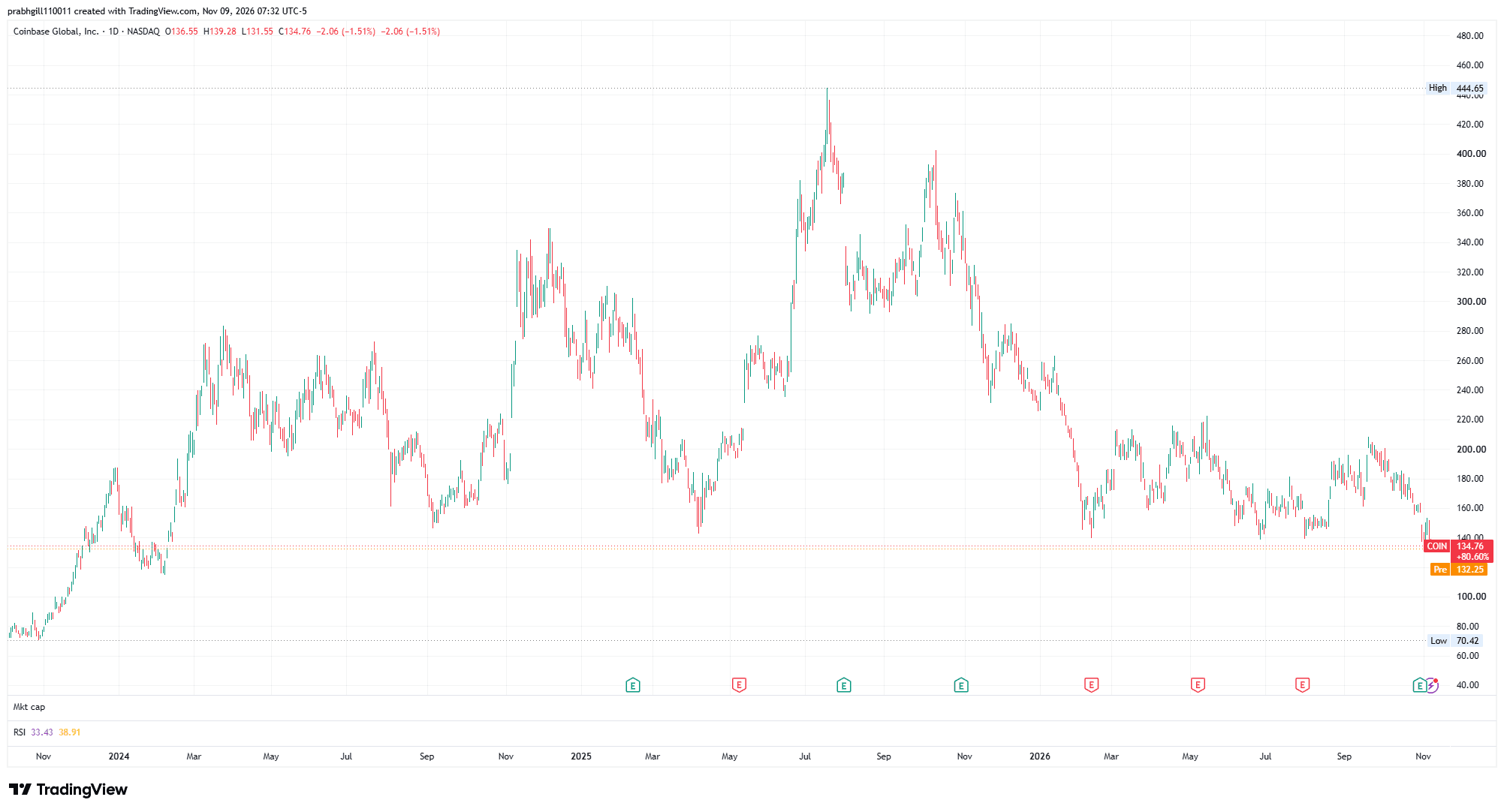
However, the development did little to lift the Coinbase shares. COIN stock fell more than 2% in pre-market trading on Monday, pressured by Bitcoin’s (BTC) decline and on track to test a fresh two-year low. On Stocktwits, retail sentiment around Coinbase remained in ‘neutral’ territory over the past day.
Advertisement|Remove ads.
Crypto Firms Are Turning To Federal Charters
The OCC approval comes as the path to comprehensive crypto legislation has become less certain. The Senate failed to advance the CLARITY Act in September. The motion received 50 votes in favor and 49 against, falling short of the 60 votes needed to move it forward. Democrats had raised concerns about the bill’s ethics provisions and potential conflicts involving President Donald Trump’s crypto-related business interests.
Democrats’ victories in both chambers of Congress in last week’s midterm elections could further complicate the bill’s prospects. The incoming Congress will have greater influence over the legislative agenda and oversight of federal regulators.
Regulators, however, have continued to consider crypto firms’ applications for federal trust charters. The OCC conditionally approved applications from Circle (CRCL), Ripple, BitGo, Fidelity Digital Assets and Paxos in December. Circle later received final approval in July, while Ripple secured its own final approval in October. Morgan Stanley (MS), Stripe’s Bridge and Nomura’s Laser Digital have also pursued federal charters.
Advertisement|Remove ads.
A federal charter can give a company a route to operate under a national regulatory framework without waiting for Congress to pass a broader market structure law.
Coinbase’s Institutional Custody Business Is The Main Prize
For Coinbase, the charter is primarily about institutional custody. The company said it safeguards more than 80% of the world’s digital-asset exchange-traded funds. Its platform held $376.6 billion in assets at the end of September, according to its latest quarterly filing.
A federal charter could make Coinbase more attractive to asset managers, hedge funds and other institutions that prefer working with firms supervised by a national banking regulator. It also gives the company a regulatory structure that may be easier for large financial institutions to assess across state lines.
Advertisement|Remove ads.
The move comes after Binance was hacked last month, leading to $6.3 billion in digital assets held in its hot wallets being siphoned off the platform. The exchange said it would cover the losses and that customer funds would not bear the cost. Coinbase, meanwhile, said last week that more than 99% of customer crypto is held in offline storage and that its systems were not affected by the Binance incident.
However, there are also limits to what the approval allows. Coinbase is not becoming a full-service commercial bank and will not be able to take ordinary retail deposits or make traditional loans under the trust charter.
Coinbase said it wants to explore additional payment products, especially those that could advance the adoption of its USDC (USDC) stablecoin. On Stocktwits, retail sentiment around USDC remained in ‘bearish’ territory over the past day.
Advertisement|Remove ads.
Read also: From Musk’s Tesla Cybertruck To Ternus’ Memory Warning: MAG 7 Voices In Midterm Election Week
For updates and corrections, email newsroom[at]stocktwits[dot]com.
Comments posted here will also appear on symbol pages.

Latest News

 Prabhjote Gill·10m ago

 Arnab Paul·12m ago

 Harshita Tyagi·25m ago
 Prabhjote Gill·58m ago

 Aveek Bhowmik·1h ago
 Arnab Paul·1h ago