


Advertisement|Remove ads.
From OpenAI To Google To Amazon: Nvidia’s Biggest Customers Are Becoming Its Biggest Rivals — The Custom Silicon Race Explained


- OpenAI on Tuesday unveiled its first custom chip and said it outperformed Nvidia’s current-generation processors on certain benchmarks.
- Nvidia’s dominance remains intact for now, analysts say, even though they see OpenAI’s results as a significant development.
- Nvidia will report its Q2 results after market hours on Wednesday.
Advertisement|Remove ads.
OpenAI’s first custom AI chip is showing an edge over Nvidia Corp.’s Blackwell systems on key inference benchmarks, adding to a growing push by the biggest AI companies to develop their own silicon and potentially reduce their dependence on Nvidia.
Nvidia continues to post record sales and profits, with investors expecting another strong second-quarter report on Wednesday. But as the AI boom enters its next phase, investors and analysts have increasingly begun asking if — and when — the chipmaker’s growth supercycle could slow.
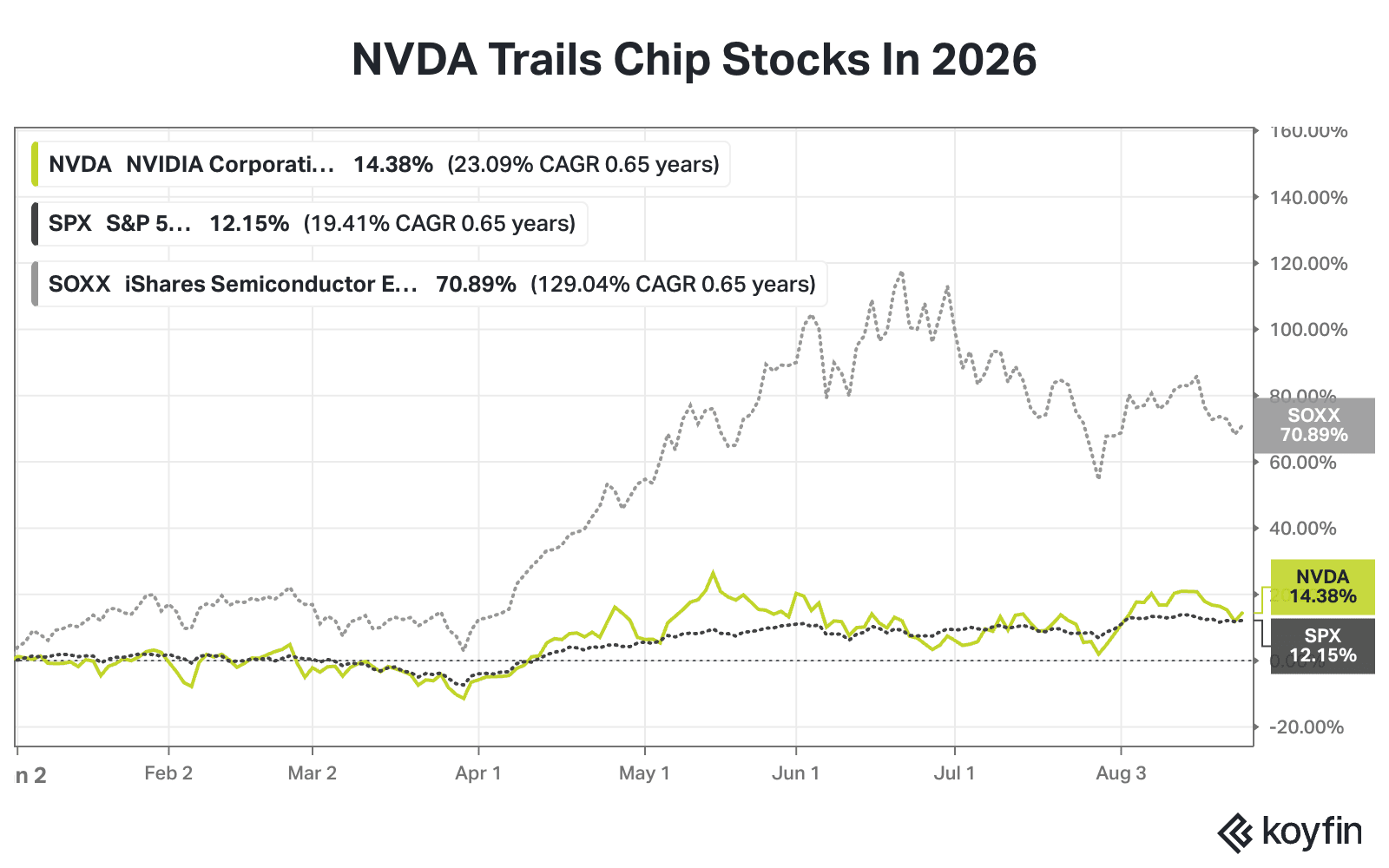
NVDA stock has underperformed the broader chip-sector benchmark, the iShares Semiconductor ETF (SOXX), by a wide margin this year, reflecting growing concerns over its valuation, while critics point out what they describe as the company’s “circular deals” that artificially bolster revenue growth and its position as the industry’s de facto AI chip supplier.
Advertisement|Remove ads.
OpenAI Joins The Custom Chips Race
OpenAI on Tuesday detailed that its Jalapeño chip delivered 1.5 to 1.9 times more AI work per watt and 1.7 to 3.6 times lower end-to-end latency than Nvidia’s GB200 and GB300 systems across GPT-OSS 120B, DeepSeek R1 and Kimi K2.5 1T.
The chip, developed with Broadcom, is designed specifically for inference — the stage where trained AI models generate responses — rather than training models. OpenAI plans to begin deploying Jalapeño in its own infrastructure by the end of 2026, with second- and third-generation chips already in development.
The company also stressed that it will continue deploying Nvidia and other accelerators for both training and inference. That makes Jalapeño less an immediate Nvidia replacement than a sign of where the AI infrastructure market could be heading: toward increasingly specialized silicon optimized for individual workloads.
Advertisement|Remove ads.
The bigger threat comes from custom chips from hyperscalers, who are also Nvidia's biggest customers. Alphabet has spent years developing its Tensor Processing Units, or TPUs, which are used internally and offered through Google Cloud and are currently on their eighth generation. Amazon has taken a similar approach with Trainium and Inferentia.
Amazon said last month that its custom chips, including Trainium and Graviton, surpassed a $25 billion annual revenue run rate.
Morgan Stanley estimates that Google’s TPUs could bring in nearly $200 billion in revenue in the coming years. “We are raising our TPU 1P sale estimates to $27bn/GW...selling at a 30% gross margin. In all, we now expect GOOGL to sell 0.3 GW of TPU systems in 2H:26, 3.2 GW in '27 and 4.2 GW in '28. This now translates into $84bn/$108bn of TPU-related Google Cloud revenue in '27/'28,” the research firm said in an investor note on Monday.
Advertisement|Remove ads.
| Company | Latest AI custom chip | Launch | Primary workload | Key Nvidia risk |
| TPU 8t / 8i | April, 2026 | Training/inference | More AI workloads can run on Google's own silicon instead of Nvidia GPUs. | |
| Amazon/ AWS | Trainium3 | December, 2025 | Training + inference | AWS can shift more workloads to its own accelerators, lowering infrastructure costs. |
| Meta | MTIA 300 | March, 2026 | Training accelerator optimized for ranking and recommendation models | Reduces reliance on general-purpose GPUs for Meta-specific workloads and gives Meta more control over performance and costs. |
Source: Stocktwits research
Meta has been ramping up its next-generation MTIA custom AI chips, detailing its MTIA 300 this week. Tesla, meanwhile, has said its upcoming AI chips for the Terafab complex will be built using Intel’s advanced 14A process.
Advertisement|Remove ads.
Those chips are not just a threat to Nvidia’s chip sales; they also help Alphabet and Amazon capture more economics from their cloud businesses by lowering the cost of running AI workloads. For Nvidia, the risk is therefore more about the share of future AI compute than an immediate collapse in demand.
Amid Custom Chips Race, Nvidia’s Position Appears Strong For Now
Investors and chip watchers were split on whether Jalapeño changes Nvidia’s outlook.
CNBC analyst Jim Cramer dismissed the threat, saying: “Every day I read about some chip that is superior to Nvidia. And every year I see no real competitors.”
Advertisement|Remove ads.
Noted semiconductor commentator and founder of news site SemiAnalysis Dylan Patel called the result more significant: “Usually first generation chips aren’t competitive, but OpenAI is beating Nvidia Blackwell and even Rubin. This is huge news!” he said in an X post.
Gavin Baker, managing director at Atreides Management, was similarly impressed but cautious, calling Jalapeño the “first good ASIC outside of TPU/Trainium,” while arguing it could underperform more specialized disaggregated accelerator systems.
Analysts broadly believe that Nvidia’s dominance remains intact, but the economics of AI are increasingly giving its biggest customers a reason to build — rather than just buy — the chips powering their models, which create risks for Nvidia.
Advertisement|Remove ads.
On Stocktwits, the retail sentiment was ‘bullish’ for NVDA and META, with all eyes on Nvidia’s quarterly report due after market hours on Wednesday.
Nvidia’s Q2 Report On The Deck
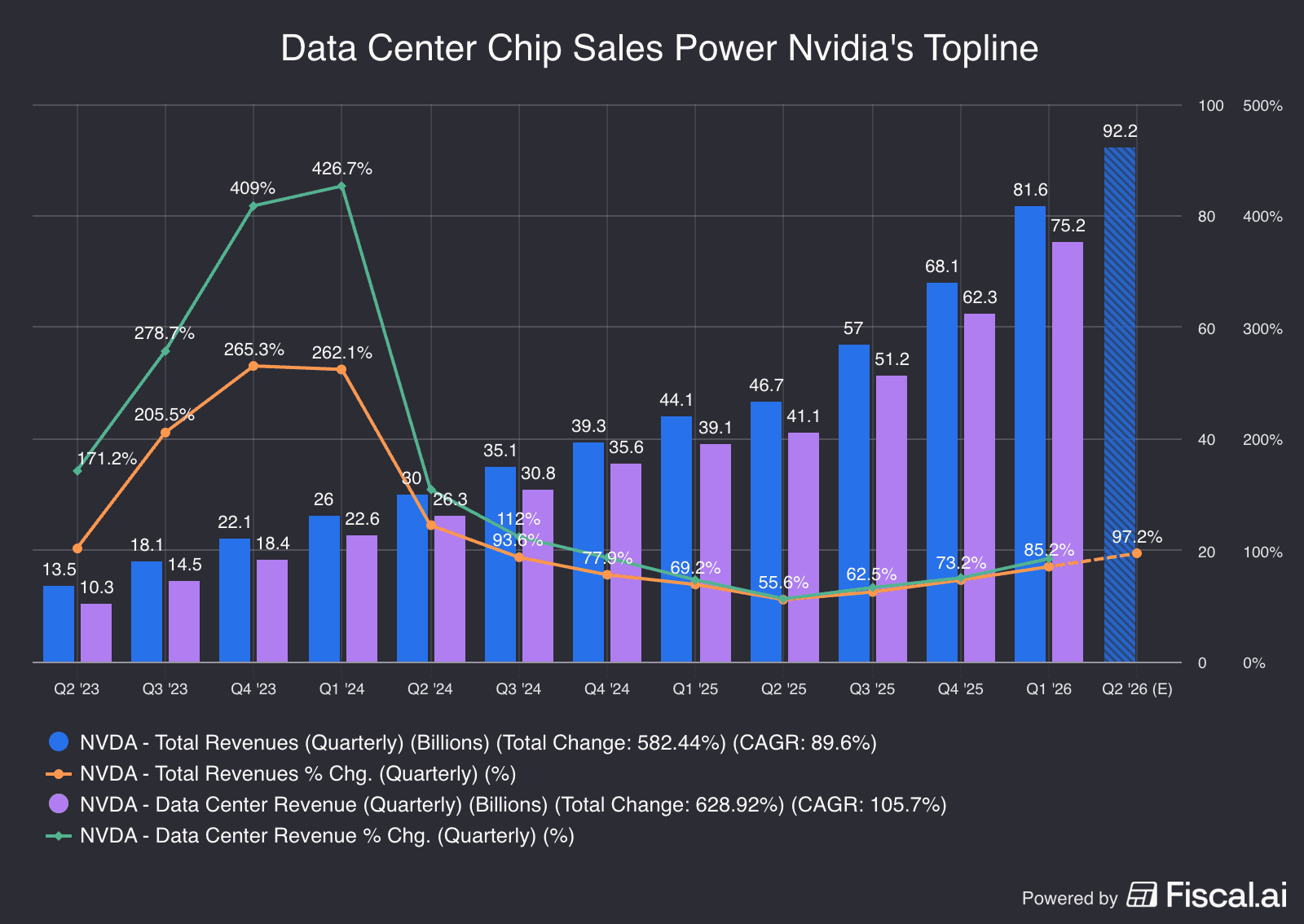
Wall Street expects Nvidia to report roughly $92 billion in quarterly revenue, nearly double the corresponding quarter last year, with analysts looking for continued strength from Blackwell and the upcoming Rubin platforms.
The setup is interesting given that NVDA stock declined in seven of the last eight sessions, losing 5.5% cumulatively. Currently, 58 out of 61 analysts have a ‘Buy’ or higher rating on NVDA stock, with a consensus upside projection of 53.3% over the next 12 months.
Advertisement|Remove ads.
NVDA stock is up 14.4% year to date, far below the 71% rise in the iShares Semiconductor ETF (SOXX).
For updates and corrections, email newsroom[at]stocktwits[dot]com.
Read Next: Why DOCU, TRI Stocks Slid Over 3% After Google Cloud’s Latest AI Release
Advertisement|Remove ads.
Comments posted here will also appear on symbol pages.

Latest News
/filters:format(webp)https://news.stocktwits-cdn.com/large_Getty_Images_2213366819_jpg_3e8b649e98.webp)
/filters:format(webp)https://news.stocktwits-cdn.com/Aashika_Suresh_Profile_Picture_jpg_2acd6f446c.webp) Aashika Suresh·21m ago
Aashika Suresh·21m ago/filters:format(webp)https://news.stocktwits-cdn.com/large_vaccine_stocks_947b8b6dd5.jpg)
/filters:format(webp)https://news.stocktwits-cdn.com/IMG_8805_JPG_6768aaedc3.webp) Deepti Sri·34m ago
Deepti Sri·34m ago/filters:format(webp)https://news.stocktwits-cdn.com/large_nvidia_OG_Jun26_860ee43e02.jpg)
/filters:format(webp)https://news.stocktwits-cdn.com/shivani_photo_jpg_dd6e01afa4.webp) Shivani Kumaresan·39m ago
Shivani Kumaresan·39m ago/filters:format(webp)https://news.stocktwits-cdn.com/large_Getty_Images_2282773954_jpg_a026630050.webp)
/filters:format(webp)https://news.stocktwits-cdn.com/IMG_9209_1_d9c1acde92.jpeg) Yuvraj Malik·53m ago
Yuvraj Malik·53m ago/filters:format(webp)https://news.stocktwits-cdn.com/large_spacex_jpg_07ab19438d.webp) Aashika Suresh·1h ago
Aashika Suresh·1h ago/filters:format(webp)https://news.stocktwits-cdn.com/large_Getty_Images_2267646383_8b464ed74a.jpg) Shivani Kumaresan·2h ago
Shivani Kumaresan·2h ago