


Advertisement|Remove ads.
Hassett Just Said Oil Will Go ‘Down Down Down’ – What’s The Deal?
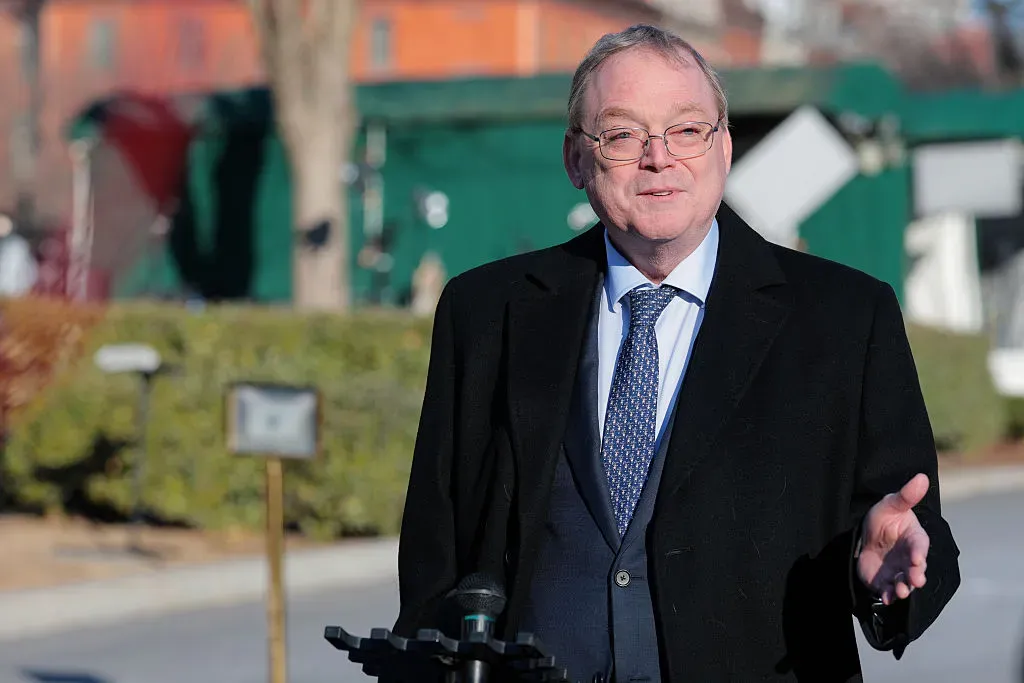


- Hassett added that the current spike in crude oil prices is not permanent, noting that ample capacity will return to the market once the war in Iran is over.
- He stated that the risk premium will be gone once oil production in the Middle East returns to normalcy after the Strait of Hormuz reopens.
- Hassett also cited the U.S. crude oil production ramp-up as another factor that will help tame energy prices.
Advertisement|Remove ads.
White House National Economic Council Director Kevin Hassett reportedly downplayed concerns that the war with Iran would push crude oil prices higher for longer.
During an interview with CNBC, Hassett said that suppliers are taking advantage of high crude oil prices right now due to the war in Iran, but that won’t be the case in one or two years.
“My view is that I think that there has been energy production that has been suppressed by the Iranian behavior in the Middle East and that when that takes off, the long run oil price is going to go down down down,” he said.
Advertisement|Remove ads.
Hassett’s comments come amid a call between Chinese President Xi Jinping and Saudi Arabia’s Crown Prince and Prime Minister, Mohammed bin Salman Al Saud. President Xi stated that the Strait of Hormuz should remain open and that normal passage through the waterway should be maintained.
Hassett Says Oil Price Spike Is Not Permanent
Hassett added that the current spike in crude oil prices is not permanent, noting that ample capacity will return to the market once the war in Iran is over.
He stated that the risk premium will be gone once oil production in the Middle East returns to normalcy after the Strait of Hormuz reopens. Oil production in the region is currently down significantly due to the shutdown of several oil fields amid attacks by Iran.
Advertisement|Remove ads.
According to the latest report from The Organization of the Petroleum Exporting Countries (OPEC), oil production fell 61% in Iraq, 53% in Kuwait, and 44% in the United Arab Emirates in March when compared to February.
Hassett also cited the U.S. crude oil production ramp-up as another factor that will help tame energy prices.
The NEC director’s comments come amid a 29% rise in U.S. gas prices since the beginning of the Iran war. According to data from AAA Fuel Prices, gas prices are currently hovering around $4.042 per gallon.
Advertisement|Remove ads.
“In terms of how long it’s going to take to recover, the Saudis still have about two million barrels a day of excess capacity. They can turn the knobs and increase that production, put it in boats and ship it around the global economy… as soon as the strait is opened, they can get going on that,” Hassett said.
Crude Oil Prices On The Boil Again
Crude oil prices rose again on Monday after tumbling on Friday amid growing tensions in the Middle East over the weekend.
U.S. West Texas Intermediate (WTI) crude futures expiring in June were up nearly 5%, hovering around $86 a barrel. Brent crude futures expiring in June rose about 4% to hover around $94 a barrel.
Advertisement|Remove ads.
The United States Oil Fund ETF (USO) was up about 4% at the time of writing, while the ProShares Ultra Bloomberg Crude Oil ETF (UCO) gained over 5%.
Meanwhile, Iranian President Masoud Pezeshkian stated that the war must end, adding that the country needs to focus on rebuilding. According to a CNN report, he stated that every rational and diplomatic path must be used to reduce tensions.
“We must recognize that continuing the conflict benefits no one — not us, not the other side, and not the future of the region or coming generations,” he said, according to the report.
Advertisement|Remove ads.
U.S. equities were mixed in Monday’s opening trade. At the time of writing, the SPDR S&P 500 ETF (SPY), which tracks the S&P 500 index, was down 0.1%; the Invesco QQQ Trust ETF (QQQ) fell 0.09%; and the SPDR Dow Jones Industrial Average ETF Trust (DIA) edged up by 0.04%. Retail sentiment on Stocktwits regarding the S&P 500 ETF was in the ‘extremely bullish’ territory.
Also See: TSLA Valuation Debate Gets Louder Ahead Of Earnings Week: Gary Black Questions ‘Rich’ Multiples
For updates and corrections, email newsroom[at]stocktwits[dot]com.
Advertisement|Remove ads.
Comments posted here will also appear on symbol pages.

Latest News
/filters:format(webp)https://news.stocktwits-cdn.com/large_Getty_Images_1390829031_d0ceb471aa.jpg)
/filters:format(webp)https://news.stocktwits-cdn.com/unnamed_jpg_9dff551b50.webp) Anan Ashraf·11m ago
Anan Ashraf·11m ago/filters:format(webp)https://news.stocktwits-cdn.com/large_Getty_Images_2288503385_05d85c70be.jpg)
/filters:format(webp)https://news.stocktwits-cdn.com/1707726834303_jpg_11f20a9aa9.webp) Shashank Nayar·47m ago
Shashank Nayar·47m ago/filters:format(webp)https://news.stocktwits-cdn.com/large_Trader_jpg_9995fd8262.webp) Shashank Nayar·54m ago
Shashank Nayar·54m ago/filters:format(webp)https://news.stocktwits-cdn.com/large_Getty_Images_2269895640_582993daf5.jpg) Anan Ashraf·1h ago
Anan Ashraf·1h ago/filters:format(webp)https://news.stocktwits-cdn.com/large_Getty_Images_2289192410_ae300369d4.jpg) Shashank Nayar·2h ago
Shashank Nayar·2h ago/filters:format(webp)https://news.stocktwits-cdn.com/large_Getty_Images_2275136246_jpg_ed278ffb66.webp) Shashank Nayar·5h ago
Shashank Nayar·5h ago