


Advertisement|Remove ads.
HIMS Stock Heads For Weekly Loss — But Ex-Netflix CFO Is Buying The Dip Despite BofA’s GLP-1 Warning



- Former Netflix CFO and Hims board member David Wells bought 48,400 shares worth about $1.17 million.
- Investor concerns intensified after Hims reported weak Q1 results that missed revenue and earnings estimates, despite raising full-year guidance.
- Competition in the obesity drug market is heating up as Eli Lilly advances next-gen therapies and Novo Nordisk faces growing generic pressure on Semaglutide globally.
Advertisement|Remove ads.
Shares of Hims & Hers Health, Inc. (HIMS) are headed toward a weekly loss as Wall Street grew more cautious on the company’s GLP-1 growth outlook, though former Netflix CFO David Wells has signaled confidence by buying into the recent selloff.
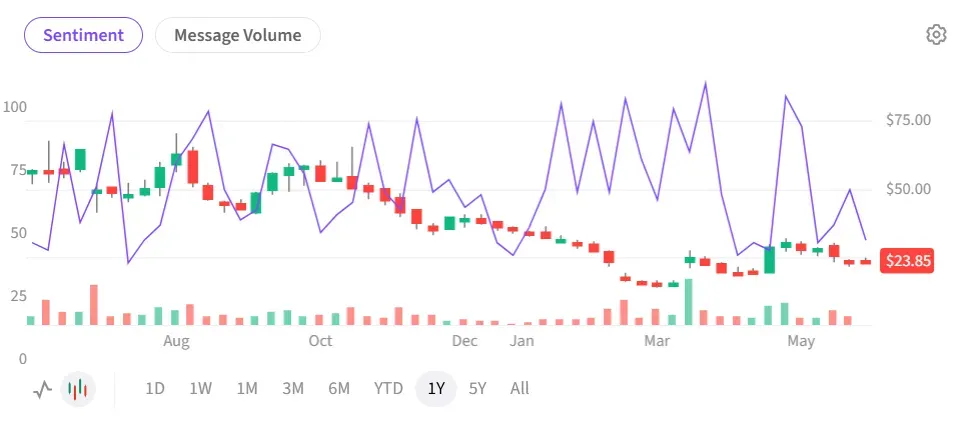
HIMS stock rose marginally on Tuesday to end at $23.85, but shares are down 12% so far this month, on track to snap two straight months of gains.
Former Netflix CFO Loads Up On HIMS Shares
A fresh filing from late Tuesday showed that Wells bought 48,400 shares of Hims on Tuesday at $24.235 per share, with the transactions executed in a range between $24.19 and $24.25 per share. The purchase increased Wells’ stake in Hims to 224,417 shares. Based on the filing, Wells spent about $1.17 million acquiring the shares.
Advertisement|Remove ads.
Wells has served on Hims & Hers’ board of directors since September 2020 and previously served as CFO of Netflix from 2010 to 2019. During his time at Netflix, Wells oversaw financial planning and analysis and also spent two years based in the Netherlands helping expand the streaming company’s European operations. He currently also serves on the boards of The Trade Desk and TransferWise.
The latest buy comes as Hims continues pushing aggressively into weight-loss drugs, diagnostics, hormone health, and AI healthcare tools as part of its efforts to evolve beyond traditional telehealth prescriptions.
BofA Flags GLP-1 Risks For HIMS
Bank of America Securities (BofA) on Tuesday lowered its price target on Hims to $25 from $28, still implying a 5% upside from current levels, while maintaining a ‘Neutral’ rating on the stock.
Advertisement|Remove ads.
The brokerage said that Hims’ 2026 revenue guidance depends on a “significant” acceleration in GLP-1 growth during the second half of next year and may not fully account for potential pricing pressure around subscription fees and intensifying competition in the weight-loss market.
The analyst also lowered the valuation multiple applied to Hims shares due to risks stemming from the company’s full-year outlook. As part of the telehealth firm’s recent weak first-quarter results, which missed analyst estimates for revenue and the bottom line, Hims raised its 2026 guidance and now expects revenue between $2.8 billion and $3. billion, alongside adjusted core profit of $275 million to $350 million.
The warning added to investor concerns about how sustainable Hims’ GLP-1-driven momentum may remain amid increasing competition across branded, compounded, and generic obesity-care treatments.
Advertisement|Remove ads.
Hims Expands Global GLP-1 Push
Last week, Hims launched generic Semaglutide in Canada after the early lapse of Novo Nordisk’s Canadian Semaglutide patent. Canadian consumers can now access generic Semaglutide through its telehealth platform as part of its weight-loss program, with treatments supplied by Apotex. The launch marked Hims’ first international rollout of a generic GLP-1 product and further expanded the company’s obesity-care business beyond the U.S.
Hims previously leaned heavily on compounded GLP-1 offerings during shortages involving Wegovy and Zepbound before later partnering directly with major drugmakers to offer branded therapies, including Wegovy, Ozempic, Zepbound and Mounjaro through its platform.
Competition across the broader GLP-1 market has intensified rapidly as Novo Nordisk and Eli Lilly continue battling for dominance in the obesity-treatment market. Lilly recently released strong late-stage data for its next-gen obesity drug Retatrutide, while also using profits from Zepbound and Mounjaro to fund aggressive acquisitions across oncology, vaccines, and AI-driven drug development.
Advertisement|Remove ads.
Meanwhile, even Novo Nordisk’s Semaglutide franchise is facing growing generic pressure globally after Brazil recently approved its first generic Ozempic rival, following recent approvals of generic Semaglutide products in India and Canada.
Upcoming Catalysts For HIMS
Hims has also been rapidly scaling its AI healthcare initiatives. Earlier this month, the company launched Labs AI, a healthcare assistant that helps users interpret biomarker trends, lab test results, and long-term health risks through personalized data analysis.
Investor focus has additionally shifted toward peptides as a potential future growth category for Hims ahead of upcoming FDA discussions around peptide compounds that may remain eligible for compounding. CEO Andrew Dudum previously compared Hims’ broader healthcare strategy to Netflix’s early growth playbook, saying that the company aims to build a more accessible and personalized healthcare ecosystem rather than rely solely on a single treatment category.
Advertisement|Remove ads.
How Do Retail Traders Feel About HIMS?
On Stocktwits, retail sentiment for HIMS has been ‘bearish’ over the past week amid a 346% jump in 24-hour message volumes.
One user said, “One thing I’d watch over the next few days: whether this turns into a cluster buy (multiple insiders buying around the same time). A single director buy is good; several insiders buying together is often a much stronger signal.”
Advertisement|Remove ads.
Another user said, “This is a golden opportunity to invest in a company that had a temporary slowdown due to change in direction. Peptides are around the corner.It's even acquiring Eucalyptus that had triple-digit growth last year.”
HIMS stock has declined 57% over the past year.
Advertisement|Remove ads.
For updates and corrections, email newsroom[at]stocktwits[dot]com.
Comments posted here will also appear on symbol pages.

Latest News
/filters:format(webp)https://news.stocktwits-cdn.com/large_Getty_Images_2261740761_jpg_17808aac0f.webp)
/filters:format(webp)https://news.stocktwits-cdn.com/Aashika_Suresh_Profile_Picture_jpg_2acd6f446c.webp) Aashika Suresh·21m ago
Aashika Suresh·21m ago/filters:format(webp)https://news.stocktwits-cdn.com/large_Getty_Images_2244673123_9da00e5574.jpg)
/filters:format(webp)https://news.stocktwits-cdn.com/shivani_photo_jpg_dd6e01afa4.webp) Shivani Kumaresan·26m ago
Shivani Kumaresan·26m ago/filters:format(webp)https://news.stocktwits-cdn.com/large_Getty_Images_2290481120_280ff97d03.jpg) Shivani Kumaresan·1h ago
Shivani Kumaresan·1h ago/filters:format(webp)https://news.stocktwits-cdn.com/large_tesla_stock_jpg_9d4cbf6a46.webp)
/filters:format(webp)https://news.stocktwits-cdn.com/IMG_8805_JPG_6768aaedc3.webp) Deepti Sri·1h ago
Deepti Sri·1h ago/filters:format(webp)https://news.stocktwits-cdn.com/large_oil_stocks_jpg_6935abe231.webp) Aashika Suresh·2h ago
Aashika Suresh·2h ago/filters:format(webp)https://news.stocktwits-cdn.com/large_Getty_Images_2245341683_0cb2bc89f5.jpg)
/filters:format(webp)https://news.stocktwits-cdn.com/1707726834303_jpg_11f20a9aa9.webp) Shashank Nayar·4h ago
Shashank Nayar·4h ago