


Advertisement|Remove ads.
SLS Stock Surges Toward Fifth Weekly Rise: CEO Touts GPS As Lifeline For Elderly Patients As Cancer Summit Looms


- CEO Angelos Stergiou highlighted new real-world AML data showing that most elderly patients never reach stem cell transplant despite achieving remission.
- The CEO also noted that earlier Phase 2 GPS data showed a 21-month median survival in a similar elderly AML population.
- Beyond GPS, investors are also tracking SLS009 after Stergiou highlighted the drug’s potential in TP53-mutated and venetoclax-resistant AML.
Advertisement|Remove ads.
Shares of Sellas Life Sciences Group (SLS) are poised to record a fifth straight weekly gain amid growing anticipation around the final late-stage readout for its lead cancer therapy, GPS, in acute myeloid leukemia (AML) patients, while CEO Angelos Stergiou is also spotlighting the drug’s potential use in elderly patients as another key catalyst.
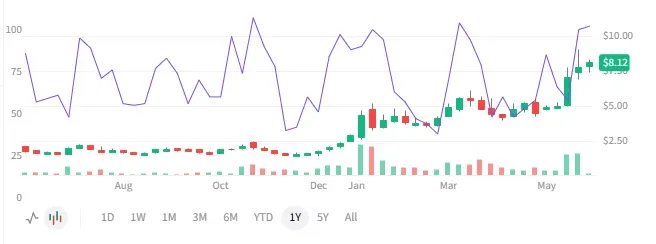
SLS stock jumped over 4% to close at $8.12 on Tuesday, with shares surging toward their best month so far in 2026.

SLS CEO Pushes GPS For Elderly AML Patients
The latest development came in a LinkedIn post published late Tuesday, in which Stergiou discussed new real-world data on elderly AML patients treated with intensive remission regimens at the MD Anderson Cancer Center.
Advertisement|Remove ads.
According to Stergiou, the study showed that newer chemotherapy combos are helping more elderly AML patients get their cancer under control, with 63% of high-risk patients achieving remission. However, he said that most of those patients still never make it to a stem cell transplant, which is often considered the best chance for longer-term survival, leaving many elderly patients with fewer effective treatment options.
“Despite being touted as a ‘bridge to transplant,’ only 15% of these patients actually made it to an allogeneic stem cell transplant,” Stergiou said. “For the remaining 85% who are too frail or older, a steep ‘therapeutic cliff’ remains.”
Stergiou added that patients unable to receive a transplant faced a median overall survival of only eight months because of “cumulative toxicities and eventual resistance to continuous chemotherapy backbones.”
Advertisement|Remove ads.
“Achieving remission shouldn't mean entering a countdown,” Stergious said. The CEO used the study to reinforce Sellas’ thesis around galinpepimut-S (GPS), the company’s immunotherapy currently being evaluated in the Phase 3 Regal study.
The CEO said that the real-world study supports the design of Sellas’ Phase 3 Regal trial, since the patients in the study received the same standard chemotherapy maintenance treatments used in the Regal control group. He also pointed to earlier Phase 2 GPS data from a similar elderly AML population with a median age of 74, in which Sellas reported a median overall survival of 21 months.
“As the REGAL trial approaches its 80th event, real-world data like this reminds us why our mission is so urgent,” Stergiou said. “We aren't just trying to help patients achieve remission; we are working to safely prolong lives.”
Advertisement|Remove ads.
TD Cowen Summit Marks Final Conference Stretch
Stergiou’s latest comments come as Sellas approaches the final analysis stage of the Regal trial, one of the company’s biggest near-term catalysts. The company recently disclosed that Regal had reached 78 events as of May 11, leaving only two events remaining before the study reaches the threshold required for final analysis and topline data release.
Sellas previously said the study would be considered successful if GPS extended median overall survival to approximately 12.6 months, compared with 8.1 months with standard treatment. Optimism around the trial has grown after Stergiou said in recent cancer conferences that survival in the Regal trial may be running longer than initially expected. Stergiou also believes there is “a very good chance” GPS could replicate or exceed the survival benefit seen in earlier Phase 2 studies.
Sellas is scheduled to participate in TD Cowen’s 7th Annual Oncology Innovation Summit in a virtual fireside chat on Wednesday, marking the last investor-facing event of the current conference season ahead of the Regal data release. The TD Cowen summit follows back-to-back presentations at the A.G.P. and Stifel oncology conferences last week.
Advertisement|Remove ads.
At the A.G.P. Annual Virtual Healthcare Conference last week, the CEO similarly said survival in Regal appeared “unexpectedly long” and reiterated that “every passing month” may improve the probability of a successful outcome due to a potential GPS effect. Stergiou also disclosed during the Stifel conference that some Regal patients remain on GPS treatment more than three years after enrollment.
SLS009 Adds Secondary AML Catalyst
Beyond GPS, Stergiou also highlighted Sellas’ second AML drug candidate, SLS009, which is currently in mid-stage clinical testing. He pointed to data from the recent AML study showing particularly poor outcomes in patients with TP53 mutations, a hard-to-treat form of leukemia, and said this further supports the potential importance of SLS009, given the drug's strong activity in lab models of TP53-mutated AML.
At the Stifel conference, Stergiou called SLS009’s activity in venetoclax-resistant AML “quite astonishing.” Sellas expects topline SLS009 data later this year while also evaluating potential accelerated approval pathways.
Advertisement|Remove ads.
How Do Retail Traders Feel About SLS?
On Stocktwits, retail sentiment for SLS has been ‘extremely bullish’ since the conference season began, amid a more than 200% jump in 24-hour message volume.
One user laid out the potential benefits of acquiring SLS, saying, “At a $40B buyout, Big Pharma is securing that leukemia engine at a bargain 5.5x Price-to-Sales multiple. Here is what the general boards completely miss: A $40B acquisition means they are getting our universal WT1 multi-cancer platform—valued at an additional $12.0 Billion across 20+ solid tumor indications—completely for free.”
Advertisement|Remove ads.
Another user echoed a similar sentiment, saying, “tomorrow when td cowen looks at the big pharma wigs joining the event: angelos stergiou brings big pharma to the yard, and he's like GPS --it's better than yours! He'll take a buyout but he'll have to charge.”
SLS stock has surged 330% over the past year.
Advertisement|Remove ads.
For updates and corrections, email newsroom[at]stocktwits[dot]com.
Comments posted here will also appear on symbol pages.

Latest News
/filters:format(webp)https://news.stocktwits-cdn.com/large_Getty_Images_2203983775_jpg_74bdd5dd43.webp)
/filters:format(webp)https://news.stocktwits-cdn.com/Aashika_Suresh_Profile_Picture_jpg_2acd6f446c.webp) Aashika Suresh·26m ago
Aashika Suresh·26m ago/filters:format(webp)https://news.stocktwits-cdn.com/large_Getty_Images_2247874160_jpg_4fb51355e6.webp)
/filters:format(webp)https://news.stocktwits-cdn.com/IMG_8805_JPG_6768aaedc3.webp) Deepti Sri·50m ago
Deepti Sri·50m ago/filters:format(webp)https://news.stocktwits-cdn.com/large_Getty_Images_2261740761_jpg_17808aac0f.webp) Aashika Suresh·1h ago
Aashika Suresh·1h ago/filters:format(webp)https://news.stocktwits-cdn.com/large_Getty_Images_2244673123_9da00e5574.jpg)
/filters:format(webp)https://news.stocktwits-cdn.com/shivani_photo_jpg_dd6e01afa4.webp) Shivani Kumaresan·1h ago
Shivani Kumaresan·1h ago/filters:format(webp)https://news.stocktwits-cdn.com/large_Getty_Images_2290481120_280ff97d03.jpg) Shivani Kumaresan·2h ago
Shivani Kumaresan·2h ago/filters:format(webp)https://news.stocktwits-cdn.com/large_tesla_stock_jpg_9d4cbf6a46.webp) Deepti Sri·2h ago
Deepti Sri·2h ago