


Advertisement|Remove ads.
IBM, NASA Use AI To Hunt For Lunar Ice, While Lockheed Martin Expands Quantum Push


- One of the model’s most important applications is identifying potential ice deposits in permanently shadowed regions, where conventional observation can be particularly difficult.
- The model can also help scientists identify Irregular Mare Patches, volcanic features that provide clues about the Moon’s volcanic and thermal history.
- IBM also announced a partnership with Lockheed Martin to establish a quantum innovation hub at ETH Zurich that is expected to host Switzerland’s first IBM Quantum System Two by the end of 2026.
Advertisement|Remove ads.
IBM (IBM) and NASA announced Thursday the open-source release of the NASA-IBM Lunar Foundation Model, one of the first publicly available AI foundation models built specifically for scientific exploration of the Moon.
The company also announced that it had entered into an agreement with Lockheed Martin (LMT) to establish a quantum innovation hub in Switzerland. The initiative is expected to bring Switzerland its first IBM Quantum System Two, which is planned for deployment at the Swiss National Supercomputing Center in Lugano by the end of 2026.

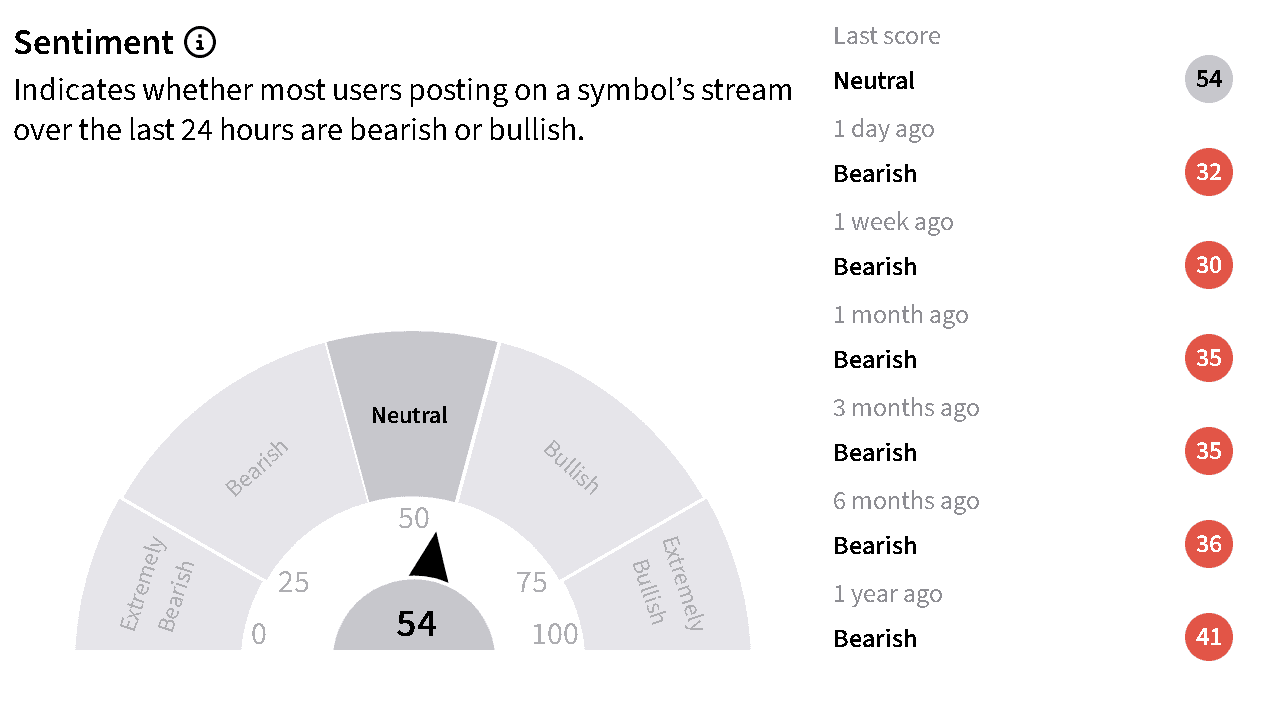
IBM stock fell as much as 1.6% in morning trade amid broader market weakness, with retail sentiment flipping to ‘bullish’ from ‘bearish’ territory over the past day. Meanwhile, LMT’s stock edged 0.3% higher, but retail sentiment fell to ‘bearish’ from ‘neutral’ territory.
Advertisement|Remove ads.
While IBM has been expanding its push into newer markets, its stock has struggled this year, down nearly 20%.
IBM, NASA Put Lunar Data To Work
“NASA has spent decades building an extraordinary scientific record of the Moon, but collecting data is only part of the job,” said Kevin Murphy, NASA’s chief science data officer.
The companies said the Lunar Foundation Model is trained on a large dataset of lunar observations collected across multiple instruments and missions. One of the goals is to search for potential ice deposits in permanently shadowed regions of the Moon. Lunar ice could provide water and oxygen for future surface operations and potentially be used to produce rocket fuel.
Advertisement|Remove ads.
The model could also help researchers map Irregular Mare Patches, volcanic features that provide insights into the Moon’s thermal history. It could also help with detecting craters. Mapping craters can help researchers study the Moon’s geological history and help NASA evaluate potential landing sites and locations for future infrastructure.
IBM Research’s Juan Bernabe-Moreno said the model gives scientists “a foundation to explore the Moon at scale,” allowing them to connect observations across different instruments and identify patterns that may be difficult to see when the data is analyzed separately.
Lunar Model Expands IBM’s Prithvi AI Family
IBM and NASA are releasing the model alongside an open-source lunar dataset designed for machine learning. The dataset combines more than 30 spatially aligned data layers from nine instruments across four missions, expanding IBM’s Prithvi family of open foundation models.
Advertisement|Remove ads.
The family began with a geospatial model in 2023 and has since expanded into areas including weather, climate and heliophysics.
IBM, Lockheed Martin Expand Quantum Research
IBM’s partnership with Lockheed Martin gives the company a foothold in Switzerland’s quantum computing ecosystem. IBM said the new hub at ETH Zurich is expected to host an IBM Quantum System Two powered by IBM’s Nighthawk processor.
Under the agreement, IBM will operate the system, while ETH Zurich will provide expertise, resources and technologies for Swiss companies, startups and academic researchers.
Advertisement|Remove ads.
The partnership also includes two planned joint development projects between IBM and Lockheed Martin. One will explore quantum sensing applications for navigation, while the other will examine ways to improve additive manufacturing of metallic alloys.
The work builds on an existing relationship between IBM and Lockheed Martin across quantum computing, AI, aerospace and defense.
Advertisement|Remove ads.
For updates and corrections, email newsroom[at]stocktwits[dot]com.
Comments posted here will also appear on symbol pages.

Latest News
/filters:format(webp)https://news.stocktwits-cdn.com/large_Getty_Images_1258292964_d4895e93ad.jpg)
/filters:format(webp)https://news.stocktwits-cdn.com/Prabhjote_DP_67623a9828.jpg) Prabhjote Gill·8m ago
Prabhjote Gill·8m ago/filters:format(webp)https://news.stocktwits-cdn.com/large_IBM_jpg_db5b7d0908.webp)
/filters:format(webp)https://news.stocktwits-cdn.com/Harshita_3cfe02022c.jpg) Harshita Tyagi·11m ago
Harshita Tyagi·11m ago/filters:format(webp)https://news.stocktwits-cdn.com/large_Getty_Images_2294108581_678b1cf125.jpg)
/filters:format(webp)https://news.stocktwits-cdn.com/shivani_photo_jpg_dd6e01afa4.webp) Shivani Kumaresan·1h ago
Shivani Kumaresan·1h ago/filters:format(webp)https://news.stocktwits-cdn.com/large_Meta_jpg_0f17dacb20.webp) Shivani Kumaresan·2h ago
Shivani Kumaresan·2h ago/filters:format(webp)https://news.stocktwits-cdn.com/large_Getty_Images_2301241048_efc5b32b0a.jpg)
/filters:format(webp)https://news.stocktwits-cdn.com/IMG_8805_JPG_6768aaedc3.webp) Deepti Sri·2h ago
Deepti Sri·2h ago/filters:format(webp)https://news.stocktwits-cdn.com/large_william_li_nio_jpg_c26eaad557.webp) Deepti Sri·2h ago
Deepti Sri·2h ago