


Advertisement|Remove ads.
Mizuho Says Memory Upside Has More Room To Run — Sees Chip Equipment As The Next Opportunity
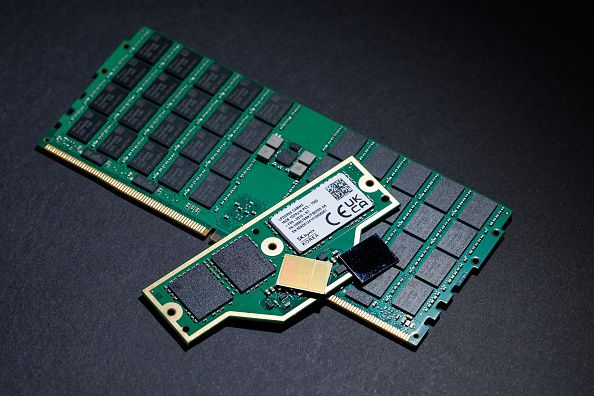


- Klein called Micron and memory stocks “dirt cheap” and expects free cash flow to accelerate significantly, according to Investing.com
- Astera Labs was the exception to Klein’s view that most chip stocks look inexpensive relative to their growth potential.
- DRAM equipment sales are projected to rise 39% to $38.8 billion in 2026, according to SEMI.
Advertisement|Remove ads.
Memory stocks still have room to run, while semiconductor equipment could emerge as the next opportunity in the chip trade, according to Mizuho’s technology, media and telecommunications specialist Jordan Klein.
According to the Investing.com report, Klein said he has grown more confident in the durability and upside potential of memory, semiconductor equipment, foundries, and parts of the hardware sector, including servers.
The analyst added that positioning in semiconductors remains well below summer highs, even as fundamentals have strengthened. Investors should remain overweight the sector, he said.
Advertisement|Remove ads.
Chip Equipment Emerges As Another Opportunity
Klein said semiconductor equipment and analog chipmakers are the least-owned parts of the sector. He favored adding equipment exposure in the near term while being more selective with analog names.
The analyst noted that SK Hynix and Samsung both closed at their highs in Korea, which is a good sign.
As per the report, Klein described Micron Technology (MU) and memory stocks as “dirt cheap” and said free cash flow should accelerate significantly.
Micron’s fiscal fourth-quarter (Q4) revenue rose to $54.23 billion from $11.32 billion a year earlier, while the company expects fiscal first-quarter revenue of $61.5 billion, plus or minus $1.5 billion.
Advertisement|Remove ads.
According to Klein, the main takeaway from Micron’s earnings update was that supply conditions are tight and should tighten further next year.
Astera Stands Out On Valuation
Klein said almost every chip stock looks inexpensive relative to its growth potential, with Astera Labs (ALAB) being the exception, according to the Investing.com report.
Astera reported second-quarter (Q2) revenue of $392.4 million, up 104% year over year, and expects third-quarter revenue of $540 million to $560 million as its Scorpio X-Series fabric switches ramp into volume production.
Advertisement|Remove ads.
Klein urged investors to look past day-to-day rotations between chip and software stocks, which he attributed to quantitative, passive, and systematic fund flows.
Memory Supply Remains Tight
TrendForce expects conventional DRAM contract prices to rise 10% to 15% sequentially in the fourth quarter. It also expects high-bandwidth memory (HBM) supply to remain constrained through 2027 as it competes with conventional memory for advanced-process and wafer capacity.
Spending on semiconductor manufacturing equipment continues to rise, with memory-related investment driving much of the increase. SEMI expects dynamic random-access memory (DRAM) equipment sales to jump 39% to $38.8 billion in 2026, followed by another 27.4% increase in 2027.
Advertisement|Remove ads.
Korea’s equipment spending is being driven by advanced memory technologies, including high-bandwidth memory.
Retail Sentiment Around ALAB, MU, DRAM
On Stocktwits, retail investors’ sentiment around ALAB stock remained ‘bearish’, while sentiment surrounding MU stock turned ‘extremely bullish’. Sentiment around the Roundhill Memory ETF (DRAM) was ‘bullish’
So far this year, Astera Labs stock has rallied over 98%, while Micron stock has surged more than 228%. In comparison, the Roundhill Memory ETF (DRAM), which tracks semiconductor companies that produce and supply HBM, NAND, and DRAM, has risen 118% over the same period.
Advertisement|Remove ads.
For updates and corrections, email newsroom[at]stocktwits[dot]com
Comments posted here will also appear on symbol pages.

Latest News
/filters:format(webp)https://st-everywhere-cms-prod.s3.us-east-1.amazonaws.com/large_nvidia_jensen_huang_ces_2025_resized2_406c6b4943.jpg)
/filters:format(webp)https://news.stocktwits-cdn.com/IMG_8805_JPG_6768aaedc3.webp) Deepti Sri·18m ago
Deepti Sri·18m ago/filters:format(webp)https://news.stocktwits-cdn.com/large_Getty_Images_2263970718_jpg_6eee003c20.webp)
/filters:format(webp)https://news.stocktwits-cdn.com/Aashika_Suresh_Profile_Picture_jpg_2acd6f446c.webp) Aashika Suresh·54m ago
Aashika Suresh·54m ago/filters:format(webp)https://news.stocktwits-cdn.com/large_elon_musk_f04806b648.jpg) Deepti Sri·55m ago
Deepti Sri·55m ago/filters:format(webp)https://news.stocktwits-cdn.com/large_Getty_Images_2295800057_fd745de575.jpg)
/filters:format(webp)https://news.stocktwits-cdn.com/shivani_photo_jpg_dd6e01afa4.webp) Shivani Kumaresan·2h ago
Shivani Kumaresan·2h ago/filters:format(webp)https://news.stocktwits-cdn.com/large_Bloom_Energy_jpg_de9372f92d.webp) Aashika Suresh·2h ago
Aashika Suresh·2h ago/filters:format(webp)https://news.stocktwits-cdn.com/moderna_hq_resized_jpg_97563ed423.webp) Aashika Suresh·2h ago
Aashika Suresh·2h ago