


Advertisement|Remove ads.
Most S&P 500 Stocks Sank In September — But Retail Traders Didn't Flee



- Only three of 75 financial stocks and one of 30 real estate stocks rose during the month.
- Message volume on S&P 500 stocks that fell more than 10% rose by a median of 72.5%.
- FICO lost nearly half its value, yet its Stocktwits watcher count grew 26%, the fastest in the index.
Advertisement|Remove ads.
The S&P 500 ended September roughly where it started. Most of its stocks did not, but you wouldn't know that if you focused only on AI and Big Tech.
Of 499 index companies (discounting secondary listings of Alphabet, Inc., Berkshire Hathaway, Fox Corp. and News Corp.), 387 fell during the month, meaning more than three in four S&P 500 stocks were a losing bet.

The typical S&P 500 stock lost nearly 6% on average, while the index slipped only about 0.4%. A small group of large tech names, led by chipmakers and Meta Platforms Inc. (META), kept the headline number steady and masked how widespread the damage was.
Advertisement|Remove ads.
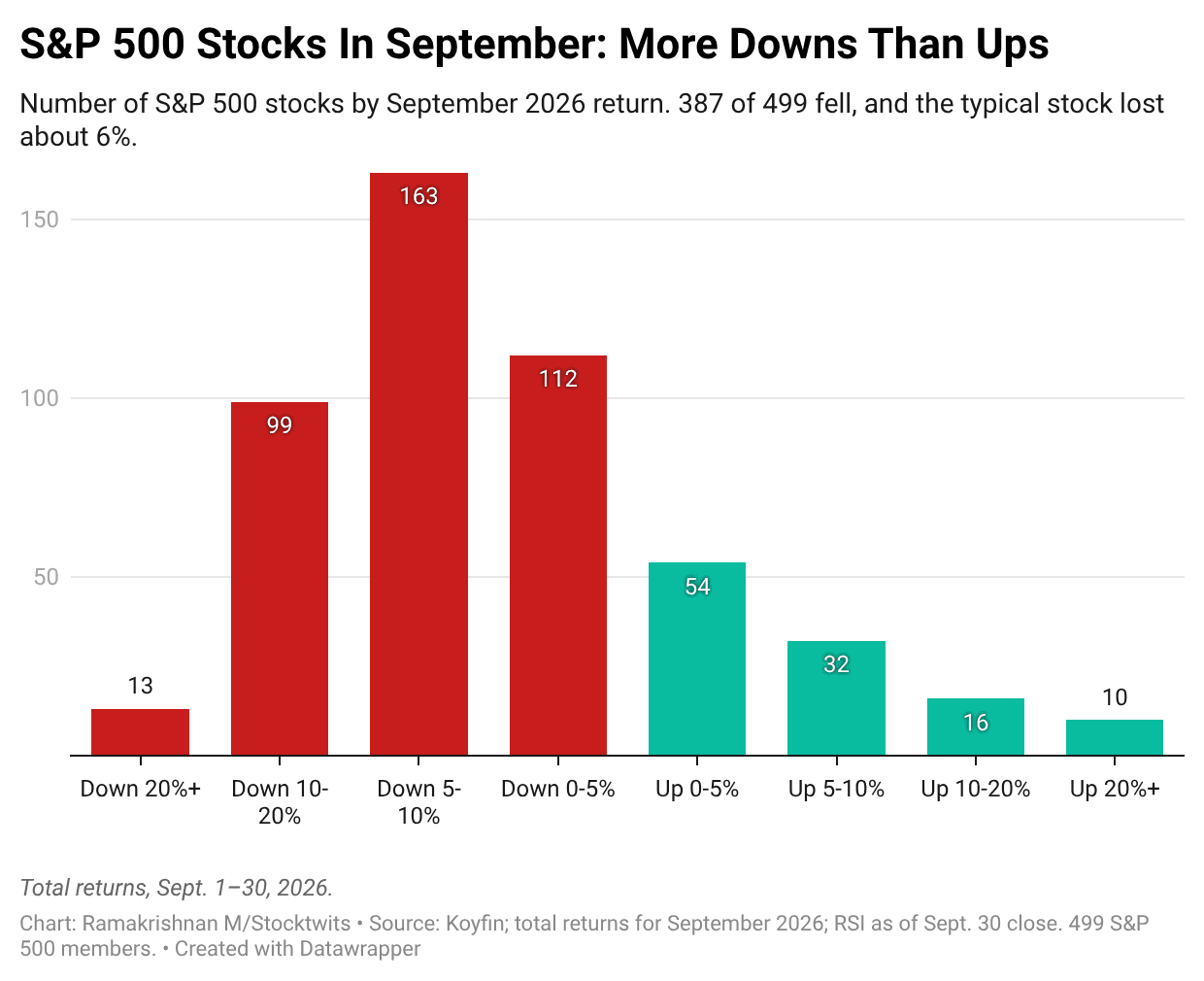
On Stocktwits, retail traders leaned into the selloff instead of stepping away, and chatter rose most on the stocks that fell hardest. The 30-day median message volume for S&P 500 stocks that took a more than 10% beating rose by over 70%.
S&P 500 In September: Narrow Rally, Broad Retreat
Advertisement|Remove ads.
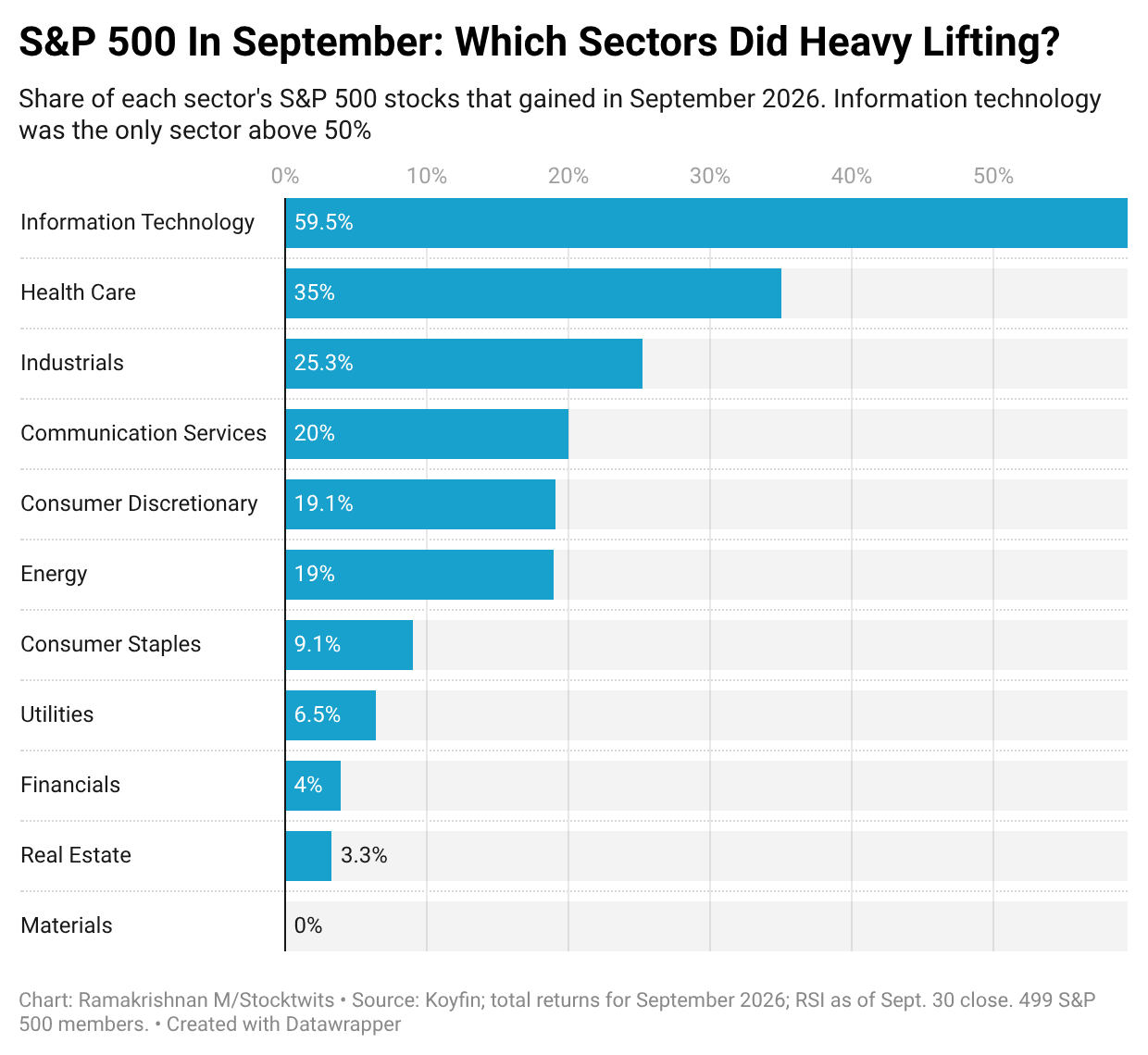
Technology was the only sector where most stocks gained, and even there the split was sharp. Chipmakers Intel Corp. (INTC) and Advanced Micro Devices Inc. (AMD) each rallied about 30%, while software names such as Intuit Inc. (INTU) were among the month's worst performers.
Everywhere else, losses were broad. Only three of 75 financial stocks rose, along with one of 30 real estate stocks and none of the 25 materials stocks.
Advertisement|Remove ads.
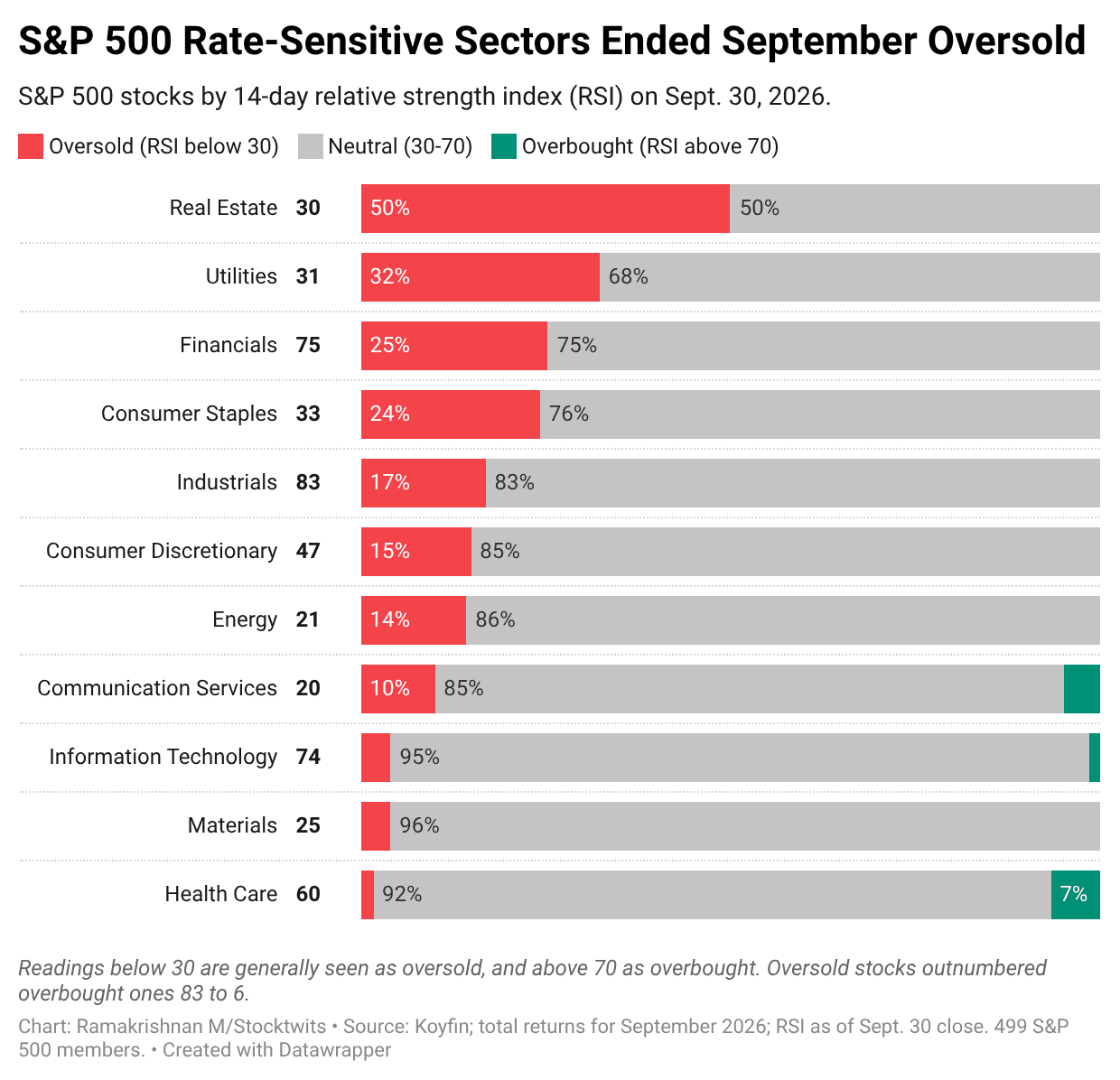
Rate-sensitive sectors came under pressure after the Federal Reserve's first rate hike in three years. The 10-year Treasury yield climbed to about 5.3% in the final days of the month, near its highest level since 2007, even after a softer-than-expected inflation report.
By month-end, 83 S&P 500 stocks had a 14-day relative strength index below 30, which puts them in "oversold" territory. Only six were above 70, the "overbought" line. Half of the real estate sector ended the month oversold.
Advertisement|Remove ads.
S&P 500’s Forgettable September: How Did Retail Traders React?
Stocktwits data shows retail attention clustered at the extremes. For S&P 500 stocks that fell more than 10% in September, message volume rose a median 72.5% from 30 days earlier. For stocks with milder declines, and even for most gainers, the increase was in the single digits.
Sentiment on the hardest-hit names was also more upbeat than on stocks with modest losses, suggesting traders were buying the dip and betting on a recovery.
Advertisement|Remove ads.
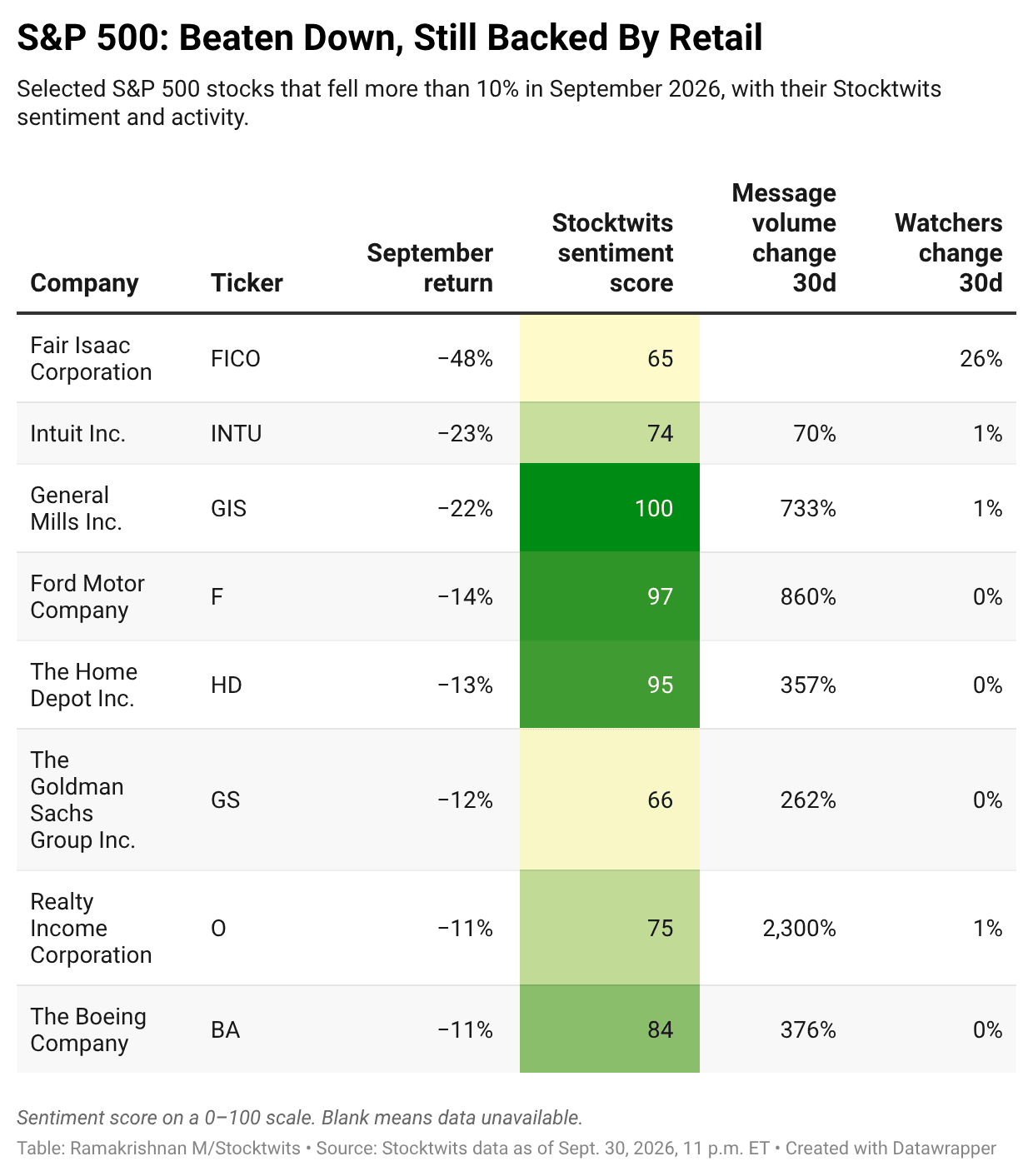
Fair Isaac Corp. (FICO) is the clearest example. The credit-scoring company lost nearly half its value in September, making it the index's worst performer. The selloff followed remarks from the director of the U.S. Federal Housing Finance Agency that mortgage pricing would be simplified and that the new system would adopt a direct competitor as its preferred credit-scoring model for all eligible loans. Over the same 30 days, its Stocktwits watcher count rose 26%, the fastest growth of any S&P 500 member.
Ford Motor Co. (F) and Home Depot Inc. (HD) each fell more than 12%, yet sentiment on both was in 'extremely bullish' territory as of the last close.
Advertisement|Remove ads.
More chatter doesn't necessarily mean more buying. Still, the pattern suggests many retail traders saw September's selloff as an opportunity rather than a warning.
S&P 500: Top 10 September Gainers
| Company | Ticker | Sector | September return |
| Everpure Inc. | P | Information Technology | 40.7% |
| Moderna Inc. | MRNA | Health Care | 37.2% |
| Intel Corporation | INTC | Information Technology | 34.3% |
| Bloom Energy Corporation | BE | Industrials | 34.3% |
| Advanced Micro Devices Inc. | AMD | Information Technology | 30.0% |
| Illumina Inc. | ILMN | Health Care | 28.1% |
| Skyworks Solutions Inc. | SWKS | Information Technology | 27.6% |
| Meta Platforms Inc. | META | Communication Services | 26.8% |
| Marvell Technology Inc. | MRVL | Information Technology | 24.8% |
| Hewlett Packard Enterprise Company | HPE | Information Technology | 22.6% |
S&P 500: Top 10 September Losers
Advertisement|Remove ads.
| Company | Ticker | Sector | September return |
| Fair Isaac Corporation | FICO | Information Technology | -48.4% |
| Gen Digital Inc. | GEN | Information Technology | -29.0% |
| Equifax Inc. | EFX | Industrials | -27.4% |
| Charter Communications Inc. | CHTR | Communication Services | -27.3% |
| Axon Enterprise Inc. | AXON | Industrials | -25.4% |
| MGM Resorts International | MGM | Consumer Discretionary | -24.9% |
| Intuit Inc. | INTU | Information Technology | -23.3% |
| Paychex Inc. | PAYX | Industrials | -22.7% |
| General Mills Inc. | GIS | Consumer Staples | -21.9% |
| Blackstone Inc. | BX | Financials | -21.8% |
US Markets: How Are Retail Traders Positioned For Q4?
With the S&P 500 and Nasdaq still finishing the third quarter in the green, retail traders are entering October in an ‘extremely bullish’ mode, going by the Stocktwits sentiment for the primary exchange-traded funds tracking those indexes.
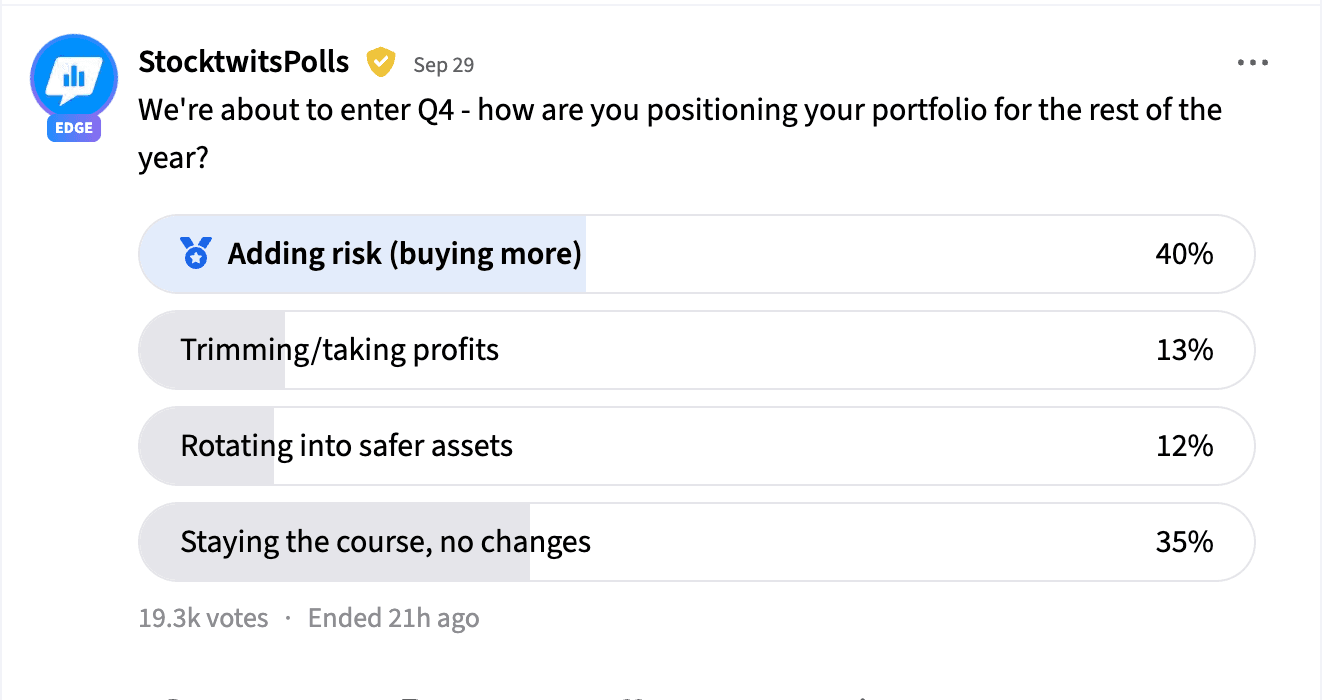
A poll on the platform that drew over 19,000 responses, asking how retail traders are positioning for the fourth quarter, shows that a majority (40%) are buying more, 35% voted “staying the course, no changes,” and the rest are either taking profits or rotating into safer assets.
Advertisement|Remove ads.
“Scaling in strategically.The process is the process. The living nightmare will come to an end at the next inauguration. Guaranteed,” said one user, referring to the next presidential election. President Donald Trump's current term ends in January 2029.
Another user preferred to exercise extreme caution: “There are more than half a dozen metrics pointing to a very real near-term correction or market crash, and so many of you are adding more risk.”
Advertisement|Remove ads.
For updates and corrections, email newsroom[at]stocktwits[dot]com.
Read Next: US 10-Year Treasury Yield Soars To 24-Year High: Will The Selloff Continue?
Comments posted here will also appear on symbol pages.

Latest News
/filters:format(webp)https://news.stocktwits-cdn.com/large_Getty_Images_2296204501_14a84e5451.jpg)
/filters:format(webp)https://news.stocktwits-cdn.com/unnamed_jpg_9dff551b50.webp) Anan Ashraf·1h ago
Anan Ashraf·1h ago/filters:format(webp)https://news.stocktwits-cdn.com/large_Getty_Images_2271714842_jpg_e9329f8e11.webp) Anan Ashraf·2h ago
Anan Ashraf·2h ago/filters:format(webp)https://news.stocktwits-cdn.com/gettyimages_131113971_594x594_18605564f3.jpg)
/filters:format(webp)https://news.stocktwits-cdn.com/1707726834303_jpg_11f20a9aa9.webp) Shashank Nayar·2h ago
Shashank Nayar·2h ago/filters:format(webp)https://news.stocktwits-cdn.com/large_IBM_jpg_db5b7d0908.webp) Shashank Nayar·3h ago
Shashank Nayar·3h ago/filters:format(webp)https://news.stocktwits-cdn.com/Getty_Images_2258302119_jpg_de7ca8145a.webp) Anan Ashraf·4h ago
Anan Ashraf·4h ago/filters:format(webp)https://news.stocktwits-cdn.com/large_Getty_Images_2296215726_e82f86b85a.jpg) Shashank Nayar·4h ago
Shashank Nayar·4h ago