


Advertisement|Remove ads.
Oil Prices Surge Past $110 Per Barrel Amid Fresh Attacks On Middle East Energy Assets
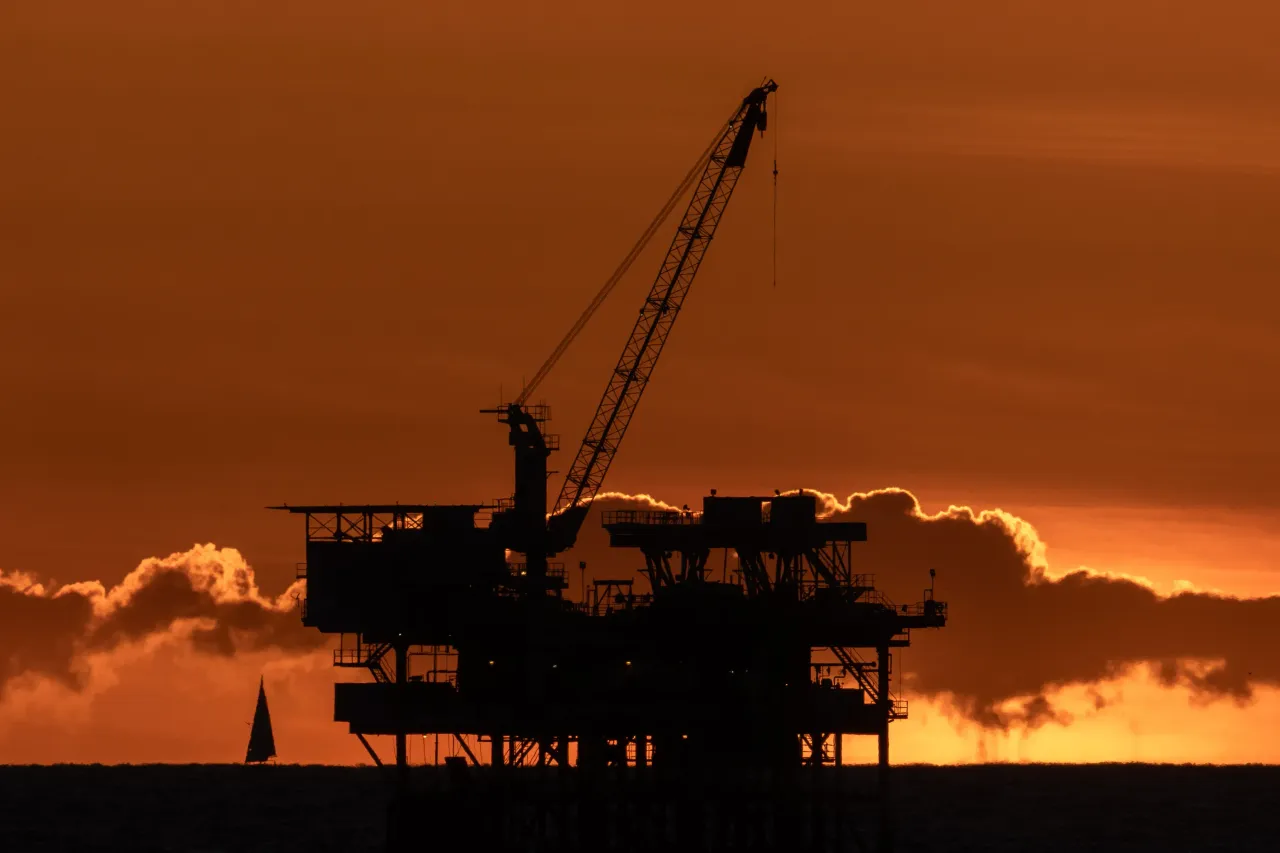


- Iran’s attack followed Israeli attacks on its South Pars gas field earlier in the day.
- Trump reportedly said that while he was aware of Israel’s strike on South Pars, he did not want any further attacks on Iranian energy sites.
- Prices of ICE Brent crude futures expiring in May climbed by over 6% to $111.55 per barrel, while WTI crude climbed nearly 3% to $100.51 per barrel.
Oil prices surged on Wednesday, with Brent crude prices topping $110 a barrel, after Iran reportedly struck the world’s largest liquefied natural gas (LNG) site in Qatar, even as the war in the Middle East approaches three weeks.
Prices of ICE Brent crude futures expiring in May climbed by over 6% to $111.55 per barrel. Meanwhile, West Texas Intermediate crude climbed nearly 3% to $100.51 per barrel.
Oil prices were previously trading at these levels in 2022 after Russia invaded Ukraine, triggering severe supply shortages amid energy sanctions.
According to a report from Bloomberg, Iran struck Qatar’s Ras Laffan Industrial City, causing “extensive damage” following Israeli attacks on its South Pars gas field earlier in the day.
Escalating Tensions
The latest attacks indicate a further escalation in the Middle East war that began on Feb. 28 after the U.S. and Israel launched coordinated strikes on Iran. The conflict has impacted global energy supplies, as the important shipping route, the Strait of Hormuz, has been choked off.
Meanwhile, U.S. President Donald Trump reportedly said that while he was aware of Israel’s strike on South Pars, he did not want any further attacks on Iranian energy sites. According to a report from the Wall Street Journal, Trump has said that Iran has got the message, even as pressure mounts on the president to curb inflation concerns amid surging oil prices.
Expert Opinions
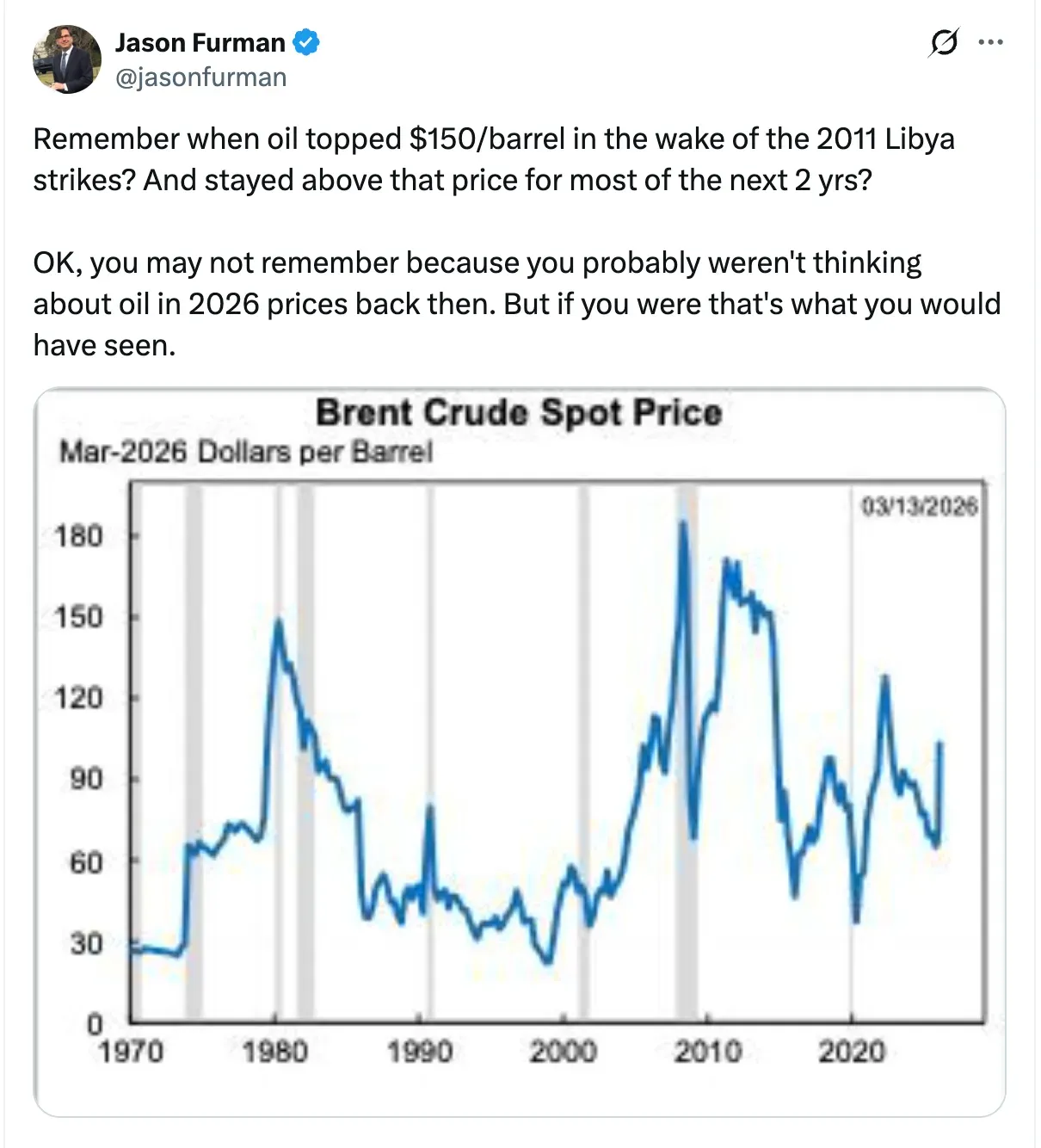
Jason Furman, Professor of Economics at the Harvard Kennedy School (HKS), compared the current trend of rising oil prices to 2011 levels, when it spiked during the NATO intervention in Libya.
Furman indicated that while oil prices hovered around $120 a barrel after the strikes on Libya, they would be around $150 per barrel today, when adjusted for 2026 price levels.
“Remember when oil topped $150/barrel in the wake of the 2011 Libya strikes? And stayed above that price for most of the next 2 yrs?” Furman said in a post on X.
“OK, you may not remember because you probably weren't thinking about oil in 2026 prices back then. But if you were that's what you would have seen,” he added, sharing a graph of the price movement.
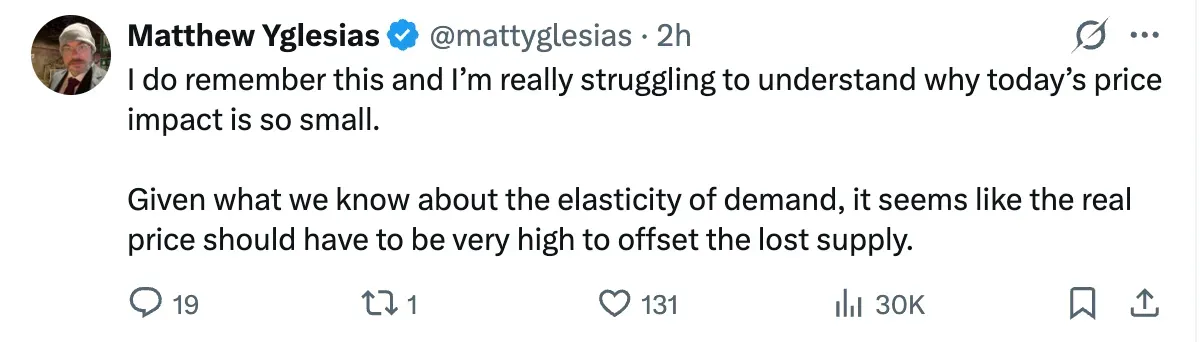
Meanwhile, Bloomberg columnist Matthew Yglesias responded to Furman’s post, saying he could not understand why today’s oil price impact is small in comparison. “Given what we know about the elasticity of demand, it seems like the real price should have to be very high to offset the lost supply,” he said.
Market Movement
Meanwhile, U.S. stock markets declined sharply on Wednesday after Federal Reserve Chair Jerome Powell flagged short-term inflation concerns over the rising oil prices and uncertainty due to the ongoing war. The Dow Jones Industrial Average fell to its lowest level this year.
U.S. equities continued to decline in Wednesday’s extended trading hours. The SPDR S&P 500 ETF (SPY), which tracks the S&P 500 index, was down 0.1% at the time of writing, the Invesco QQQ Trust ETF (QQQ) fell 0.16%, and the SPDR Dow Jones Industrial Average ETF Trust (DIA) fell 0.17%.
Retail sentiment around the S&P 500 ETF on Stocktwits was in the ‘extremely bearish’ territory.
Meanwhile, the United States Oil Fund LP (USO) was up 0.79% in after-hours trading at the time of writing, after having closed up 2.38% on Wednesday.
For updates and corrections, email newsroom[at]stocktwits[dot]com.

Latest News
/filters:format(webp)https://news.stocktwits-cdn.com/large_Getty_Images_2227931237_jpg_256cbfd026.webp)
/filters:format(webp)https://st-everywhere-cms-prod.s3.us-east-1.amazonaws.com/unnamed_jpg_9dff551b50.webp) Anan Ashraf·1h ago
Anan Ashraf·1h ago/filters:format(webp)https://news.stocktwits-cdn.com/large_Getty_Images_2233660867_jpg_2fb83a8353.webp)
/filters:format(webp)https://news.stocktwits-cdn.com/Aashika_Suresh_Profile_Picture_jpg_2acd6f446c.webp) Aashika Suresh·2h ago
Aashika Suresh·2h ago/filters:format(webp)https://news.stocktwits-cdn.com/large_rocketlab_CEO_OG_jpg_27083e216d.webp)
/filters:format(webp)https://st-everywhere-cms-prod.s3.us-east-1.amazonaws.com/Prabhjote_DP_67623a9828.jpg) Prabhjote Gill·2h ago
Prabhjote Gill·2h ago/filters:format(webp)https://st-everywhere-cms-prod.s3.us-east-1.amazonaws.com/large_stock_rising_resized_f17852d7aa.jpg)
/filters:format(webp)https://news.stocktwits-cdn.com/shivani_photo_jpg_dd6e01afa4.webp) Shivani Kumaresan·2h ago
Shivani Kumaresan·2h ago/filters:format(webp)https://news.stocktwits-cdn.com/large_mohamed_el_erian_jpg_4608eef11b.webp)
/filters:format(webp)https://st-everywhere-cms-prod.s3.us-east-1.amazonaws.com/Rounak_Author_Image_7607005b05.png) Rounak Jain·2h ago
Rounak Jain·2h ago/filters:format(webp)https://news.stocktwits-cdn.com/Getty_Images_2128592313_jpg_e85c91febe.webp)
/filters:format(webp)https://news.stocktwits-cdn.com/vivekkrishnanphotography_58_jpg_0e45f66a62.webp) Arnab Paul·2h ago
Arnab Paul·2h ago