


Advertisement|Remove ads.
RKLB Stock Jumps Overnight: Rocket Lab Is About To Attempt A Mars Maneuver That’s Never Worked Before



- Rocket Lab’s Blue and Gold spacecraft will swing past Earth next month and fire its engines to set course for Mars.
- The company said its mission operations team is rehearsing the maneuver ahead of next month's attempt.
- Rocket Lab is building a replacement propellant-tank dome after a manufacturing issue delayed Neutron’s debut until 2027.
Advertisement|Remove ads.
Shares of Rocket Lab (RKLB) jumped nearly 4% overnight late Tuesday as the company prepared its twin NASA spacecraft for a maneuver next month that it says has never been successfully completed before, using a close pass by Earth to propel them toward Mars.
RKLB stock fell nearly 1% to $50.90 on Tuesday, bringing its October decline to 27% and putting it on track for its worst monthly performance since July.

Rocket Lab Rehearses Mars-Bound Engine Burns
Blue and Gold will swing close past Earth next month and each fire its main engine in a single, continuous burn, using Earth’s gravity to amplify the burn and set course for Mars, Rocket Lab said. “The first multi-spacecraft science mission to Mars is about to make its big move,” the company said on X.
Advertisement|Remove ads.
Rocket Lab designed and built the twin spacecraft for NASA and the University of California, Berkeley’s Space Sciences Laboratory for the Escape and Plasma Acceleration and Dynamics Explorers mission, known as ESCAPADE.
The spacecraft launched last year aboard Blue Origin’s New Glenn rocket. Rather than traveling directly to Mars, they entered a yearlong loiter phase near Earth ahead of their November departure.
“It’s a maneuver that’s never been successfully done before,” Rocket Lab said, adding that its mission operations team was rehearsing the trans-Mars injection — the engine burns that will put the spacecraft on course for Mars.
Advertisement|Remove ads.
Rocket Lab-Built Twins To Study Mars
The spacecraft are expected to reach Mars in September next year, then adjust and synchronize their orbits ahead of science operations.
Their mission is to investigate how the solar wind strips material from Mars’ upper atmosphere, helping scientists understand the processes that transformed the planet’s climate.
Using two spacecraft will let researchers measure plasma and magnetic fields from different locations, providing a broader picture of how Mars interacts with the solar wind. Built and tested at Rocket Lab’s Long Beach, California, facility, Blue and Gold are based on its Explorer spacecraft platform. They incorporate company-built components including solar panels, star trackers, reaction wheels, radios and propulsion tanks.
Advertisement|Remove ads.
Neutron Progress In Focus After Manufacturing Setback
Meanwhile, Rocket Lab is working through a manufacturing setback that pushed Neutron’s first flight into 2027, with production underway on a replacement dome for the rocket’s first-stage propellant tank.
CEO Peter Beck said inspectors found tiny air pockets between carbon-fiber layers in thicker sections of the original forward dome. Such defects can compromise the component’s strength and reliability. “Possible success isn’t our standard,” Beck said, explaining why they investigated.
Rocket Lab reproduced the issue in testing and revised its manufacturing process. Beck said the updated process produced the company’s highest-quality aft dome to date, giving the team confidence to build the replacement forward dome.
Advertisement|Remove ads.
The company said its automated fiber placement machine lays carbon-fiber strands onto custom molds at speeds up to 100 meters per minute. The replacement must still be cured, or hardened, and inspected before the first stage is assembled and tested under pressure and at extremely low temperatures.
“In the meantime I’d rather show you real-time progress than give you a date that I might have to walk back,” Beck said. He also highlighted customer demand: “There’s significant demand for what Neutron has to offer, including some new contracts we’ll be able to talk about soon.”
Rocket Lab Readies Electron Mission
As for the most immediate catalyst, Electron completed its wet dress rehearsal for “We’re Not Hawking Around,” a dedicated HawkEye 360 mission with a launch window scheduled to open Wednesday at 3 a.m. EDT from New Zealand.
Advertisement|Remove ads.
The rehearsal involves loading propellant and practicing the countdown, stopping before engine ignition to check launch-day systems and procedures. The mission will deploy three Hawk satellites into a 520-kilometer low Earth orbit. Operating in clusters of three, the satellites collect radio-frequency signals for applications including maritime tracking, navigation-jamming detection and radar monitoring.
Two iQPS launches are scheduled next, no earlier than Nov. 4 and Nov. 10, bringing Electron closer to its 100th flight.
How Do Retail Traders Feel About RKLB?
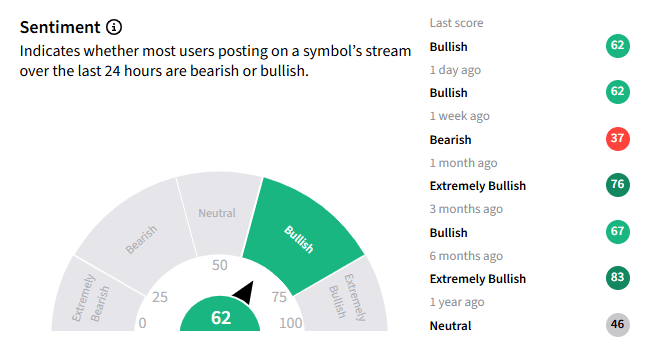
On Stocktwits, retail sentiment for RKLB jumped to ‘bullish’ from ‘bearish’ levels a week ago amid a 96% rise in 24-hour message volumes.
Advertisement|Remove ads.
One user noted, “$RKLB first time I’ve seen this over the 200SMA in the 15 min chart in a while… fingers crossed”
Another user said, “$RKLB calling the bottom here for another run to 70s. I'm batting 100% this month so that means I'm definitely wrong.”
Advertisement|Remove ads.
RKLB stock has declined 27% year-to-date.
For updates and corrections, email newsroom[at]stocktwits[dot]com.
Advertisement|Remove ads.
Comments posted here will also appear on symbol pages.

Latest News

 Deepti Sri·28m ago

 Aashika Suresh·35m ago
 Deepti Sri·59m ago

 Shivani Kumaresan·1h ago
 Deepti Sri·2h ago
 Aashika Suresh·2h ago