


Advertisement|Remove ads.
Tesla Stock Slips Premarket: Cybertruck Recall And Brutal China Sales Slump Rattle Investors


- Tesla sold 25,956 vehicles in China during April, down 10% from the previous year.
- The EV giant's share of China’s overall new-energy vehicle market dropped to 3%, the weakest level since November 2025.
- Tesla’s Shanghai factory exported over 53,000 vehicles during April, helping total China wholesale deliveries reach nearly 79,500 units for the month.
Advertisement|Remove ads.
Shares of Tesla, Inc. (TSLA) slipped 1% in premarket trading on Monday as the EV maker faced fresh Cybertruck and software recalls, while its China retail sales and market share continued losing ground to aggressive domestic rivals.
TSLA stock logged its second straight week of gains, surging 10% last week.
Cybertruck, Software Recalls Add Pressure
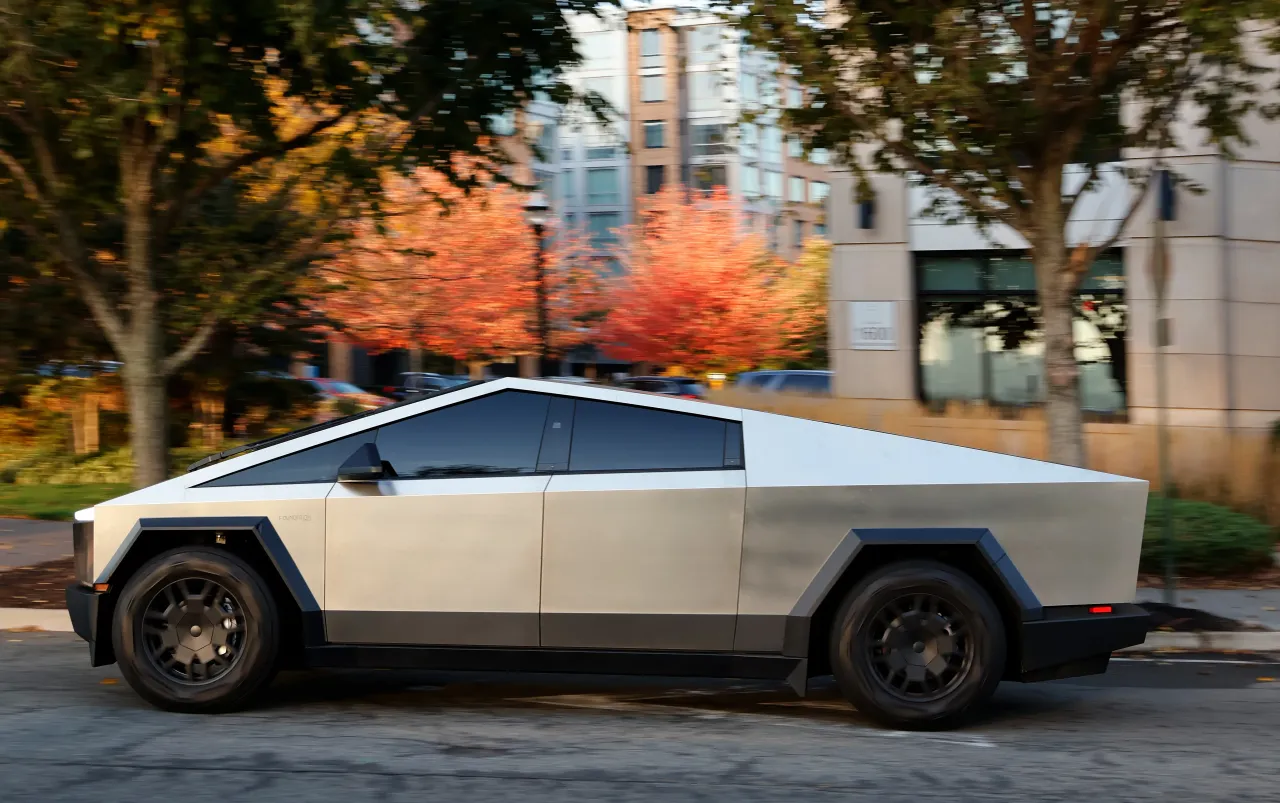
The automaker recently recalled 173 Tesla Cybertruck vehicles from model years 2024 through 2026 because of concerns on wheel hub components. According to the U.S. National Highway Traffic Safety Administration, stress from rough roads or aggressive cornering can cause cracking in the rotor near the wheel stud. In more severe cases, the wheel stud could separate from the hub, potentially affecting steering control and increasing crash risk.
Advertisement|Remove ads.
Tesla said it will replace the affected brake rotors, hubs and lug nuts with upgraded components free of charge. Separately, the company also recalled more than 200,000 Tesla Model Y, Tesla Model S, Tesla Model X and Tesla Model 3 vehicles because of a software issue that could temporarily disable the rearview camera display. Regulators said that the issue could reduce driver visibility while reversing, raising the likelihood of a collision.
Domestic Weakness Overshadowed By Export Boom
Tesla sold 25,956 vehicles in China during April, down 10% from a year earlier and also lower than March levels, according to data released by the China Passenger Car Association. The drop marked the company’s second straight month of annual retail-sales declines in the country, according to a report by CnEVPost.
The slowdown also chipped away at Tesla’s position in China’s competitive EV market. Tesla’s share of the country’s total new-energy vehicle (NEV) retail market fell to 3% in April, its weakest level since November 2025. In battery-electric vehicles specifically, Tesla’s market share slid to 4%.
Advertisement|Remove ads.
The weak retail numbers contrasted with Tesla’s exports out of Shanghai. The company shipped over 53,000 vehicles overseas in April, marking one of the strongest export months ever for the factory. Including exports, Tesla China’s wholesale deliveries hit nearly 79,500 vehicles for the month.
While local competition continues intensifying inside China, Tesla’s Shanghai plant remains a major production and export base serving Europe and other international markets. Tesla also tweaked financing offers in China recently as it attempts to drive domestic demand. The company removed a long-term low-interest financing option, while keeping zero-interest loans for shorter periods.
BYD Pressure Continues To Build
China’s EV market has become far more crowded over the past year, with domestic manufacturers pushing aggressively into both pricing and technology. BYD remains Tesla’s biggest rival in the region, while companies linked to Xiaomi and Huawei are also expanding rapidly with software-heavy vehicle platforms. Last month, Ford CEO Jim Farley called BYD the benchmark competitor in China from a manufacturing and cost perspective.
Advertisement|Remove ads.
However, Tesla CEO Elon Musk argued that Tesla’s biggest limitation in China was based more on Full Self-Driving (FSD) approvals and production constraints than demand itself. “This is before supervised FSD is approved in China,” Musk said. “Limiting factor is production output in Shanghai.”
Chinese automakers have increasingly bundled advanced driver-assistance systems into lower-cost vehicles, often without charging extra software fees, creating additional pressure on Tesla’s premium-priced FSD strategy in the region.
FSD Rollout And Supply Chain Risks In Focus
Tesla has continued laying groundwork for a broader supervised FSD rollout in China, though regulators have not yet granted full approval. Earlier this year, Tesla China Vice President Grace Tao said that the company established a local training center to better adapt the system to Chinese roads and driving behavior.
Advertisement|Remove ads.
Meanwhile, geopolitical tensions between Washington and Beijing have also influenced Tesla’s supply-chain strategy. A Wall Street Journal report last year said that Tesla accelerated plans to reduce the use of China-made components in vehicles built for the U.S. market as tariffs and trade tensions escalated.
Despite the recent pressure in China, Tesla still reclaimed the global battery-electric vehicle delivery lead during the first quarter of 2026, delivering more fully electric vehicles worldwide than BYD.
How Do Retail Traders Feel About TSLA?
On Stocktwits, retail sentiment for TSLA was ‘bullish’ amid ‘normal’ message volume.
Advertisement|Remove ads.

One user said, “Momentum is building, with a clean trendline break off 100WMA support. Though its premium valuation versus the rest of the Mag7 may cap follow-through. It favors more of a quick trade than a long hold, at least until valuations normalize.”
Another user questioned, “for every dollar you pay as an investor, Tesla P/E is saying it will produce $390 in revenue. Can they do that? Automobile margins are around 16-18%, robots and robotaxi is “speculation” at best.”
Advertisement|Remove ads.
So far this year, TSLA stock has lagged several “Magnificent Seven” peers, making it the group’s third-worst performer, with a 5% decline.
For updates and corrections, email newsroom[at]stocktwits[dot]com.
Advertisement|Remove ads.
Read Next: MRNA, INO, SABS, NVAX Stocks Jump Premarket: Deadly Hantavirus Reaches US After Cruise Ship Outbreak
Comments posted here will also appear on symbol pages.

Latest News
/filters:format(webp)https://news.stocktwits-cdn.com/large_viking_jpg_7a4076836e.webp)
/filters:format(webp)https://news.stocktwits-cdn.com/unnamed_jpg_9dff551b50.webp) Anan Ashraf·11m ago
Anan Ashraf·11m ago/filters:format(webp)https://news.stocktwits-cdn.com/Getty_Images_2250240969_jpg_dd9be8c5ea.webp)
/filters:format(webp)https://news.stocktwits-cdn.com/1707726834303_jpg_11f20a9aa9.webp) Shashank Nayar·18m ago
Shashank Nayar·18m ago/filters:format(webp)https://news.stocktwits-cdn.com/large_Getty_Images_2288749409_c861154814.jpg) Shashank Nayar·1h ago
Shashank Nayar·1h ago/filters:format(webp)https://news.stocktwits-cdn.com/large_Getty_Images_1315792134_ab6fe92231.jpg) Anan Ashraf·2h ago
Anan Ashraf·2h ago/filters:format(webp)https://news.stocktwits-cdn.com/large_Getty_Images_2201667454_jpg_2f4f6cc4ac.webp) Shashank Nayar·2h ago
Shashank Nayar·2h ago/filters:format(webp)https://news.stocktwits-cdn.com/large_Getty_Images_2285062936_jpg_bdb92d3f40.webp) Shashank Nayar·3h ago
Shashank Nayar·3h ago