


Advertisement|Remove ads.
Treasury Yields Are Back Near 2007 Highs, Raising Fresh Market Fears – And Analysts Warn Bond Selloff Isn’t Done Yet


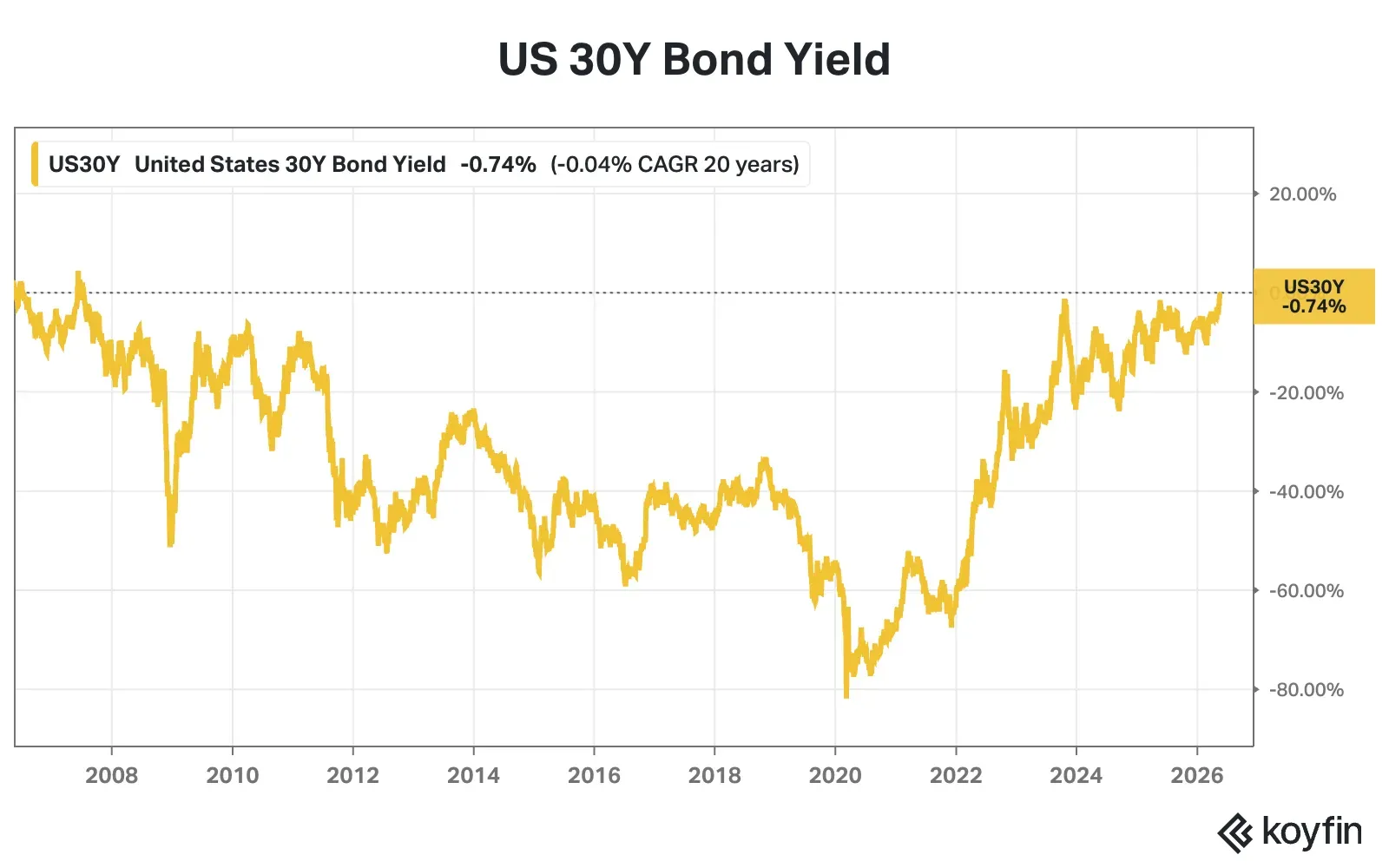
- The 30-year Treasury yield closed at 5.12% last week, near its highest level since 2007.
- Guneet Dhingra, head of U.S. rates strategy at BNP Paribas, reportedly said that once 30-year yields broke above 5%, the market effectively lost a clear ceiling.
- Veteran investor Peter Schiff has also warned that traders may still be underestimating how high both oil prices and bond yields could climb.
Advertisement|Remove ads.
The sharp selloff in U.S. government bonds may be far from over, according to market experts, as Treasury yields near levels last seen in 2007.
The 30-year Treasury yield closed at 5.12% last week, near its highest level since 2007. The 20-year Treasury yield also climbed to roughly 5.145%, underscoring mounting pressure across the long end of the bond market.

"The question going forward is: will guys really buy here because I believe this (selloff) will continue to persist," said Padhraic Garvey, head of global rates and debt strategy at ING, as per a Reuters report.
Advertisement|Remove ads.
“We’re probably headed to 4.75% in the next round,” Garvey added, warning that even a modest rise in long-term inflation expectations could drive yields another 10 to 30 basis points higher “very easily.” The benchmark 10-year Treasury yield rose to around 4.62% late Monday.
Analysts Expect Further Pressure
Wall Street analysts have cited recent hotter-than-expected inflation readings amid the Iran war, rising oil prices, and massive fiscal deficits for the ongoing pressure in the bond market. Economist Steve Hanke noted these factors for higher yields across the world in a post on X, adding that “bond vigilantes are riding again.”
Other market veterans are also warning that traditional buyers of U.S. debt are no longer providing the same stabilizing force. Guneet Dhingra, head of U.S. rates strategy at BNP Paribas, reportedly said that once 30-year yields broke above 5%, the market effectively lost a clear ceiling, while in the past, certain levels tended to act as barriers.
Advertisement|Remove ads.
"Now that we have no anchor, what stops bond yields from going up in a world of high inflation, ever-rising deficits, and global bond yield pressure?" Dhingra said, as per Reuters.
Meanwhile, Gregory Peters, co-chief investment officer at PGIM Fixed Income, reportedly said that although elevated Treasury yields appear attractive, he remains wary of long-dated government bonds. As per a Bloomberg report, Peters noted, “The global bond market is in disarray as investors are losing confidence.”
Veteran investor Peter Schiff has also warned that traders may still be underestimating how high both oil prices and bond yields could climb.
Advertisement|Remove ads.
Rate Hike Expectations
Amid rising bond yields and growing inflationary pressures, some market participants are expecting the Federal Reserve to move toward a rate hike rather than a rate cut.
Ed Yardeni, President of Yardeni Research, reportedly said he believes the Fed is “likely” to raise key borrowing rates by a quarter of a percentage point as soon as July. Market commentary service The Kobeissi Letter also said that interest rate futures are increasingly signaling that the Fed’s next policy move could be a rate increase rather than a cut. The firm added that markets see the odds of the Fed lowering interest rates before July 2027 to be minimal.
Meanwhile, U.S. equities were down in Monday’s overnight trading. The SPDR S&P 500 ETF (SPY), which tracks the benchmark S&P 500 index, was down 0.34% at the time of writing, while the Invesco QQQ Trust (QQQ), which mirrors the Nasdaq 100, fell 0.54%, and the SPDR Dow Jones Industrial Average ETF (DIA) declined 0.21%.
Advertisement|Remove ads.
The iShares 20+ Year Treasury Bond ETF (TLT) was also down 0.14% at the time of writing, while the Rbb Fund Inc. US Treasury 30 Year Bond ETF (UTHY) was up 0.13%.
Retail sentiment around SPY on Stocktwits was in the ‘extremely bullish’ territory and for TLT, it was in the ‘bearish’ territory.
For updates and corrections, email newsroom[at]stocktwits[dot]com.
Advertisement|Remove ads.
Comments posted here will also appear on symbol pages.

Latest News
/filters:format(webp)https://news.stocktwits-cdn.com/large_Getty_Images_2219723511_103fa4d061.jpg)
/filters:format(webp)https://news.stocktwits-cdn.com/unnamed_jpg_9dff551b50.webp) Anan Ashraf·1h ago
Anan Ashraf·1h ago/filters:format(webp)https://news.stocktwits-cdn.com/datadog_resized_jpg_20b6f8ccc0.webp)
/filters:format(webp)https://news.stocktwits-cdn.com/1707726834303_jpg_11f20a9aa9.webp) Shashank Nayar·2h ago
Shashank Nayar·2h ago/filters:format(webp)https://news.stocktwits-cdn.com/large_Getty_Images_2296204406_1dce30a7be.jpg) Shashank Nayar·3h ago
Shashank Nayar·3h ago/filters:format(webp)https://news.stocktwits-cdn.com/large_musk_adc78b164e.jpg) Anan Ashraf·3h ago
Anan Ashraf·3h ago/filters:format(webp)https://st-everywhere-cms-prod.s3.us-east-1.amazonaws.com/large_pepsico_resized_jpg_9bdd1807dd.webp)
/filters:format(webp)https://news.stocktwits-cdn.com/Heera_1_1c30cb0170.PNG) Heera Hari·4h ago
Heera Hari·4h ago/filters:format(webp)https://news.stocktwits-cdn.com/large_ionis_jpg_80195eb65e.webp)
/filters:format(webp)https://news.stocktwits-cdn.com/vivekkrishnanphotography_58_jpg_0e45f66a62.webp) Arnab Paul·4h ago
Arnab Paul·4h ago