


Advertisement|Remove ads.
TSLA Stock Reverses After-Hours Gains As Tesla Cuts Full-Year Capex Guidance To $20B, Musk Tempers Optimus Timeline


- CFO Vaibhav Taneja said Tesla is revising full-year capital expenditure guidance to approximately $20 billion for the current year “as a result of managing our capital deployment efficiently.”
- Musk now expects it will take “probably at least a year, maybe a little longer,” to reach an annualized rate of 20,000 units of Optimus a week.
- Tesla’s FSD is approved in many European countries, and the company is now hoping for EU-wide approval within a few months, Musk said, later than its previous estimate of October.
Advertisement|Remove ads.
Shares of Tesla (TSLA) reversed earlier after-hours gains and turned lower during the company’s third-quarter earnings call on Wednesday after management cut its full-year capital expenditure guidance to about $20 billion from more than $25 billion and outlined a still-measured timeline for scaling the Optimus robot.

The stock edged up 2% after hours immediately after the company’s earnings report before paring gains and was trading 4% lower at the time of writing. The electric-vehicle maker posted revenue of $28.0 billion, compared to an analyst estimate of $28.3 billion, and adjusted earnings of $0.48 per share, against an expected EPS of $0.45, for the period ended September 30. Both revenue and earnings, however, dropped from the corresponding quarter of 2025.
Advertisement|Remove ads.
Revised Capex Guidance And Cash Outlook
CFO Vaibhav Taneja said Tesla is revising full-year capital expenditure guidance to approximately $20 billion for the current year “as a result of managing our capital deployment efficiently.” The company had previously pinned full-year capex estimate at $25 billion.
The company secured capacity to borrow up to $30 billion to support expected growth in CapEx but “do not plan to make any draws under any of the new facilities in this calendar year,” he said. CEO Elon Musk had previously described 2026 as “a massive capex year” but expressed confidence that the investments would deliver “the best capex returns that we’ve ever seen.”
Taneja, however, noted that CapEx for the next few years will continue to expand as Tesla scales its Robotaxi fleet, expands Optimus production, installs solar manufacturing capacity, purchases additional superintelligence compute infrastructure, and builds a semiconductor fab. Tesla ended Q3 with positive free cash flow of over $1.5 billion and an overall cash and investment balance of over $45 billion.
Advertisement|Remove ads.
Optimus Production And Timeline
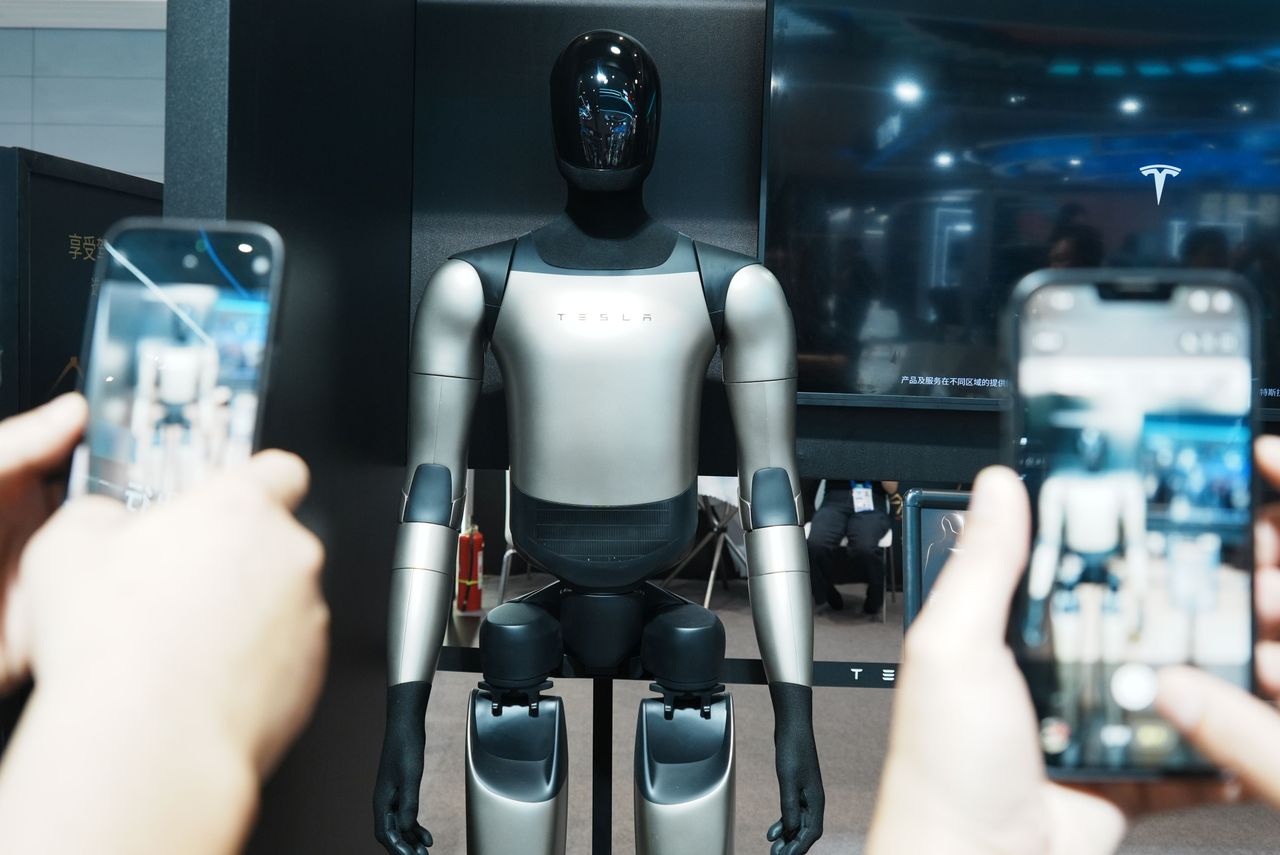
Musk said Tesla has begun early production of its humanoid robot Optimus on a high-volume line in Fremont. He reiterated that Optimus growth follows an S-curve whose initial phase has “a shallow slope and is somewhat bumpy.” Musk expects it will take “probably at least a year, maybe a little longer,” to reach an annualized rate of 20,000 units a week.
He anticipates key issues will be solved “around the end of next year,” around the timeframe for delivering Optimus to external customers.
FSD And Autonomy Progress
Tesla’s full self-driving driving assistance software is approved in many European countries, and the company is now hoping for EU-wide approval within a few months, Musk said, while adding that he “would be surprised if it takes longer than Q1.” The company had previously pinned EU-wide approval for October.
Advertisement|Remove ads.
On Robotaxi, Musk said fully autonomous miles are scaling “extremely fast” week-over-week after the company launched its dedicated robotaxi offering called the Cybercab, with no steering wheel or pedals, in Austin earlier this quarter.
Tesla VP of AI software Ashok Elluswamy said that the company intends to introduce the Cybercab into Dallas next, where Model Y vehicles are already providing robotaxi services in select areas. Taneja added that the company sees a path to charge just $0.30 per mile for its robotaxi services as it scales operations.
Elluswamy also said the company suspects it can turn on unsupervised driving on consumer cars, allowing them to operate as part of the robotaxi fleet, somewhere around Q2 next year. Musk has previously envisioned a conjoined operating system for Tesla robotaxi network where Tesla owns a portion of the fleet and car owners can lend their vehicles to the network when they do not need them for additional income.
Advertisement|Remove ads.
On Stocktwits, retail sentiment around TSLA fell from 'bullish' to 'neutral' territory over the past 24 hours, while message volume stayed at 'high' levels.
TSLA stock has dropped 14% year-to-date.
Advertisement|Remove ads.
For updates and corrections, email newsroom[at]stocktwits[dot]com.
Comments posted here will also appear on symbol pages.

Latest News
 Anan Ashraf·52m ago
 Anan Ashraf·1h ago
 Shashank Nayar·2h ago
 Shashank Nayar·3h ago
 Anan Ashraf·3h ago
 Shashank Nayar·3h ago