


Advertisement|Remove ads.
TSLA Stock Slides Premarket: Australian Judge Warns Tesla Of ‘Really Bad Time’ As Robotaxi Worries Mount


- An Australian federal judge warned Tesla it could face “a really bad time” if it failed to cooperate properly in a class-action lawsuit.
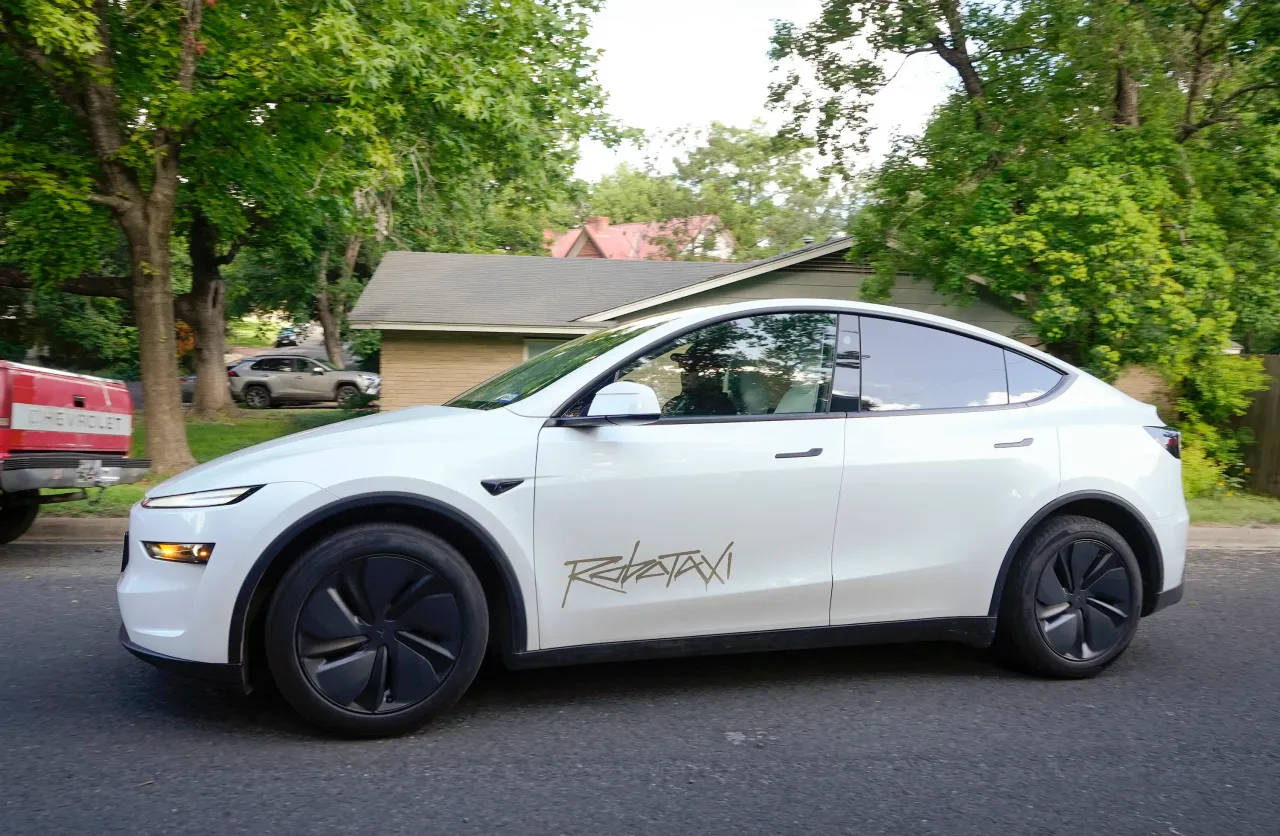
- Tesla’s robotaxi network remains limited in scale, with 50 vehicles operating in Austin compared with more than 250 deployed by Waymo in the city.
- Musk recently said Tesla was taking a “very cautious” approach to its robotaxi rollout, focused on “rigorous validation.”
Advertisement|Remove ads.
Shares of Tesla, Inc. (TSLA) fell over 2% in premarket trading on Friday after the EV maker faced fresh courtroom pressure in Australia just days after renewed concerns surfaced around its robotaxi operations in Texas.
TSLA stock is headed for its third straight week of gains, rising over 3% so far this week.
Tesla Faces Australia Court Heat
An Australian federal judge warned Tesla it could face “a really bad time” if the company failed to improve cooperation in a class-action lawsuit accusing the automaker of overstating self-driving capabilities, battery range and phantom-braking performance, Reuters noted.
Advertisement|Remove ads.
The comments came during a hearing on a lawsuit involving 10,000 Tesla drivers. Lawyers representing the plaintiffs argued that the company had delivered only a small fraction of the requested material despite months of discovery proceedings.
Justice Tom Thawley openly questioned whether Tesla had approached the process seriously, calling the scale of disclosures “gobsmacking,” expressing frustration over the pace of document production. Tesla defended its handling of the process, saying that it had already reviewed a massive volume of internal records and remained concerned about disclosing sensitive information, including engineering data and the identities of individuals involved in the case.
The court ordered Tesla to complete discovery by the end of July ahead of another hearing scheduled on Sept. 1.
Advertisement|Remove ads.
Tesla’s Robotaxi Push Hits Speed Bumps
The legal clash comes amid rising troubles for Tesla’s broader autonomous-driving ambitions. Earlier this week, Reuters reported that recent robotaxi test rides in Dallas, Houston and Austin highlighted operational issues including long wait times, repeated ride unavailability, incorrect drop-off points and navigation difficulties.
The rollout was initially viewed by bullish investors as proof that Tesla was accelerating the realization of CEO Elon Musk’s long-promised robotaxi vision. Instead, the experiences altered expectations, making it seem that the service still resembles a tightly controlled beta program rather than a scalable commercial network.
Some riders reportedly waited over half an hour for a vehicle, while others encountered canceled rides or lengthy detours on simple routes. In multiple cases, the robotaxis avoided highways entirely and relied heavily on slower surface streets. Austin, Tesla’s longest-running robotaxi market, also appeared far smaller in scale than rivals. Tesla reportedly operated about 50 robotaxis in the city, compared with more than 250 vehicles deployed by Waymo.
Advertisement|Remove ads.
Tesla Takes ‘Very Cautious’ Robotaxi Approach
During Tesla’s recent earnings call, Musk said the main constraint on robotaxi expansion was “rigorous validation” and making sure the system is “completely safe,” adding that Tesla was taking a “very cautious” approach since it did not want “a single accidental injury.”
That caution is increasingly showing up in the real-world rollout. Tesla’s robotaxi service remains limited to Austin, Dallas and Houston despite Musk previously predicting the service could reach half the U.S. population by the end of 2025. On the latest earnings call, Musk instead said Tesla could expand into “a dozen or so states” by the end of 2026.
How Do Retail Traders Feel About TSLA?
On Stocktwits, retail sentiment for TSLA was ‘bullish’ amid ‘high’ message volume.
Advertisement|Remove ads.

One user said, “yields are up. Not looking too good tomorrow. Expect a short-term correction near the $414 level.”
Another user noted that “Tesla has a major AI advantage in autonomous driving because it trains on massive amounts of real-world video and driving behavior data collected from its vehicle fleet, unlike many AI models that primarily rely on text and static datasets.”
Advertisement|Remove ads.
So far this year, TSLA stock has lagged several of its “Magnificent Seven” peers, making it the group’s third-worst performer, with a 1% decline.
For updates and corrections, email newsroom[at]stocktwits[dot]com.
Advertisement|Remove ads.
Comments posted here will also appear on symbol pages.

Latest News
/filters:format(webp)https://news.stocktwits-cdn.com/large_mrna_100157676a.jpg)
/filters:format(webp)https://news.stocktwits-cdn.com/shivani_photo_jpg_dd6e01afa4.webp) Shivani Kumaresan·32m ago
Shivani Kumaresan·32m ago/filters:format(webp)https://news.stocktwits-cdn.com/large_Getty_Images_2252639150_jpg_443c4f690e.webp)
/filters:format(webp)https://news.stocktwits-cdn.com/IMG_9209_1_d9c1acde92.jpeg) Yuvraj Malik·41m ago
Yuvraj Malik·41m ago/filters:format(webp)https://news.stocktwits-cdn.com/large_Getty_Images_2225993272_jpg_c03859cabc.webp)
/filters:format(webp)https://news.stocktwits-cdn.com/Aashika_Suresh_Profile_Picture_jpg_2acd6f446c.webp) Aashika Suresh·43m ago
Aashika Suresh·43m ago/filters:format(webp)https://news.stocktwits-cdn.com/large_pharma_stocks_jpg_b9a7aa0ef7.webp)
/filters:format(webp)https://news.stocktwits-cdn.com/IMG_8805_JPG_6768aaedc3.webp) Deepti Sri·1h ago
Deepti Sri·1h ago/filters:format(webp)https://news.stocktwits-cdn.com/large_Getty_Images_2259661360_jpg_dfabfb9ee4.webp) Shivani Kumaresan·1h ago
Shivani Kumaresan·1h ago/filters:format(webp)https://news.stocktwits-cdn.com/large_iren_OG_jpg_ba842dd11a.webp) Yuvraj Malik·2h ago
Yuvraj Malik·2h ago