


Advertisement|Remove ads.
TWLO Stock On Track To Post Worst Single-Day Performance In Over A Year, Drops To 3-Month Low: CEO Says Long-Term 'Tailwinds Are Intact'



- Shipchandler estimated that voice AI has reached just 1% penetration of customer voice interactions, leaving room for wider adoption.
- He said Twilio aims to benefit from AI adoption by supplying communications infrastructure to AI companies rather than competing at the application layer.
- The CEO added that Twilio’s AI agent identity product is in private beta, though he does not expect it to become a significant revenue contributor next year.
Advertisement|Remove ads.
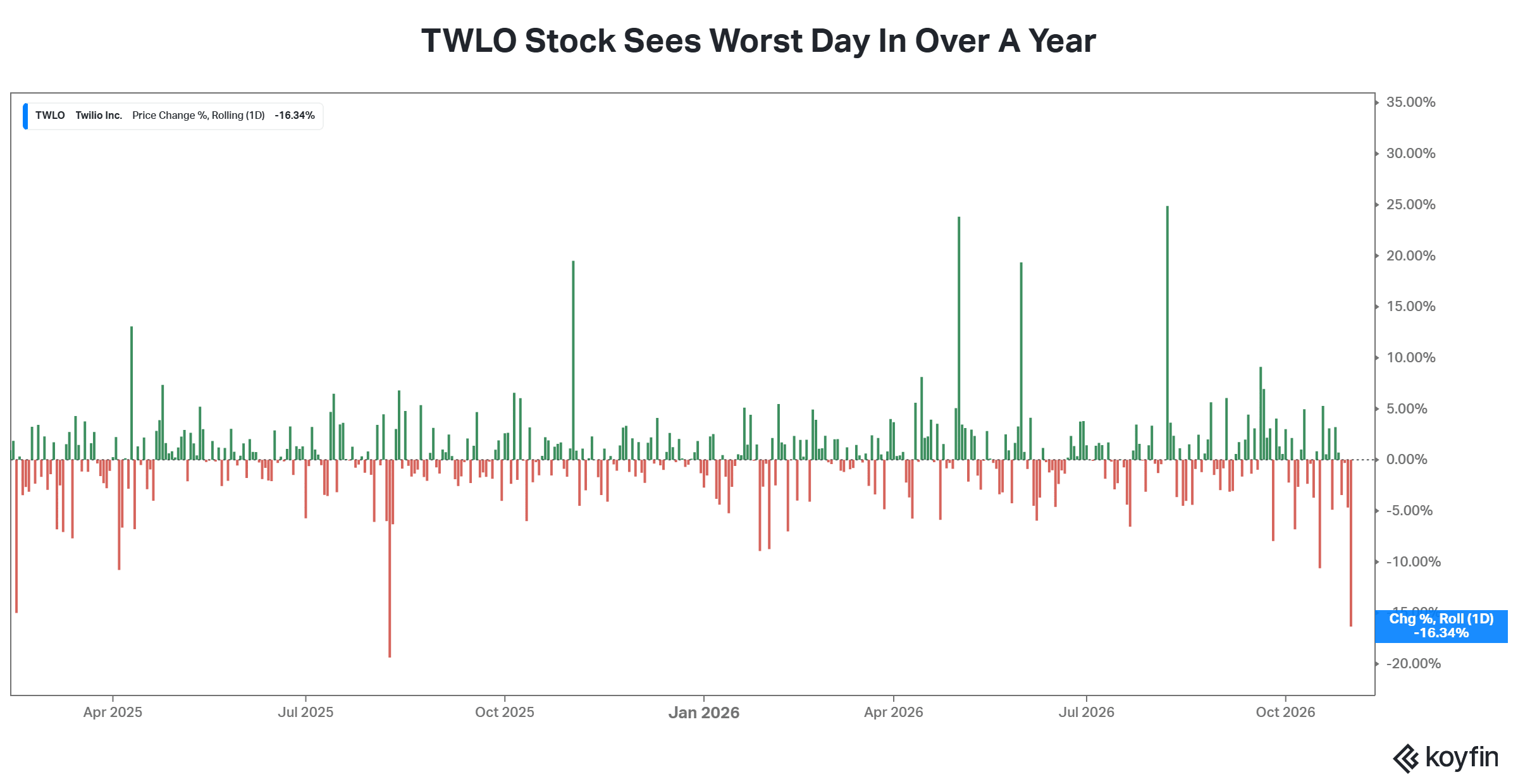
Twilio (TWLO) shares were on track to log their worst day in over a year, dropping to three-month lows, on Friday despite the company reporting third-quarter results that beat estimates on both earnings and revenue.
In an interview with CNBC, CEO Khozema Shipchandler shrugged off the drop in share price, stating that the communications platform’s long-term growth drivers remain in place.

“I think the long-term and very secular tailwinds here are intact,” he said, pointing to demand from AI agents that talk to customers by voice, email and text.
Advertisement|Remove ads.
TWLO stock dropped over 16% in midday trade. On Stocktwits, retail sentiment around the company shifted to ‘bullish’ from ‘neutral’ territory over the past day, and chatter rose to ‘high’ from ‘normal’ levels.
Twilio CEO Sees Long-Term Opportunity In Voice AI
Shipchandler said Twilio’s usage-based business model makes revenue harder to forecast than a fixed subscription model because customers pay according to how much they use its services, including the number of calls and messages they send.
“I mean, it’s a usage-based business model, so there’s always like some degree of inherent conservatism in terms of the way that we think about things,” he said.
Advertisement|Remove ads.
According to him, voice AI remains in its early stages, leaving room for adoption to expand. “I mean, voice AI, if you think about it, is 1% penetrated in terms of voice interactions that customers are having,” he said. “Consumer AI basically just got started a few weeks ago, I think both of those represent longer-term structural tailwinds.”
Twilio Sells The Infrastructure Behind AI Agents
Shipchandler said companies building AI agents need communications infrastructure to connect with consumers. According to him, this puts Twilio at an advantage, since the firm provides programmable voice and messaging capabilities rather than developing AI models or consumer-facing applications itself.
“What every one of these companies that’s in the voice AI space is putting out there is these AI agents who end up interacting with consumers. To be able to do that vis-à-vis Twilio, they need voice infrastructure, programmable voice software capabilities to be able to deliver that experience,” he said.
Advertisement|Remove ads.
He noted that Twilio’s position beneath the application layer allows it to serve companies across the AI ecosystem rather than compete directly with them.
Business Adoption Could Take Time
Shipchandler said wider adoption will depend partly on whether businesses accept AI agents interacting with their customer service systems. Consumers may eventually use personal AI agents to wait on hold, contact customer support or handle tasks such as insurance claims, but he expects adoption to be gradual.
“One is that businesses are blocking this stuff, right? So it’s going to take some time in terms of the adoption cycle for businesses to actually accept agents on the other side, being able to call into those businesses,” he said. He added that regulated industries are likely to move last.
Advertisement|Remove ads.
Despite the adoption hurdles, Shipchandler expects both voice AI and consumer AI to create opportunities for Twilio over time. “The technology is very cool to be sure, but I think it’s going to take some time,” he said.
The CEO added that Twilio’s AI agent identity product is in private beta, though he does not expect it to become a significant revenue contributor next year.
Wall Street Cuts TWLO Stock Price Targets
Twilio reported earnings of $1.65 per share, beating the consensus estimate of $1.47 as per Koyfin. Revenue came in at $1.56 billion, ahead of the estimated $1.51 billion.
Advertisement|Remove ads.
However, several analysts cited by TheFly lowered their price targets following Twilio’s results, even as they maintained bullish ratings on the stock.
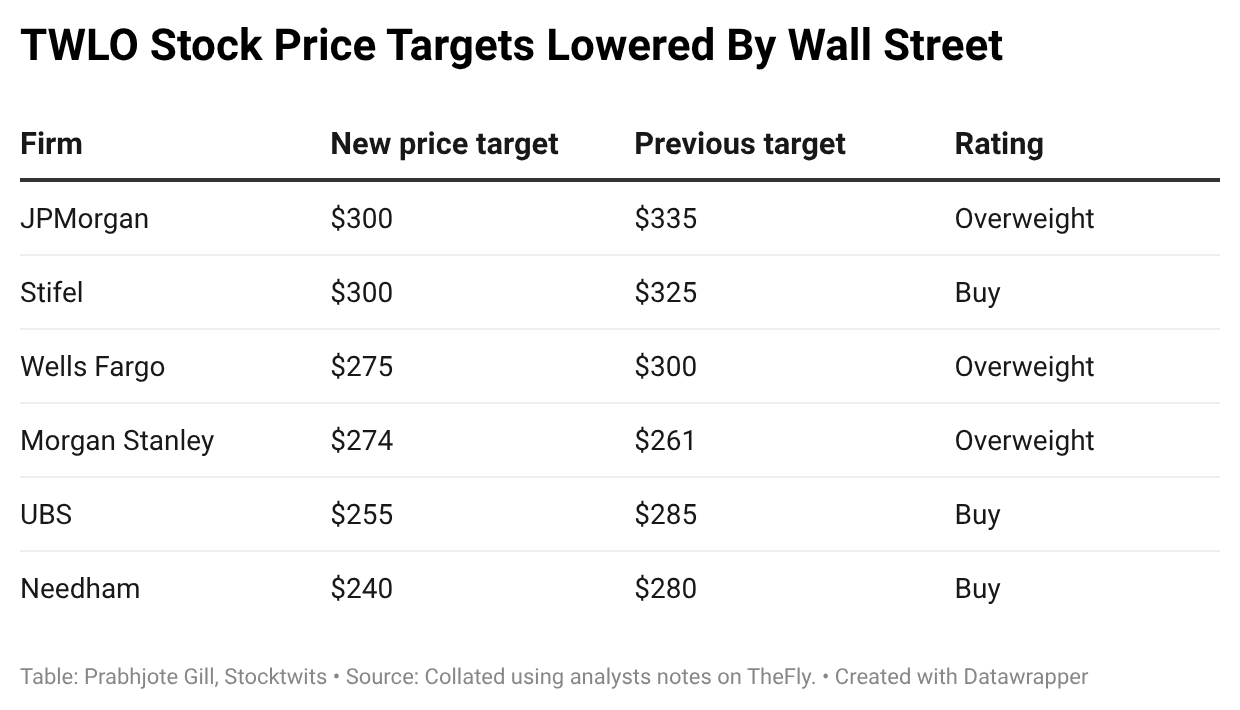
Needham cited overly bullish sentiment ahead of the report and a softer revenue beat for its price target cut, while UBS pointed to slowing organic revenue growth and softer fourth-quarter gross profit guidance.
Wells Fargo said the results were solid, but investors had wanted more upside to organic growth. Meanwhile, Morgan Stanley was an exception, raising its price target to $274 from $261 and maintaining an ‘Overweight’ rating.
Advertisement|Remove ads.
At the time of writing, TWLO stock held onto year-to-date gains of 45% and has climbed over 75% in the last 12 months.
Read also: Dan Ives Says AI Disruption Is ‘On Full Display’ In Tech Earnings, Sees 2027 As Inflection Year
For updates and corrections, email newsroom[at]stocktwits[dot]com.
Advertisement|Remove ads.
Comments posted here will also appear on symbol pages.

Latest News

 Arnab Paul·14m ago

 Prabhjote Gill·57m ago

 Harshita Tyagi·1h ago

 Heera Hari·1h ago
 Prabhjote Gill·2h ago
 Arnab Paul·2h ago