


Advertisement|Remove ads.
US Banking Group Challenges Coinbase’s OCC Approval, Calling It A ‘Grave Mistake’


- The Independent Community Bankers of America called the Office of the Comptroller of the Currency's conditional approval of Coinbase's national trust bank charter application a mistake.
- A national trust bank charter would allow Coinbase to offer custody and trust services under federal oversight.
- Coinbase’s stock was ticking up during the after-hours trading.
Advertisement|Remove ads.
The Independent Community Bankers of America (ICBA) called the Office of the Comptroller of the Currency's (OCC) conditional approval of Coinbase Global Inc.’s (COIN) national trust bank charter application "a grave mistake."
The Washington, DC-based trade group representing thousands of community banks across the United States explained that the application contained significant problems, including “flawed risk and control functions, profitability challenges, and resolution risks,” raising questions about what would happen to customer assets if the company were to fail.
The Office of the Comptroller of the Currency, the federal agency that charters and regulates national banks, had conditionally approved Coinbase's application for a national trust bank charter for its subsidiary, Coinbase National Trust Co, on Thursday.
Advertisement|Remove ads.
A national trust bank charter would allow Coinbase to offer custody and trust services, such as holding assets on behalf of clients, under federal oversight, without being subject to the full range of regulations that apply to traditional Federal Deposit Insurance Corporation (FDIC) insured banks.
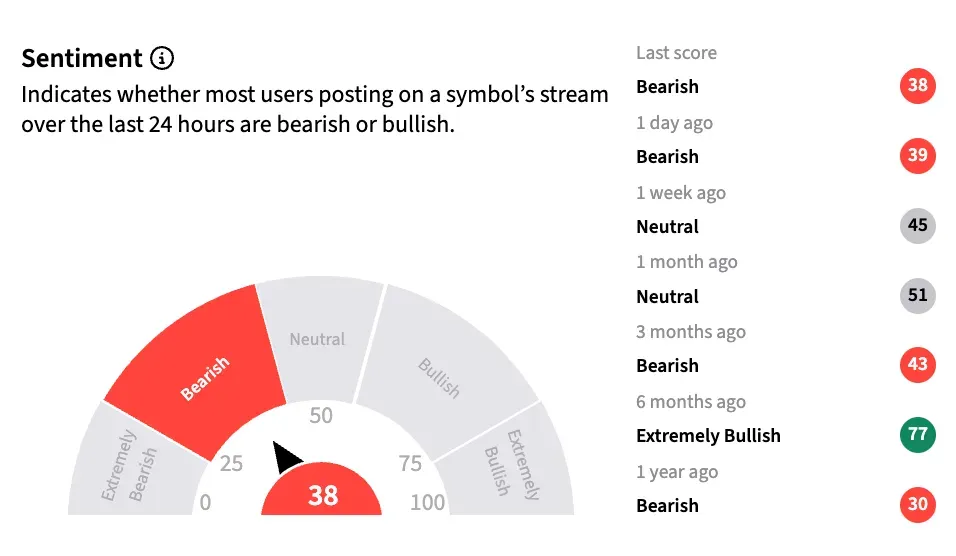
Coinbase’s stock was trading up by 0.02% during after-hours trading, and the stock had closed over $171 on Friday. On Stocktwits, the retail sentiment around COIN remained in the ‘bearish’ zone, while chatter levels around it remained ‘low’ over the past day.
ICBA's Opposition Dates Back To Last Year
This is not the first time the ICBA has pushed back on Coinbase's banking ambitions. In a letter to the OCC filed in November last year, the ICBA formally objected to the application, arguing that Coinbase failed to meet requirements under the National Bank Act and the OCC's own regulations and standards on multiple independent grounds that disqualify it.
Advertisement|Remove ads.
More broadly, the ICBA has argued that the OCC lacked statutory authority to expand non-fiduciary trust powers. This meant that the legal right to offer services beyond traditional trustee roles, and that the surge in charter applications from crypto and fintech companies reflected an attempt to gain the benefits of a U.S. bank charter without meeting the full regulatory burden that traditional banks must satisfy.
Read also: Bitcoin's Chief Cryptographer Adam Back Pushes Back On Google's Quantum Threat Paper
For updates and corrections, email newsroom[at]stocktwits[dot]com.
Advertisement|Remove ads.
Comments posted here will also appear on symbol pages.

Latest News
/filters:format(webp)https://news.stocktwits-cdn.com/large_Seagate_jpg_50a56724b4.webp)
/filters:format(webp)https://news.stocktwits-cdn.com/1707726834303_jpg_11f20a9aa9.webp) Shashank Nayar·32m ago
Shashank Nayar·32m ago/filters:format(webp)https://news.stocktwits-cdn.com/large_Getty_Images_2128530471_1b79e1b428.jpg)
/filters:format(webp)https://news.stocktwits-cdn.com/unnamed_jpg_9dff551b50.webp) Anan Ashraf·41m ago
Anan Ashraf·41m ago/filters:format(webp)https://news.stocktwits-cdn.com/large_qualcomm_jpg_bf257cee94.webp) Shashank Nayar·44m ago
Shashank Nayar·44m ago/filters:format(webp)https://news.stocktwits-cdn.com/large_Getty_Images_1321754803_jpg_a6258004b8.webp)
/filters:format(webp)https://news.stocktwits-cdn.com/Anushka_Basu_make_me_smile_in_the_picture_b92832aa_af59_4141_aacc_4180d2241ba8_1_2_png_1086e0ed8c.webp) Anushka Basu·56m ago
Anushka Basu·56m ago/filters:format(webp)https://news.stocktwits-cdn.com/Boeing_resized_jpg_0f31dda6f6.webp)
/filters:format(webp)https://news.stocktwits-cdn.com/Heera_1_1c30cb0170.PNG) Heera Hari·1h ago
Heera Hari·1h ago/filters:format(webp)https://news.stocktwits-cdn.com/gettyimages_953784846_612x612_63259afd0e.jpg)
/filters:format(webp)https://news.stocktwits-cdn.com/Prabhjote_DP_67623a9828.jpg) Prabhjote Gill·1h ago
Prabhjote Gill·1h ago