


Advertisement|Remove ads.
Citi Sees Markets Underpricing Risk Of Fed Rate Hike In 2026 — Analyst Says 'Inflation May Be Here To Stay'



- Citigroup’s Jim McCormick said that the calculus of U.S. investors in terms of buying the dip on Treasuries has changed.
- McCormick’s comments come amid a surge in 30-year U.S. Treasury yields, which rose by four basis points to 5.19%, the highest level since July 2007.
- Schwab Center for Financial Research’s Michelle Gibley warned that inflation could remain persistent due to higher energy prices and stronger economic growth.
Advertisement|Remove ads.
Citigroup’s Head of Macro Strategist Jim McCormick on Tuesday said that the focus of bond traders will likely move to 5.5% as the new “round number” for 30-year U.S. Treasury yields amid rising inflation concerns.
According to a Bloomberg report, McCormick highlighted that core inflation is showing no signs of slowing, even as the U.S. economy has shown resilience when compared to its developed-market peers.
“I see markets underpricing the risk of a Fed rate hike starting this year,” said McCormick, while adding that the calculus of U.S. investors in terms of buying the dip on Treasuries has changed.
Advertisement|Remove ads.
Data from the CME FedWatch tool shows that the odds of a rate hike during the final Federal Open Market Committee (FOMC) meeting in December this year stood at 41.4%. This is the first instance of the odds of a rate hike being higher than the odds of rates being unchanged.
McCormick’s comments come amid a surge in 30-year U.S. Treasury yields, which rose by four basis points to 5.19%, the highest level since July 2007. The 30-year Treasury yields are more sensitive to political, fiscal, and geopolitical risks when compared to shorter-term Treasurys.
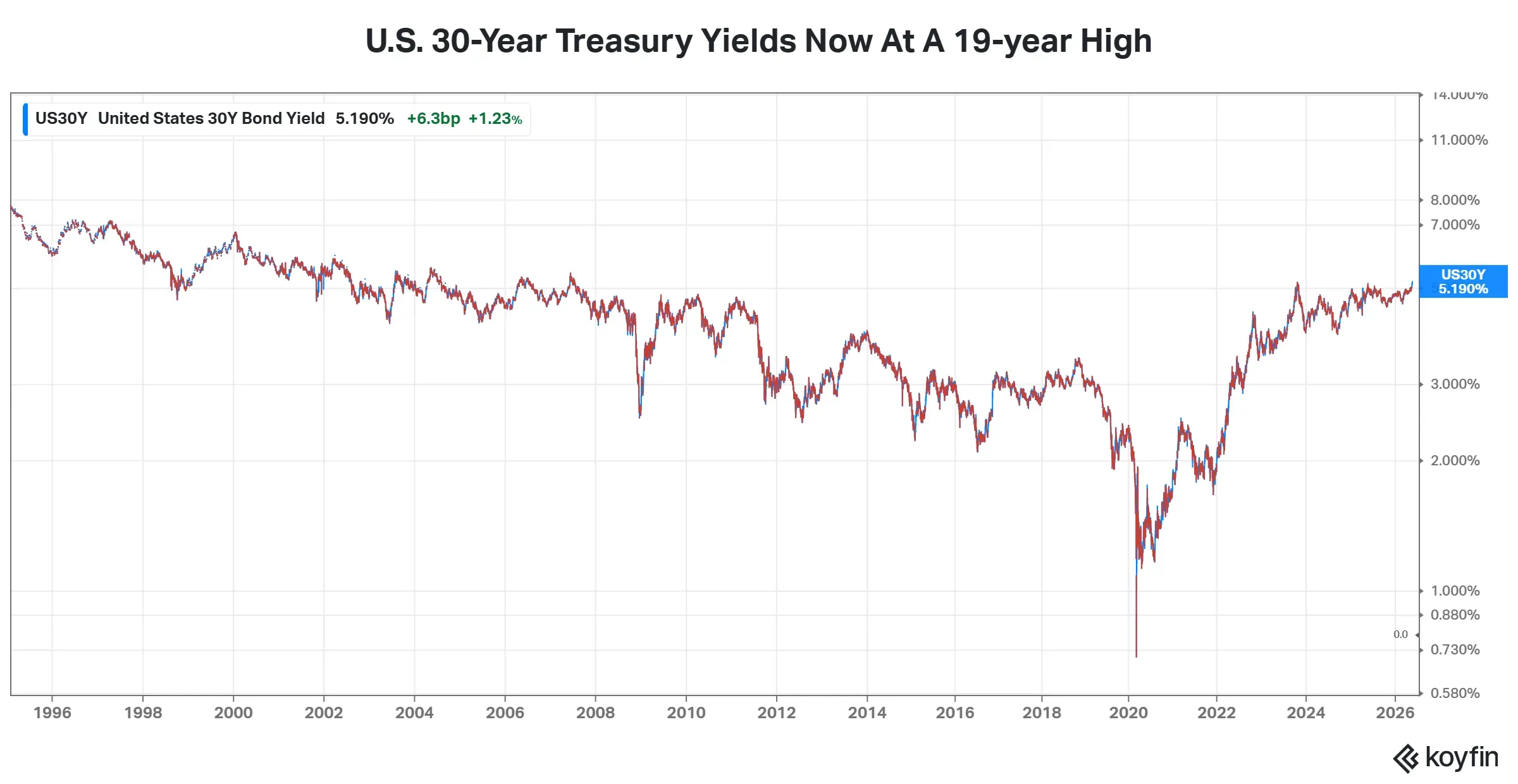
The benchmark 10-Year Treasury yield rose five basis points to 4.675%, while the 2-Year Treasury yield was up four basis points to hover at 4.129% at the time of writing.
Advertisement|Remove ads.
The iShares 20+ Year Treasury Bond ETF (TLT) was down 1% at the time of writing, while the iShares 7-10 Year Treasury Bond ETF (IEF) was down 0.5%.
Analyst Warns Inflation May Be Here To Stay
Michelle Gibley, Director of International Equity Research and Strategy at the Schwab Center for Financial Research, warned on Tuesday that inflation may be here to stay. Gibley added that this could be either from the potential second order impacts from higher energy prices or hotter economic growth.
“There appears to have been hope that the Xi-Trump meeting would result in a diplomatic breakthrough to shorten the conflict in Iran. The longer the Strait of Hormuz is closed, inflation risks are rising and waking up bond yields,” she said.
Advertisement|Remove ads.
Gibley added that rising bond yields hurts the outlook for equities.
Annual CPI Highest Since 2023
Data from the Bureau of Labor Statistics (BLS) released last week showed that on a seasonally adjusted basis, the Consumer Price Index (CPI) rose 0.6% in April after rising 0.9% in March.
The increase pushed the annual inflation rate to 3.8% before seasonal adjustments, marking the highest level since May 2023 amid rising energy prices.
Advertisement|Remove ads.
Higher energy costs were the primary driver of the jump in headline inflation, with the energy index rising 3.8% in April and accounting for more than 40% of the monthly increase in consumer prices.
Crude Oil Prices Remain Above $100 A Barrel
Meanwhile, crude oil prices continued to hover above $100 a barrel amid the ongoing Iran conflict. U.S. West Texas Intermediate (WTI) futures expiring in June fell about 1% to hover around $103 a barrel. Brent crude futures expiring in July were down 1%, at $110 a barrel.
The United States Oil Fund ETF (USO) was up about 1% at the time of writing, while the ProShares Ultra Bloomberg Crude Oil ETF (UCO) rose more than 2%.
Advertisement|Remove ads.
Meanwhile, U.S. equities declined in Tuesday’s opening trade. At the time of writing, the SPDR S&P 500 ETF (SPY), which tracks the S&P 500 index, was down 0.92%; the Invesco QQQ Trust ETF (QQQ) fell 1.4%; and the SPDR Dow Jones Industrial Average ETF Trust (DIA) declined 0.4%. Retail sentiment on Stocktwits regarding the S&P 500 ETF was in the ‘extremely bullish’ territory.
For updates and corrections, email newsroom[at]stocktwits[dot]com.
Advertisement|Remove ads.
Comments posted here will also appear on symbol pages.

Latest News
/filters:format(webp)https://news.stocktwits-cdn.com/large_Getty_Images_2183604828_0179169ddb.jpg)
/filters:format(webp)https://news.stocktwits-cdn.com/Anushka_Basu_make_me_smile_in_the_picture_b92832aa_af59_4141_aacc_4180d2241ba8_1_2_png_1086e0ed8c.webp) Anushka Basu·1h ago
Anushka Basu·1h ago/filters:format(webp)https://news.stocktwits-cdn.com/large_Getty_Images_1244247217_jpg_900a48e334.webp) Anushka Basu·2h ago
Anushka Basu·2h ago/filters:format(webp)https://news.stocktwits-cdn.com/large_Getty_Images_2187781361_2f00b8c65a.jpg) Anushka Basu·4h ago
Anushka Basu·4h ago/filters:format(webp)https://news.stocktwits-cdn.com/large_arthur_hayes_2026_OG_jpg_9f3524f8b1.webp) Anushka Basu·5h ago
Anushka Basu·5h ago/filters:format(webp)https://news.stocktwits-cdn.com/large_Tom_Lee_BMNR_64157a5786.webp) Anushka Basu·7h ago
Anushka Basu·7h ago/filters:format(webp)https://news.stocktwits-cdn.com/large_Getty_Images_2194650023_jpg_2af2244b5a.webp)
/filters:format(webp)https://st-everywhere-cms-prod.s3.us-east-1.amazonaws.com/i_OS_App_Icon_1_8054f2a2fe.png) Stocktwits News Desk·7h ago
Stocktwits News Desk·7h ago