


Advertisement|Remove ads.
USO, UCO, XLE Rise On Renewed Iran Tensions: Analyst Says US Attack On Iran 'Destroys The MOU'



- Oil prices climbed sharply following the attacks, moving above $70 a barrel.
- The Energy Select Sector SPDR Fund (XLE) climbed nearly 3% at close, while the United States Oil Fund (USO) jumped more than 4% and ProShares Ultra Bloomberg Crude Oil (UCO) was up nearly 6%.
- Brett Erickson, managing principal at Obsidian Risk Advisors, said that the escalations point to a “complete destruction of the Memorandum of Understanding between the United States and Iran.”
Advertisement|Remove ads.
Oil prices spiked on Tuesday after a re-escalation of conflict between the U.S. and Iran in the Strait of Hormuz, sending energy-related exchange-traded funds higher.
The Energy Select Sector SPDR Fund (XLE) climbed nearly 3% at close, inching higher in the overnight session. The United States Oil Fund (USO) jumped more than 4% and ProShares Ultra Bloomberg Crude Oil (UCO) was up nearly 6% at market close.

US Revokes Iran Oil License
Iran struck three commercial ships in the Strait of Hormuz late Monday and early Tuesday, including Qatari and Saudi Arabian oil tankers, after the tankers reportedly ignored warnings.
Advertisement|Remove ads.
In response, the U.S. Treasury Department on Tuesday revoked a sanctions waiver that had allowed Iranian oil sales through Aug. 21. The waiver followed an interim agreement between Washington and Tehran last month after months of conflict between the two sides. It involved restoring shipping through the Strait of Hormuz in exchange of permitting imports of Iranian crude into the U.S. and allowing dollar-denominated payments to Iran, among other measures.
U.S. forces also said they had carried out a "series of powerful strikes" against Iran late Tuesday.
“U.S. Central Command forces have begun launching a series of powerful strikes against Iran to impose heavy costs for targeting and attacking commercial shipping crewed by innocent civilians in an international waterway,” the U.S. Central Command said in a post on X.
Advertisement|Remove ads.
“The U.S. strikes are in response to Iranian attacks on three commercial vessels that were transiting the Strait of Hormuz. Iran’s demonstrated aggression was unwarranted, dangerous, and a clear violation of the ceasefire.”
Oil Prices Surge Following Attacks
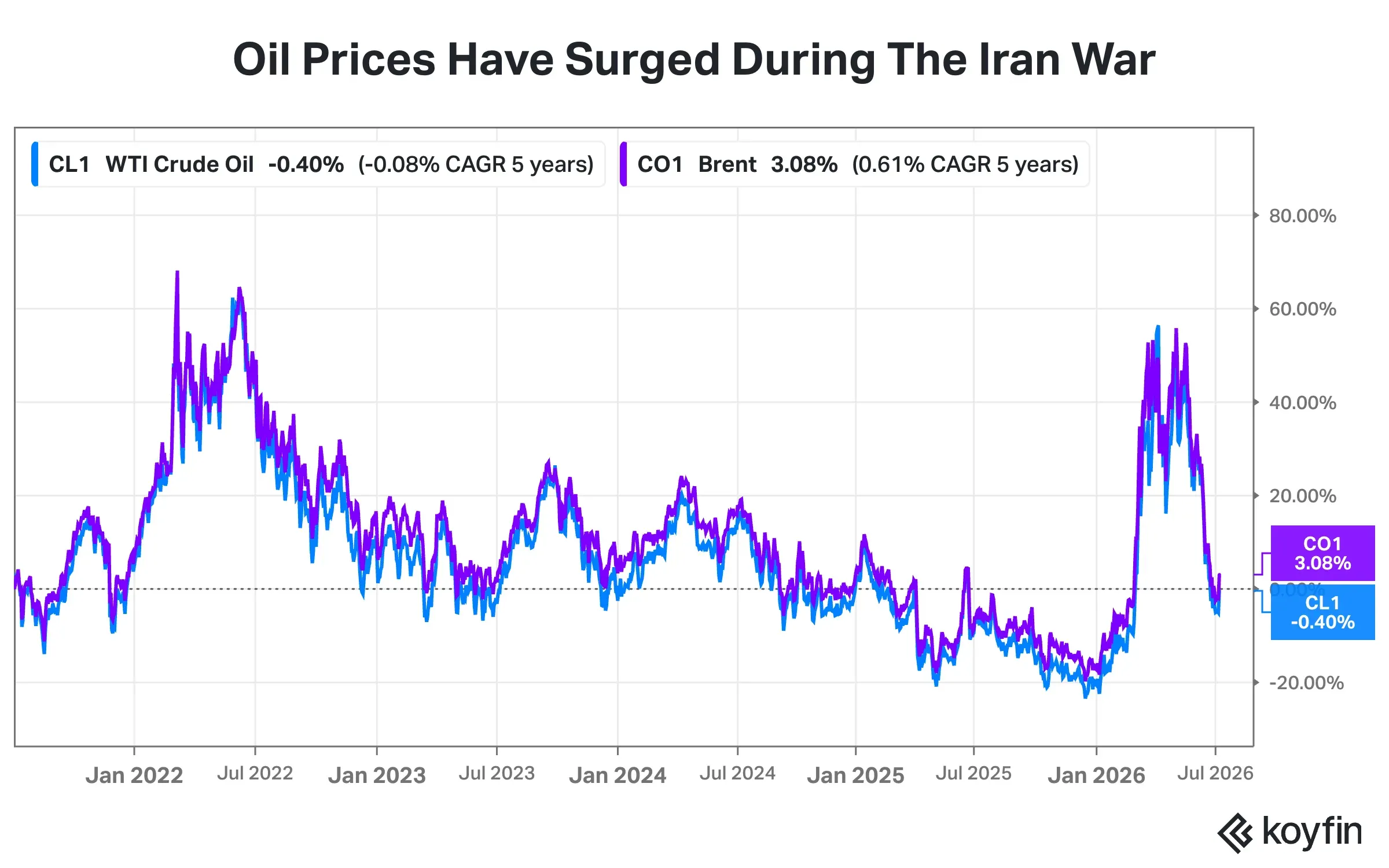
Oil prices climbed sharply following the attacks, moving above $70 a barrel. At the time of writing, Brent crude futures expiring in August were up 2.55%, trading at around $76.05 per barrel. Meanwhile, WTI crude futures expiring in August gained 2.56% to trade at $72.24 per barrel.
Global crude oil prices surged above $100 per barrel during the peak of the war with Iran, revisiting highs not seen since the 2022 energy shocks.
Advertisement|Remove ads.
Analyst Take On Rising Hostilities
Brett Erickson, managing principal at Obsidian Risk Advisors, said that the escalations point to a “complete destruction of the Memorandum of Understanding between the United States and Iran.”
In a post on X, the analyst highlighted what the revocation of the oil license meant, saying that “The significance of this move cannot be overstated.”
Erickson noted that while Washington had grounds to revoke the Iran oil sanctions waiver following recent attacks on vessels transiting the Strait of Hormuz, he said the move would seriously undermine U.S.-Iran negotiations. He noted that the waiver was one of the few tangible concessions Iran had received under the agreement to reopen the Strait and that its economic value was relatively modest compared with the broader wartime damage suffered by Tehran.
Advertisement|Remove ads.
“What this revocation DOES accomplish, is a complete and total destruction of the Memorandum of Understanding between the United States and Iran. This is far more detrimental to negotiations and an permanent cessation of hostilities than a tit for tat response to the vessel strikes by Washington,” he said. “This destroys the MOU,” he added.
Meanwhile, the Light, Sweet Crude Oil Futures (CL_F) were trading 2.53% higher at the time of writing.
On the markets front, major benchmark indexes were trading mixed overnight. The SPDR S&P 500 ETF (SPY), which tracks the S&P 500 index, was down about 0.01% at the time of writing amid ‘extremely bullish’ retail sentiment.
Advertisement|Remove ads.
The Invesco QQQ Trust (QQQ) was trading higher at the time of writing, while the SPDR Dow Jones Industrial Average ETF Trust (DIA) was down 0.10%.
Retail sentiment around USO, UCO, and XLE was in the green territory at the time of writing.
For updates and corrections, email newsroom[at]stocktwits[dot]com.
Advertisement|Remove ads.
Comments posted here will also appear on symbol pages.

Latest News
/filters:format(webp)https://news.stocktwits-cdn.com/large_Getty_Images_2295800057_fd745de575.jpg)
/filters:format(webp)https://news.stocktwits-cdn.com/shivani_photo_jpg_dd6e01afa4.webp) Shivani Kumaresan·6m ago
Shivani Kumaresan·6m ago/filters:format(webp)https://news.stocktwits-cdn.com/large_Bloom_Energy_jpg_de9372f92d.webp)
/filters:format(webp)https://news.stocktwits-cdn.com/Aashika_Suresh_Profile_Picture_jpg_2acd6f446c.webp) Aashika Suresh·12m ago
Aashika Suresh·12m ago/filters:format(webp)https://news.stocktwits-cdn.com/moderna_hq_resized_jpg_97563ed423.webp) Aashika Suresh·34m ago
Aashika Suresh·34m ago/filters:format(webp)https://news.stocktwits-cdn.com/large_Getty_Images_2295513588_4013502a48.jpg) Shivani Kumaresan·1h ago
Shivani Kumaresan·1h ago/filters:format(webp)https://news.stocktwits-cdn.com/large_new_york_stock_exchange_jpg_e1f85c0d8c.webp) Aashika Suresh·1h ago
Aashika Suresh·1h ago/filters:format(webp)https://st-everywhere-cms-prod.s3.us-east-1.amazonaws.com/large_lam_research_logo_resized_3eeb50952a.jpg)
/filters:format(webp)https://news.stocktwits-cdn.com/IMG_8805_JPG_6768aaedc3.webp) Deepti Sri·1h ago
Deepti Sri·1h ago