


Advertisement|Remove ads.
XPeng Vs Tesla: Race To Own The Future Of Cars, Robots, And Flying Machines
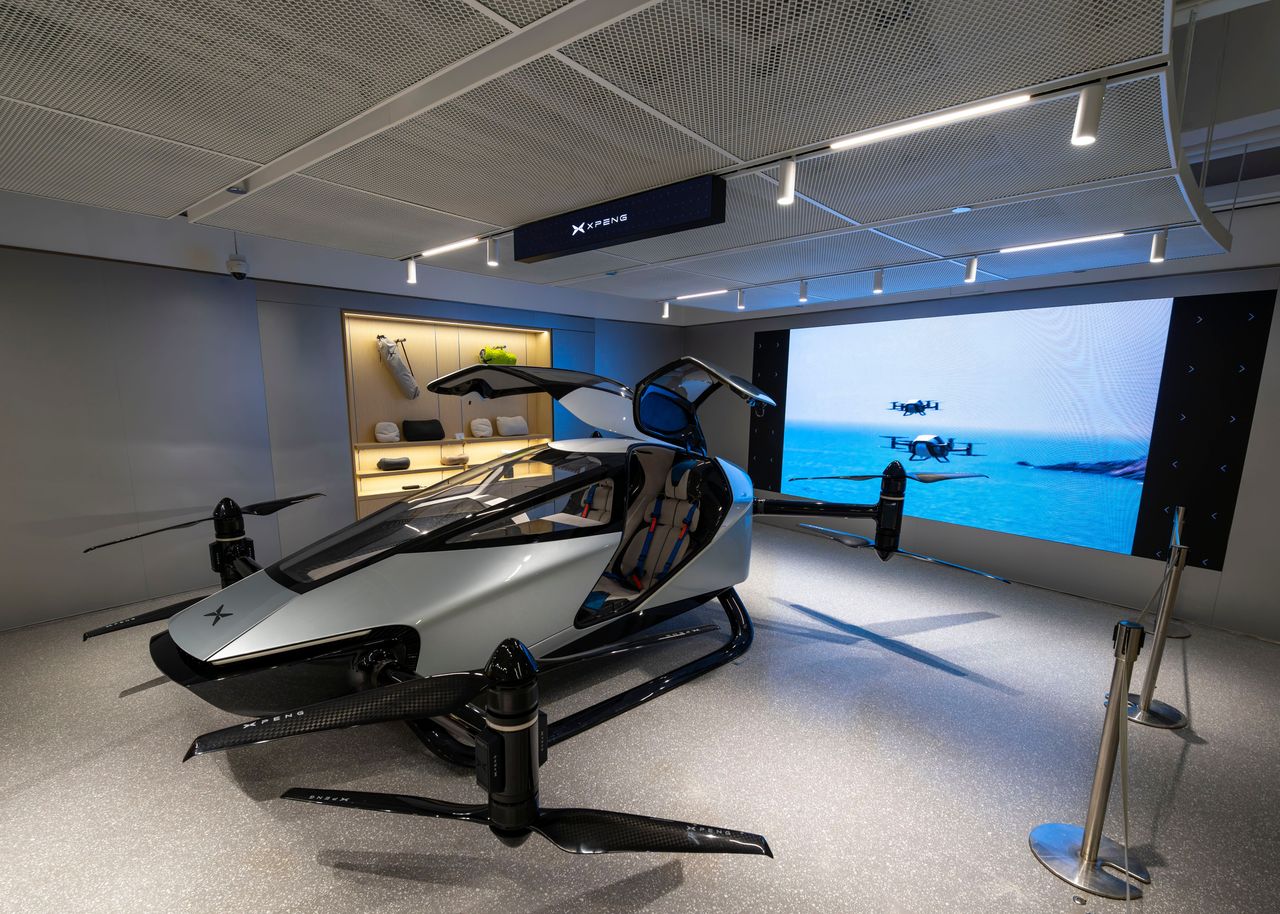


- Founded in 2014, nearly 10 years after Tesla, XPeng launched its first mass-produced EV, the G3 SUV, in late 2018 and has since scaled up deliveries and expanded its markets.
- XPeng’s IRON humanoid robot targets mass production by the end of 2026 with monthly capacity exceeding 1,000 units.
- Through its AeroHT subsidiary, XPeng is also developing the Land Aircraft Carrier — a six-wheeled ground vehicle paired with a detachable two-seat eVTOL.
Advertisement|Remove ads.
As Tesla prepares to unveil a new design for its “flying car” Roadster, Chinese rival XPeng is advancing parallel ambitions in physical AI.
XPeng has emerged as a Tesla challenger through competitive EVs and advanced driver-assistance systems.
The Guangzhou-based company is now expanding into commercial humanoid robots and flying cars.
Advertisement|Remove ads.
Advent into Electric Vehicles
Founded in 2014, nearly 10 years after Tesla, XPeng launched its first mass-produced EV, the G3 SUV, in late 2018. In 2025, it delivered 429,445 vehicles, a 126% year-over-year increase. Cumulative deliveries exceeded 1.2 million by the end of July 2026.
Growth moderated in 2026 amid a product transition, with first-half deliveries of 165,977 units, down about 16%. Second-quarter volume reached 103,295 vehicles. June was the strongest month of the year at 40,126 units, followed by 38,027 in July.
XPEV’s International Expansion
XPeng entered Norway, its first international location, in 2020–2021. By 2026, its presence covered more than 60 countries and regions. Overseas deliveries in the first half of 2026 totaled approximately 31,600 units, up nearly 69% year-over-year, suggesting growing adoption.
Advertisement|Remove ads.
The company aims for overseas revenue to exceed 20% of the total in 2026.
XPeng Financials
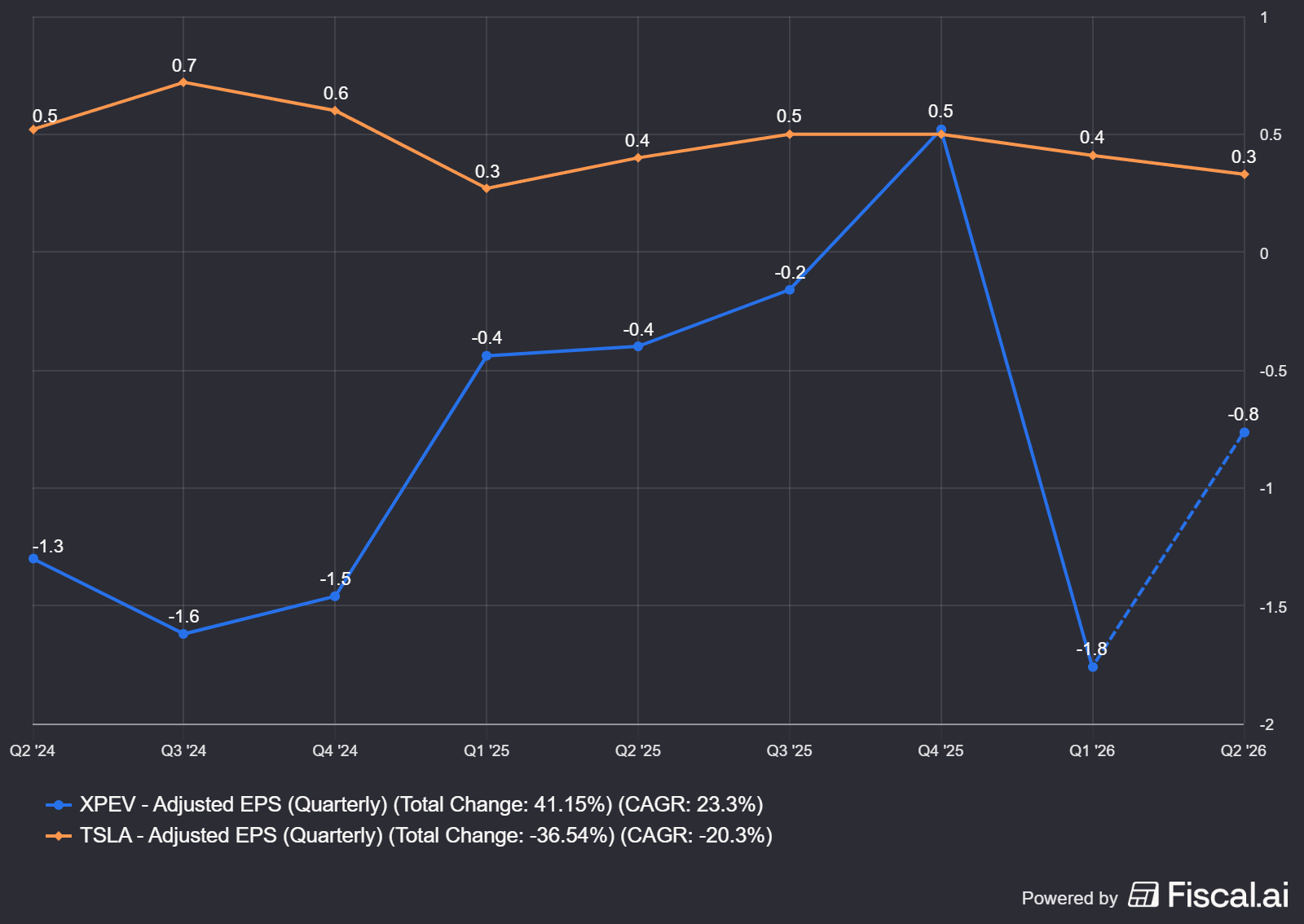
XPeng’s full-year 2025 revenue reached RMB 76.72 billion, up 88%, while adjusted net loss came in at RMB 0.46 billion. First-quarter 2026 revenue was RMB 13.03 billion, down 17.6%, with a net loss of RMB 1.78 billion. Cash stood at RMB 42.09 billion (about $6.1 billion) as of March 31.
Unlike Tesla, which has been profitable for years, XPeng has recorded profit in only one quarter — an adjusted net profit of RMB 0.51 billion in Q4 2025 — before returning to a loss. However, that has not stopped the EV maker.
Advertisement|Remove ads.
Push Into Robotics
XPeng’s IRON humanoid robot targets mass production by the end of 2026 with monthly capacity exceeding 1,000 units. CEO He Xiaopeng took direct leadership of the unit in June 2026. Trial deployment in showrooms is planned for Q1 2027, followed by commercial deliveries later that year. Longer-term capacity is set at one million units annually by 2030.
Meanwhile, Tesla has converted the former Model S/X lines at its Fremont factory into the first Optimus production lines. On its July 22 earnings call, the company said it expects to start production “soon” later in 2026.
Advertisement|Remove ads.
Tesla’s 2026 target is 50,000–100,000 units. External customer sales are expected no earlier than 2027. Long-term capacity goals include up to one million units per year at Fremont and eventually 10 million at a dedicated Giga Texas facility.
Flying Cars Ambition
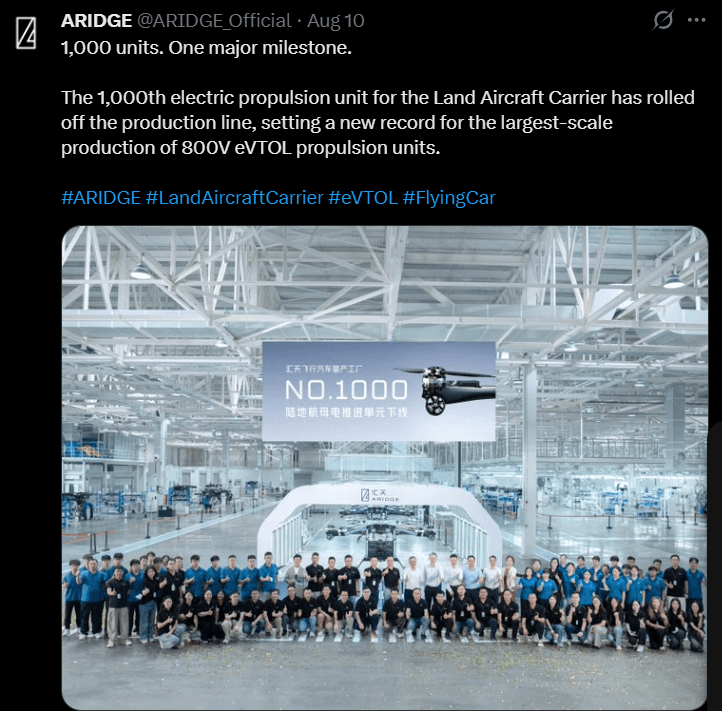
Through its AeroHT subsidiary, now called Aridge, XPeng is also developing the Land Aircraft Carrier — a six-wheeled ground vehicle paired with a detachable two-seat eVTOL. It has more than 7,000 pre-orders. Its Guangzhou factory has completed trial production, with early deliveries targeted for late 2026 and large-scale production in 2027 pending Chinese aviation approvals.
Advertisement|Remove ads.
Tesla has no dedicated passenger eVTOL program but is preparing a limited-edition next-generation Roadster with SpaceX cold-gas thrusters for brief lift or hover. A demonstration is planned as early as August 2026 at SpaceX’s McGregor site.
Self-Driving Cars
Both companies are pursuing vehicle autonomy — XPeng with its Next Generation Pilot system and Tesla with Full Self-Driving — yet both still require active driver supervision in most scenarios. XPeng rolled out its first mass-produced robotaxi in May 2026 and began employee testing. Tesla began manufacturing its dedicated robotaxi offering, the Cybercab, in Texas in the second quarter and already operates Model Y robotaxis in parts of Austin and San Francisco.
Rivalry Between Execs
XPeng CEO He Xiaopeng regularly treats Tesla as a primary benchmark. Earlier this year, he invited Musk to test XPeng’s latest autonomy system and said he personally found Tesla’s FSD in Silicon Valley in late 2025 to have reached a “reassuring experience stage of quasi-L4.”
Advertisement|Remove ads.
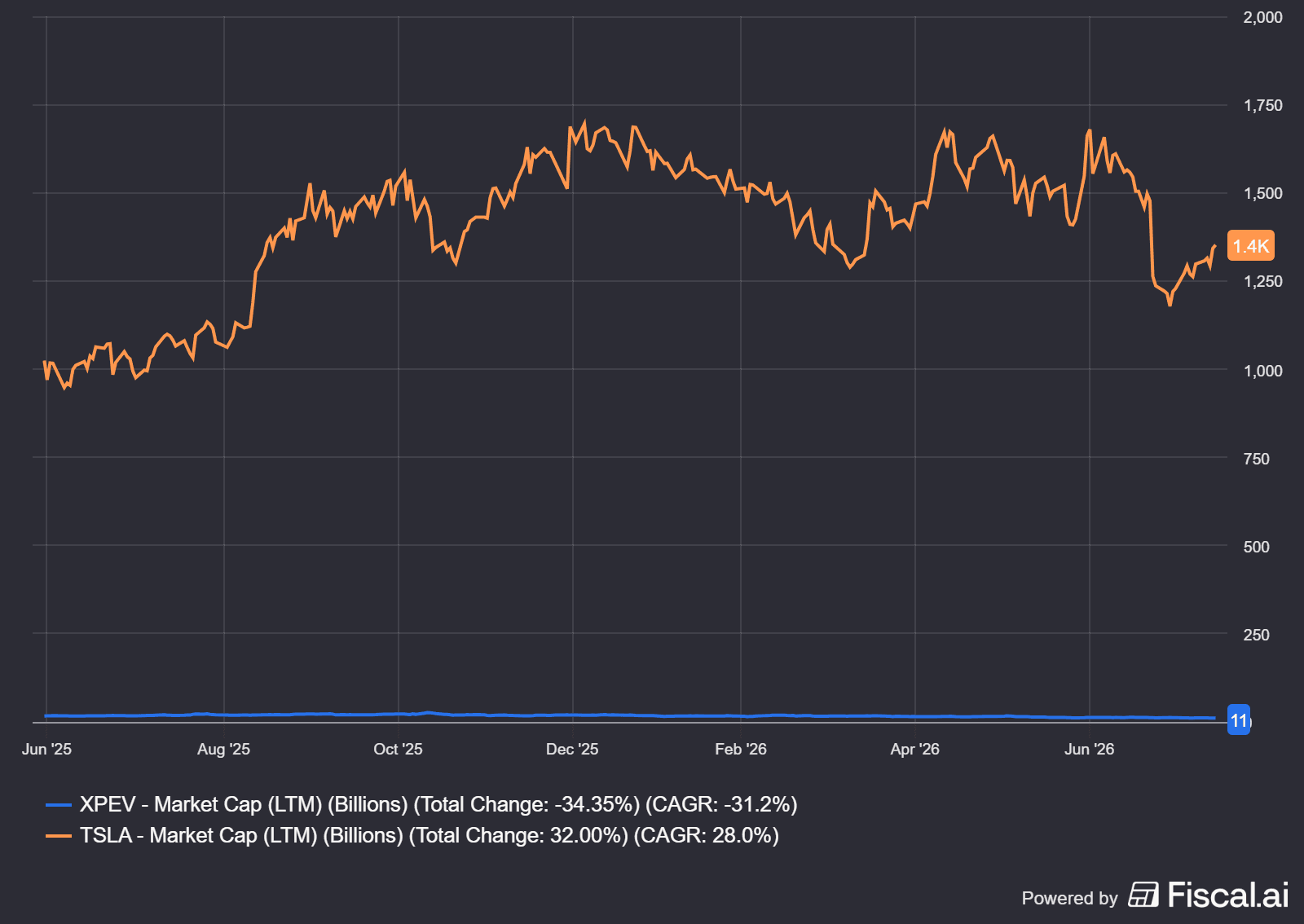
While still smaller than Tesla in global scale, brand recognition outside China, and market capitalization, XPeng has demonstrated rapid delivery growth and clear commercialization timelines across EVs, robots, and flying vehicles. As of the time of writing, XPEV’s market cap stands at about $11 billion, compared to Tesla’s $1.07 trillion.
How Did Retail Traders React?
On Stocktwits, retail sentiment around TSLA stock was ‘bullish’ at the time of writing, while XPEV sentiment remained ‘bearish.'
Advertisement|Remove ads.
While TSLA stock has fallen 24% year-to-date, XPEV lost 42%.
Read More: Berkshire Hathaway Makes Alphabet Its No. 3 Holding After 48M Share Buy
For updates and corrections, email newsroom[at]stocktwits[dot]com.
Advertisement|Remove ads.
Comments posted here will also appear on symbol pages.

Latest News
/filters:format(webp)https://news.stocktwits-cdn.com/large_US_economy_representative_image_jpg_88c3aa4736.webp)
/filters:format(webp)https://st-everywhere-cms-prod.s3.us-east-1.amazonaws.com/i_OS_App_Icon_1_8054f2a2fe.png) Stocktwits News Desk·18m ago
Stocktwits News Desk·18m ago/filters:format(webp)https://news.stocktwits-cdn.com/large_Getty_Images_2245498821_jpg_a630ddc6e3.webp) Stocktwits News Desk·1h ago
Stocktwits News Desk·1h ago/filters:format(webp)https://news.stocktwits-cdn.com/large_Getty_Images_2187692895_jpg_1d5aec6424.webp)
/filters:format(webp)https://news.stocktwits-cdn.com/Anushka_Basu_make_me_smile_in_the_picture_b92832aa_af59_4141_aacc_4180d2241ba8_1_2_png_1086e0ed8c.webp) Anushka Basu·2h ago
Anushka Basu·2h ago/filters:format(webp)https://news.stocktwits-cdn.com/large_Getty_Images_2294367938_81e2686905.jpg) Stocktwits News Desk·2h ago
Stocktwits News Desk·2h ago/filters:format(webp)https://news.stocktwits-cdn.com/large_Getty_Images_1239809188_jpg_1d9fac9e1f.webp) Stocktwits News Desk·3h ago
Stocktwits News Desk·3h ago/filters:format(webp)https://news.stocktwits-cdn.com/large_trump_musk_b978a60a57.jpg) Stocktwits News Desk·4h ago
Stocktwits News Desk·4h ago