


Advertisement|Remove ads.
CBOE, CME, ICE, NDAQ Stocks Take A Hit After Kalshi's Bitcoin Perps Approval – TD Cowen Sees Real Risk, But RBC Says It's ‘Manageable’



- CBOE’s stock led the slide among exchange operators on Tuesday after Wall Street analysts flagged off that last week's approval of Bitcoin perpetual futures on Kalshi as a potential new competitive threat.
- TD Cowen forecast that the approval could weigh on valuation multiples for some exchange operators, particularly Cboe, CME Group and Intercontinental Exchange.
- RBC Capital Markets stated that the competitive threat remains “manageable” because established exchanges retain advantages in liquidity, institutional relationships, and market structure.
Shares of major exchange operators, including Nasdaq (NDAQ), Cboe Global Markets (CBOE), CME Group (CME), and Intercontinental Exchange (ICE) moved lower in midday trade on Tuesday after analysts pointed to last week's approval of Bitcoin (BTC) perpetual futures on Kalshi as a potential new competitive threat to established market operators.
However, Wall Street is divided on how serious the threat actually is. In a note to investors cited by TheFly, TD Cowen said the decision could weigh on multiples for selected exchanges while RBC Capital offered a more measured read. The one factor they agreed on was that Cboe would be the most at-risk.
Exchange Stocks Fall After Kalshi Bitcoin Futures Approval
CBOE’s stock took the heaviest hit among exchange operators on Tuesday, dropping more than 8% in afternoon trade. Retail sentiment ticked upward to ‘bullish’ from ‘neutral’ territory over the past day, amid ‘high’ levels of chatter.
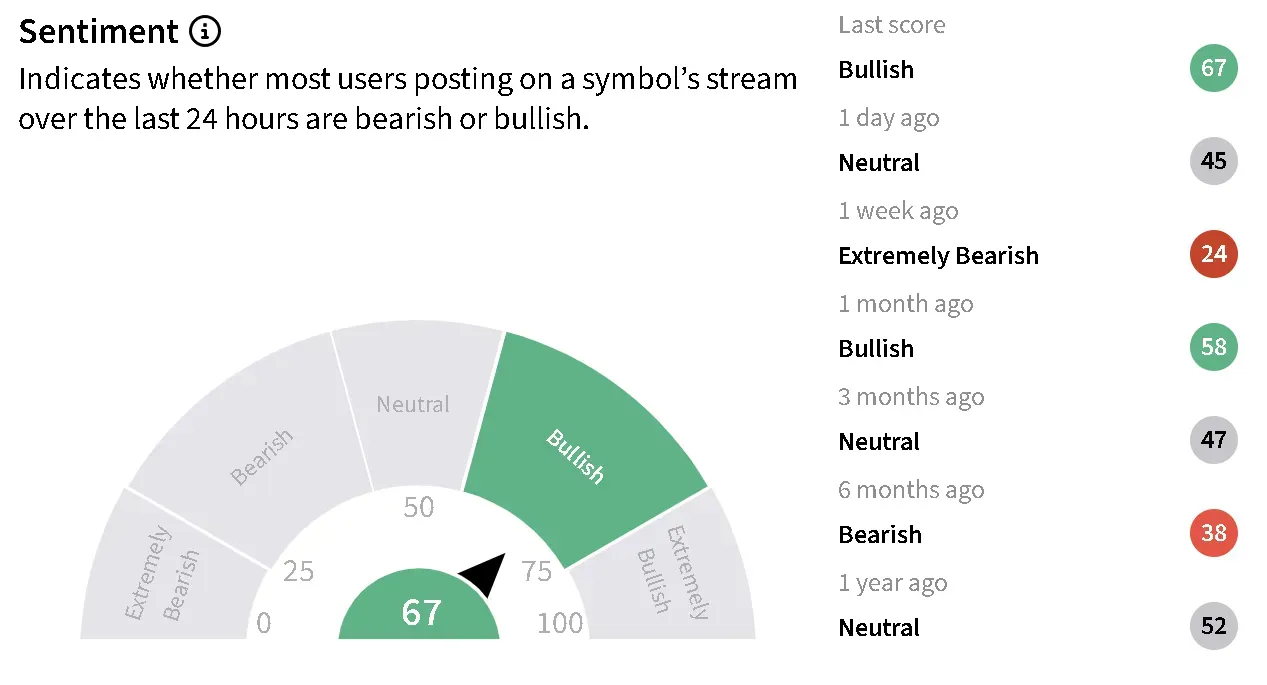
NDAQ’s stock fell nearly 5% in midday trade, and CME’s stock dropped 3.5% in afternoon trade. The former saw retail sentiment drop to ‘bearish’ from ‘neutral’ territory over the past day, and the latter saw sentiment rise to ‘bullish’ from the ‘neutral’ zone. Meanwhile, ICE’s stock dipped 2.5%, with retail sentiment trending in ‘bullish’ territory over the past day.
The Commodity Futures Trading Commission (CFTC) approved Kalshi to offer Bitcoin perpetual futures on regulated U.S. markets on Friday.
Wall Street Analysts Split On Competitive Threat
While TD Cowen identified Cboe as the company most exposed to the development, it also believes CME and ICE are at risk. The firm forecast a limited downside to the Nasdaq and the Marex Group (MRX).
Meanwhile, RBC Capital Markets stated that weakness in Cboe and CME stocks may be driven less by Kalshi's Bitcoin product itself and more by concerns that the CFTC approval could establish a broader regulatory precedent. It noted that investors appeared worried that perpetual futures could eventually expand into other asset classes, creating a larger competitive challenge across the derivatives industry.
The firm stated the competitive threat to Cboe and CME is "manageable," adding that established exchanges still benefit from deep liquidity pools, institutional relationships, and product structures that are not easily replicated. The firm maintains ‘Sector Perform’ ratings on both companies.
The debate comes at a time when perpetual futures have become one of the fastest-growing segments of the crypto market. Much of that growth has been driven by an uptick in perpetual trading on decentralized exchanges like Hyperliquid (HYPE) amid geopolitical uncertainty between the U.S. and Iran. HYPE’s price recently climbed to a record high and entered the top 10 cryptocurrencies by market capitalization, surpassing Dogecoin.
The HYPE token was also outperforming BTC on Tuesday, down only 0.24% in the last 24 hours, while Bitcoin’s price plummeted 5.5% to hit $67,400. The sharp drawdown wiped out more than $1 billion in crypto bets over the past day.
Read also: After Three Winning Calls, Arthur Hayes Is Betting Big On Sam Altman’s Crypto Project
For updates and corrections, email newsroom[at]stocktwits[dot]com

Latest News
/filters:format(webp)https://st-everywhere-cms-prod.s3.us-east-1.amazonaws.com/large_Git_Lab_resized_49b70b74d0.jpg)
/filters:format(webp)https://st-everywhere-cms-prod.s3.us-east-1.amazonaws.com/unnamed_jpg_9dff551b50.webp) Anan Ashraf·3m ago
Anan Ashraf·3m ago/filters:format(webp)https://news.stocktwits-cdn.com/large_Getty_Images_2272987290_jpg_d38601de88.webp) Anan Ashraf·55m ago
Anan Ashraf·55m ago/filters:format(webp)https://news.stocktwits-cdn.com/large_Getty_Images_1132529735_jpg_29946efb40.webp)
/filters:format(webp)https://news.stocktwits-cdn.com/1707726834303_jpg_11f20a9aa9.webp) Shashank Nayar·1h ago
Shashank Nayar·1h ago/filters:format(webp)https://news.stocktwits-cdn.com/large_swarmer_OG_jpg_735eba4fcb.webp) Anan Ashraf·2h ago
Anan Ashraf·2h ago/filters:format(webp)https://news.stocktwits-cdn.com/large_Getty_Images_2237069056_jpg_d98439ca43.webp)
/filters:format(webp)https://news.stocktwits-cdn.com/Whats_App_Image_2026_05_11_at_09_45_43_1_jpeg_a08c0cf251.webp) Aveek Bhowmik·2h ago
Aveek Bhowmik·2h ago/filters:format(webp)https://news.stocktwits-cdn.com/large_trump_jpg_c997816325.webp) Aveek Bhowmik·3h ago
Aveek Bhowmik·3h ago