


Advertisement|Remove ads.
Ethereum-Based Polkadot Token Exploit Sees 1B Tokens Minted In Hyperbridge Attack



- An attacker minted 1 billion Polkadot tokens and sold them for $237,000 on Monday, using a bridged DOT hack on Ethereum.
- A weakness in a Hyperbridge gateway contract allowed an attacker to gain admin control and mint tokens by reusing a transaction "proof."
- Polkadot indicated that the problem only affects DOT bridges via Hyperbridge, not its original DOT, parachains, or the core network.
Advertisement|Remove ads.
Polkadot's (DOT) native token, DOT, was bridged on Ethereum (ETH) and reportedly experienced a security issue on Monday. The incident allegedly allowed an attacker to create around 1 billion tokens before selling them in a single transaction.
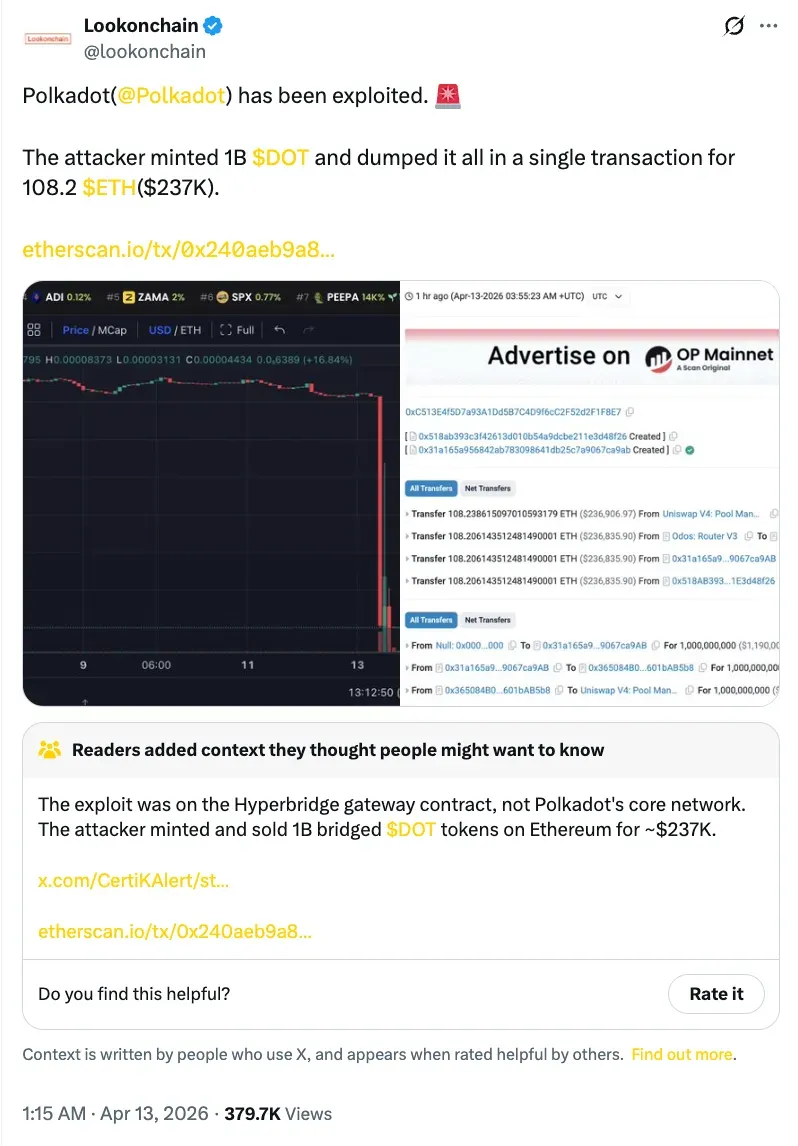
Lookonchain, an on-chain firm that tracks crypto tokens, shared on X that the attacker walked away with approximately 108.2 ETH, worth over $237,000 at the time. CertiK, another blockchain security firm, confirmed that the issue was an exploit of the Hyperbridge gateway contract, which connects Polkadot to Ethereum.
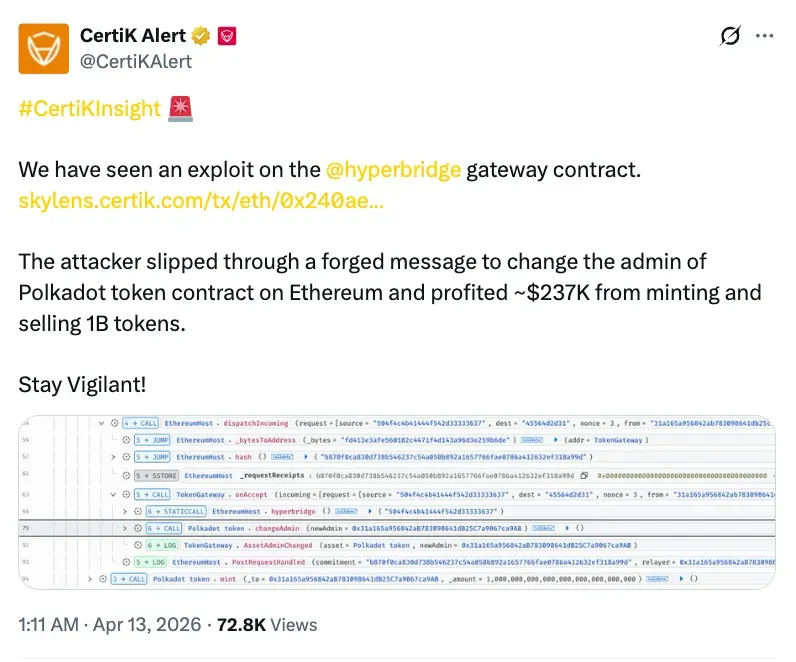
The attacker reused a valid “proof” from an earlier transaction instead of creating a new one, said Certik. As a result, they gained control of the admin position associated with a Polkadot token contract on Ethereum, enabling large-scale token minting.
Advertisement|Remove ads.
Polkadot has since acknowledged the issue. The team clarified on X that the attack only affects DOT tokens connected to Ethereum via Hyperbridge. However, the team said that Polkadot, its parachains, and native DOT are unaffected. Furthermore, DOT transfers via alternative bridging devices have not been affected. Hyperbridge has been temporarily halted while investigations are ongoing.

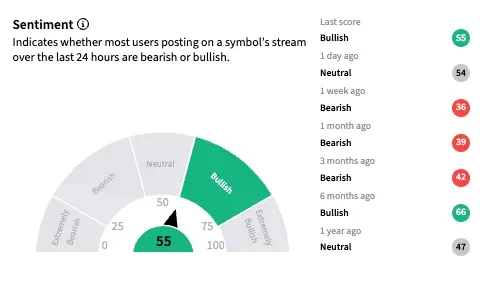
At the time of writing, Polkadot’s price was down over 3%. Meanwhile, on a technical level, DOT's continuous decline is approaching a crucial stage, with the risk of falling below $1. On Stocktwits, retail sentiment around DOT remained in the ‘bearish’ zone, while chatter around it stayed at ‘high’ levels over the past day.
Advertisement|Remove ads.

Ethereum’s price, on the other hand, was trading at $2,182, down over 1%. On Stocktwits, retail sentiment around ETH changed to ‘bullish’ from ‘neutral’ zone, while chatter remained at ‘high’ levels over the past day.
Dangers In Bridging Infrastructure
The event was another example of the ongoing security dangers in cross-chain infrastructure. Bridges are among the most vital components of the crypto industry's infrastructure, yet they remain vulnerable to attack. Attackers are increasingly targeting message verification and admin controls. Wrapped and bridged assets are still at risk, even if the main chain is safe.
A 2025 exploit cost Radiant Capital, a cross-chain lending mechanism, about $50 million. The attack targeted Ethereum's ecosystem, including EVM-compatible networks and cross-chain infrastructure like Arbitrum (ARB) and BNB Chain (BNB). The attacker exploited chain-verification flaws to withdraw funds without collateral.
Advertisement|Remove ads.
For updates and corrections, email newsroom[at]stocktwits[dot]com.
Comments posted here will also appear on symbol pages.

Latest News
/filters:format(webp)https://news.stocktwits-cdn.com/large_Getty_Images_2236793425_jpg_2458e96bb4.webp)
/filters:format(webp)https://news.stocktwits-cdn.com/Harshita_3cfe02022c.jpg) Harshita Tyagi·26m ago
Harshita Tyagi·26m ago/filters:format(webp)https://news.stocktwits-cdn.com/large_Eli_Lilly_jpg_953956d5f8.webp)
/filters:format(webp)https://news.stocktwits-cdn.com/vivekkrishnanphotography_58_jpg_0e45f66a62.webp) Arnab Paul·27m ago
Arnab Paul·27m ago/filters:format(webp)https://news.stocktwits-cdn.com/large_terawulf_OG_jpg_a87a18705d.webp)
/filters:format(webp)https://news.stocktwits-cdn.com/Prabhjote_DP_67623a9828.jpg) Prabhjote Gill·52m ago
Prabhjote Gill·52m ago/filters:format(webp)https://news.stocktwits-cdn.com/gettyimages_2295061056_594x594_afda5c9169.jpg)
/filters:format(webp)https://news.stocktwits-cdn.com/Heera_1_1c30cb0170.PNG) Heera Hari·1h ago
Heera Hari·1h ago/filters:format(webp)https://news.stocktwits-cdn.com/large_SPACEX_SPCX_d5bfc46a3b.webp) Arnab Paul·1h ago
Arnab Paul·1h ago/filters:format(webp)https://news.stocktwits-cdn.com/large_Getty_Images_2294367938_81e2686905.jpg) Harshita Tyagi·2h ago
Harshita Tyagi·2h ago