


Advertisement|Remove ads.
SEC’s Paul Atkins Backs Scott Bessent’s CLARITY Act Push To Stop ‘Rogue Regulators’ And ‘Future-Proof’ US Economy



- The Treasury Secretary’s comments come as the CLARITY Act faces a markup deadline in the Senate Banking Committee in the second half of April, though no final date has been locked in yet.
- Scott Bessent also noted that the GENIUS Act, requires additional support from the CLARITY Act to be fully effective.
- SEC Chair Paul Atkins backed the Treasury Secretary’s push, stating that it would strip 'rogue regulators' from the financial system.
Securities and Exchange Commission (SEC) Chairman Paul Atkins on Thursday Supported Treasury Secretary Scott Bessent’s call for swift passage of the Digital Asset Market Clarity Act of 2025, saying the legislation is key to “future-proofing” the U.S. financial system.
In a post on X, Atkins said that it’s time to “future-proof” the financial system against “rogue” regulators. Atkins added Project Crypto is intended to ensure agencies are ready to implement the framework once Congress passes the bill.

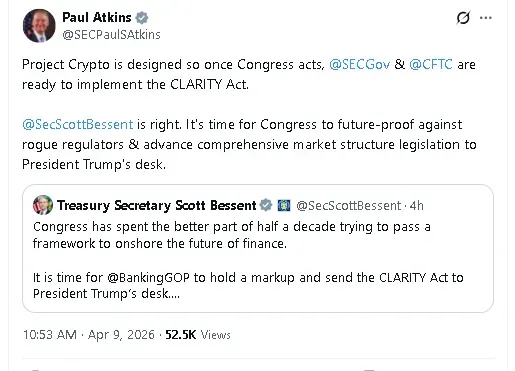
His comments after U.S. Treasury Secretary Scott Bessent on Thursday urged Congress to quickly pass the Digital Asset Market Clarity Act of 2025 so that President Donald Trump can sign it into law.
Advertisement|Remove ads.
In an op-ed in The Wall Street Journal, Bessent wrote that the passing of the CLARITY Act is fundamental to bringing back blockchain developers and crypto entrepreneurs to the U.S. after much of the industry relocated to Abu Dhabi and Singapore, which have clearer rules and regulations.
He added that the GENIUS Act, passed in July last year, can’t be fully realized without support from the CLARITY Act. “With stablecoins gaining a regulatory foothold, the next frontier is the financial infrastructure they power: tokenized assets, decentralized exchanges, and new means of capital formation,” he wrote. “Whether that ecosystem—and its associated jobs and tax revenue—will develop domestically or abroad depends on the durability of U.S. rules.”
Bessent's comments come as the CLARITY Act faces a markup deadline in the Senate Banking Committee in the second half of April, though no final date has been locked in yet. According to the crypto community, if the bill is not tabled by the end of April, it is unlikely to reach a full Senate vote before the summer recess. After that, it is likely to get sidelined by campaign season for the November 2026 midterm elections.
Advertisement|Remove ads.
Regulators And Lawmakers Rally Behind CLARITY Act Push
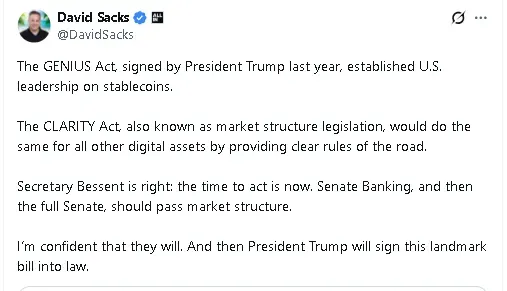
David Sacks, who served as the White House AI and Crypto Czar until last month, also backed the push on X, stating lawmakers should move quickly to pass market structure legislation and send it to President Donald Trump for approval.
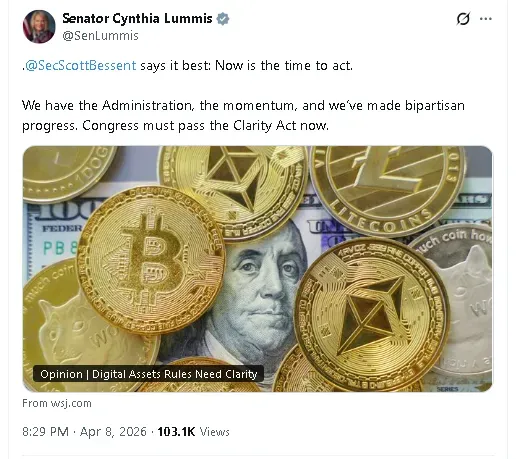
Senator Cynthia Lummis echoed that view, calling on Congress to act promptly and citing growing momentum behind the bill.
Why Is The CLARITY Act Taking So Long To Reach The Senate?
The CLARITY Act has been stalled since January, with the crypto and banking industries debating whether stablecoin rewards should be allowed in any form. Banking advocates have argued that offering yield could draw deposits away from the traditional financial system, while proponents of crypto, especially Coinbase (COIN) CEO Brian Armstrong, have said offering yield is critical for crypto adoption.
Advertisement|Remove ads.
On Wednesday, the White House published a report stating that offering rewards on stablecoins would barely impact bank deposits. “In short, a yield prohibition would do very little to protect bank lending, while forgoing the consumer benefits of competitive returns on stablecoin holdings,” the report said.
According to the last public draft of the stablecoin rewards portion of the CLARITY Act, Circle (CRCL) could offer rewards on deposits, since it’s the issuer of stablecoin USDC (USDC), but Coinbase, with which it shares a 50-50 revenue-sharing agreement, would not.
On Stocktwits, retail sentiment around stablecoin USDC (USDC) trended in ‘extremely bullish’ territory over the past day with chatter at ‘extremely high’ levels.
Advertisement|Remove ads.
Meanwhile, COIN’s stock dipped 1.13% in midday trade on Thursday amid a volatile market. Retail sentiment around Coinbase on Stocktwits trended in ‘bearish’ territory over the past day, while chatter increased to ‘normal’ from ‘low’ levels. CRCL’s stock took a bigger hit, down nearly 5% in midday trade, with retail sentiment also trending in ‘bearish’ territory over the past day. Chatter stayed at ‘low’ levels.
Read also: Bitcoin ETF Bleed Continues: MSBT Fails To Reverse Flows Despite $31 Million Inflows On Debut
For updates and corrections, email newsroom[at]stocktwits[dot]com.
Advertisement|Remove ads.
Comments posted here will also appear on symbol pages.

Latest News
/filters:format(webp)https://news.stocktwits-cdn.com/large_Getty_Images_2219723511_103fa4d061.jpg)
/filters:format(webp)https://news.stocktwits-cdn.com/unnamed_jpg_9dff551b50.webp) Anan Ashraf·1h ago
Anan Ashraf·1h ago/filters:format(webp)https://news.stocktwits-cdn.com/datadog_resized_jpg_20b6f8ccc0.webp)
/filters:format(webp)https://news.stocktwits-cdn.com/1707726834303_jpg_11f20a9aa9.webp) Shashank Nayar·2h ago
Shashank Nayar·2h ago/filters:format(webp)https://news.stocktwits-cdn.com/large_Getty_Images_2296204406_1dce30a7be.jpg) Shashank Nayar·3h ago
Shashank Nayar·3h ago/filters:format(webp)https://news.stocktwits-cdn.com/large_musk_adc78b164e.jpg) Anan Ashraf·3h ago
Anan Ashraf·3h ago/filters:format(webp)https://st-everywhere-cms-prod.s3.us-east-1.amazonaws.com/large_pepsico_resized_jpg_9bdd1807dd.webp)
/filters:format(webp)https://news.stocktwits-cdn.com/Heera_1_1c30cb0170.PNG) Heera Hari·4h ago
Heera Hari·4h ago/filters:format(webp)https://news.stocktwits-cdn.com/large_ionis_jpg_80195eb65e.webp)
/filters:format(webp)https://news.stocktwits-cdn.com/vivekkrishnanphotography_58_jpg_0e45f66a62.webp) Arnab Paul·4h ago
Arnab Paul·4h ago