


Advertisement|Remove ads.
Bull Case For US Stocks Intact Despite ‘Melt-Up’ Fears: Yardeni Research


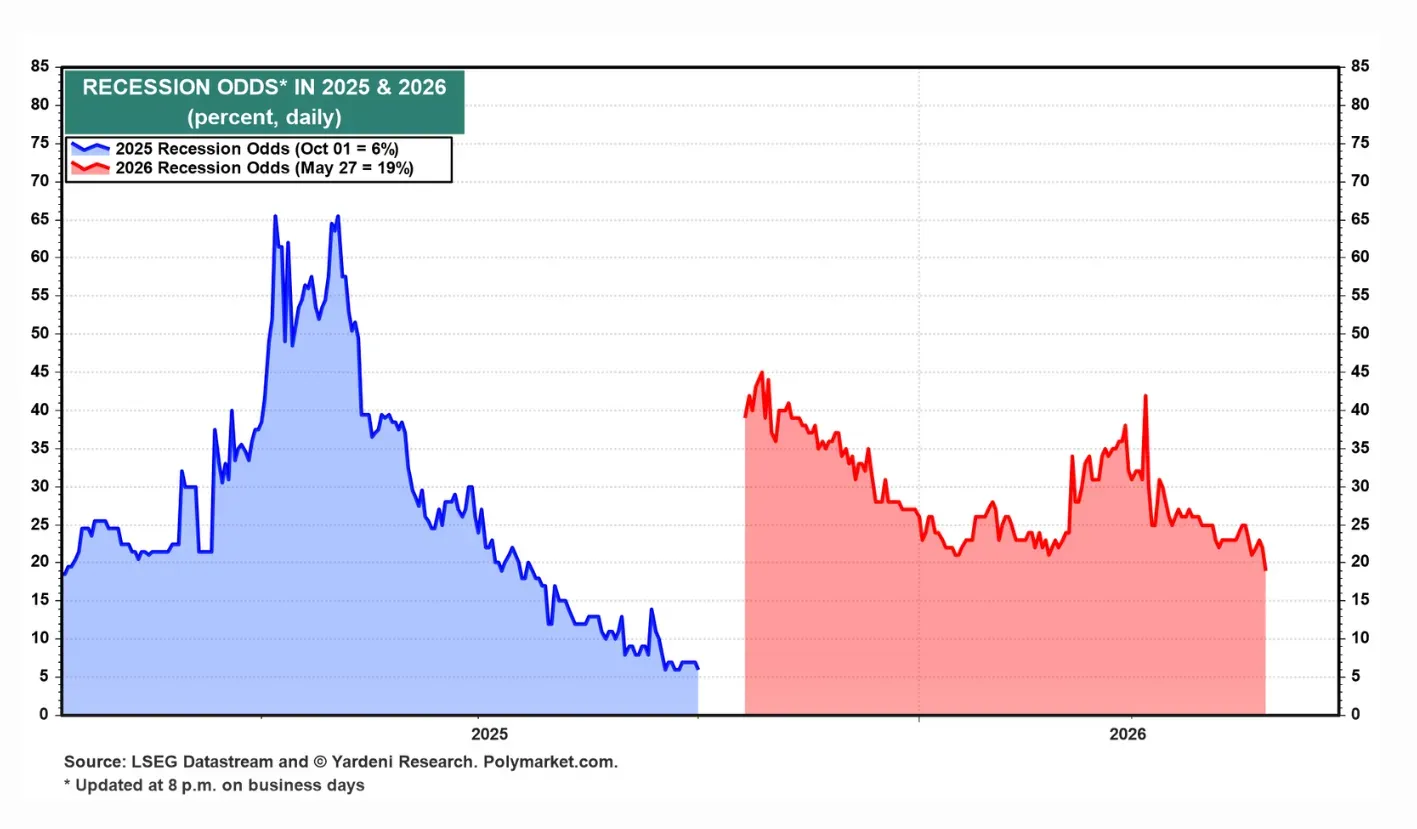
- The financial consulting firm said that the probability of a U.S. recession in 2026 has fallen to 19%, marking the lowest reading of the year.
- The firm also believes that the benchmark S&P 500 will rise to reach 10,000 by the end of the decade.
- Yardeni’s president and chief investment strategist dismissed concerns that the market is entering bubble territory and said that earnings momentum was fueling the rise.
Advertisement|Remove ads.
Independent financial consulting firm Yardeni Research believes that the bull case for U.S. stocks remains firmly intact amid higher consumer spending, strong corporate earnings, and the ongoing artificial intelligence investment boom.
“The bull case for the stock market remains intact,” Yardeni Research said in a post on Wednesday as the S&P 500 climbed to another record high.
“The economy and the labor market remain resilient. Consumers are spending. The AI boom is boosting capital spending. Corporate earnings are soaring on strong revenues growth and higher profit margins,” the firm said.
Advertisement|Remove ads.
Yardeni Says ‘FEMO’ Has Replaced ‘FOMO’
The research firm also noted that the probability of a U.S. recession in 2026 has fallen to 19%, marking the lowest reading of the year.
“Stock prices are rising on FEMO (fabulous earnings momentum) rather than FOMO (fear of missing out),” the firm said.
The firm reiterated its “steadfastly” bullish stance, doubling down on its “Roaring 2020s thesis.” According to the firm, the S&P 500 will rise to 10,000 by the end of the decade, as fundamentals continue to support its stance.
Advertisement|Remove ads.
Ed Yardeni, president and chief investment strategist at the company, dismissed concerns that the market is entering bubble territory while speaking on Bloomberg Television’s Surveillance on Wednesday.
“The big difference is earnings,” Yardeni said, also adding that the forward price-to-earnings ratio for the S&P 500, currently around 20 to 22 times earnings, remains reasonable if the U.S. economy avoids recession over the next several years.
While he acknowledged that the market feels like a “meltup” as some semiconductor stocks are rising sharply, he said that he has seen only one meaningful selloff this year, in March, and doubts another will occur before year-end.
Advertisement|Remove ads.
Goldman Sachs Reiterates Bullish Stance
Yardeni’s stance comes shortly after Goldman Sachs raised its year-end 2026 target for the S&P 500 to 8,000 from 7,600. The bank has also supported the financial firm’s stance, saying the market rally is being powered primarily by earnings growth rather than expanding valuations.
“Earnings growth has powered the entire S&P 500 return so far this year, and we expect this dynamic to continue,” Goldman strategists wrote.
The S&P 500 has gained more than 9.6% so far this year, while the Dow Jones Industrial Average has shot up more than 4.6%. Meanwhile, the tech-heavy Nasdaq-100 has gained nearly 19% over the same period, driven higher by AI-related spending and robust demand.
Advertisement|Remove ads.
Meanwhile, among the ETFs tracking benchmark indexes, the SPDR S&P 500 ETF (SPY), Invesco QQQ Trust (QQQ), and SPDR Dow Jones Industrial Average ETF Trust (DIA) were all trading in the red at the time of writing.
Retail sentiment was in the ‘bullish’ territory for SPY, in the ‘neutral’ territory for QQQ, and in the ‘bearish’ territory for DIA.
For updates and corrections, email newsroom[at]stocktwits[dot]com.
Advertisement|Remove ads.
Comments posted here will also appear on symbol pages.

Latest News
/filters:format(webp)https://news.stocktwits-cdn.com/gettyimages_2228663934_594x594_97e3b13d04.jpg)
/filters:format(webp)https://news.stocktwits-cdn.com/Heera_1_1c30cb0170.PNG) Heera Hari·20m ago
Heera Hari·20m ago/filters:format(webp)https://news.stocktwits-cdn.com/large_Getty_Images_2294072315_5f0a29cff4.jpg)
/filters:format(webp)https://news.stocktwits-cdn.com/Prabhjote_DP_67623a9828.jpg) Prabhjote Gill·26m ago
Prabhjote Gill·26m ago/filters:format(webp)https://news.stocktwits-cdn.com/large_Getty_Images_2241292402_jpg_9661b0c852.webp)
/filters:format(webp)https://news.stocktwits-cdn.com/vivekkrishnanphotography_58_jpg_0e45f66a62.webp) Arnab Paul·1h ago
Arnab Paul·1h ago/filters:format(webp)https://news.stocktwits-cdn.com/gettyimages_2292585020_594x594_cb12bc8682.jpg)
/filters:format(webp)https://news.stocktwits-cdn.com/Harshita_3cfe02022c.jpg) Harshita Tyagi·2h ago
Harshita Tyagi·2h ago/filters:format(webp)https://st-everywhere-cms-prod.s3.us-east-1.amazonaws.com/large_american_airlines_resized_546ba616ea.jpg) Heera Hari·2h ago
Heera Hari·2h ago/filters:format(webp)https://news.stocktwits-cdn.com/large_Getty_Images_2300447831_383f41fb7f.jpg) Prabhjote Gill·2h ago
Prabhjote Gill·2h ago