


Advertisement|Remove ads.
CAPR Stock Eyes Worst Month In 9 Years On FDA Doubts — ‘Pharma Bro’ Shkreli Piles On, But Retail Turns More Bullish Than Ever



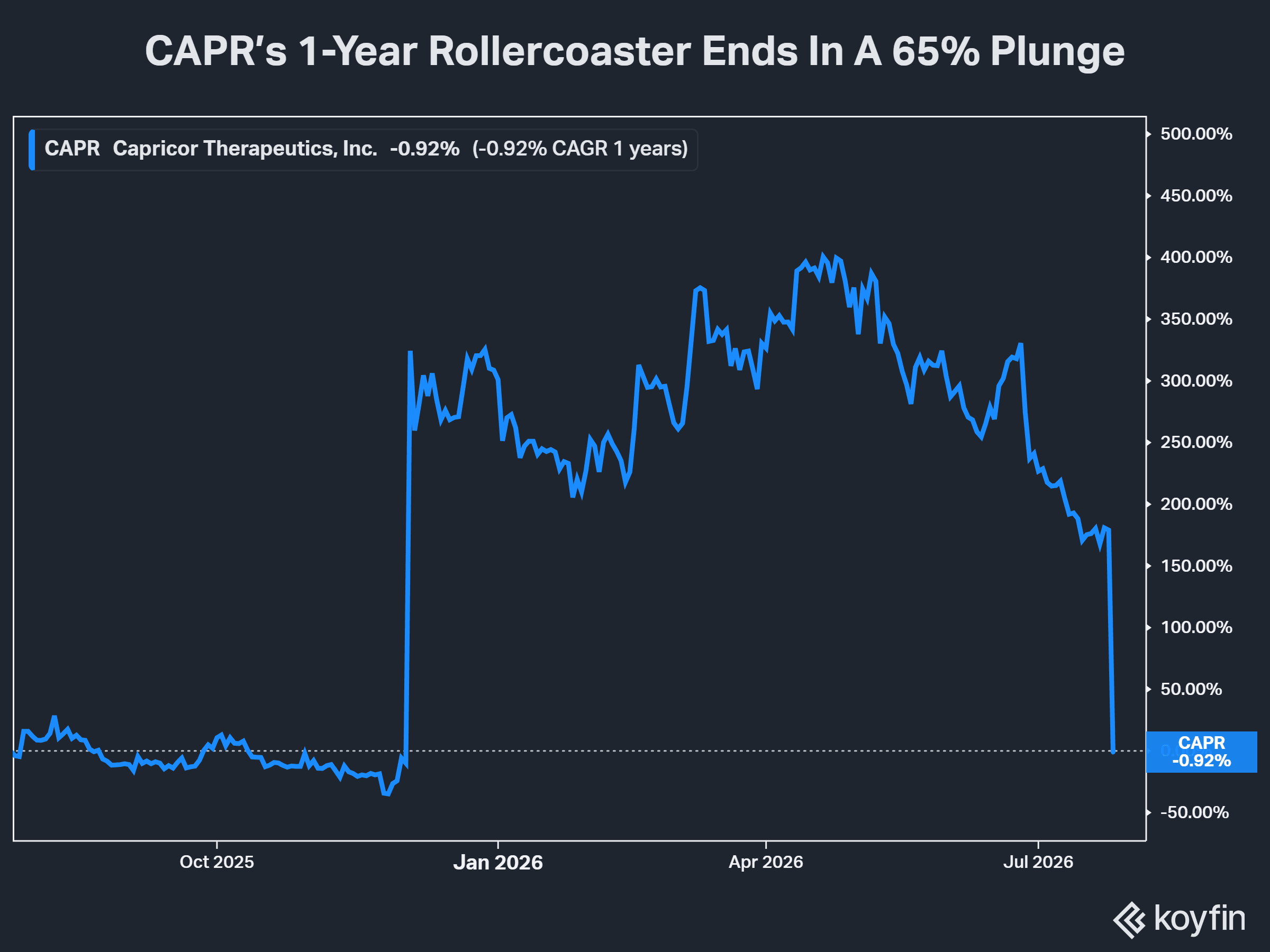
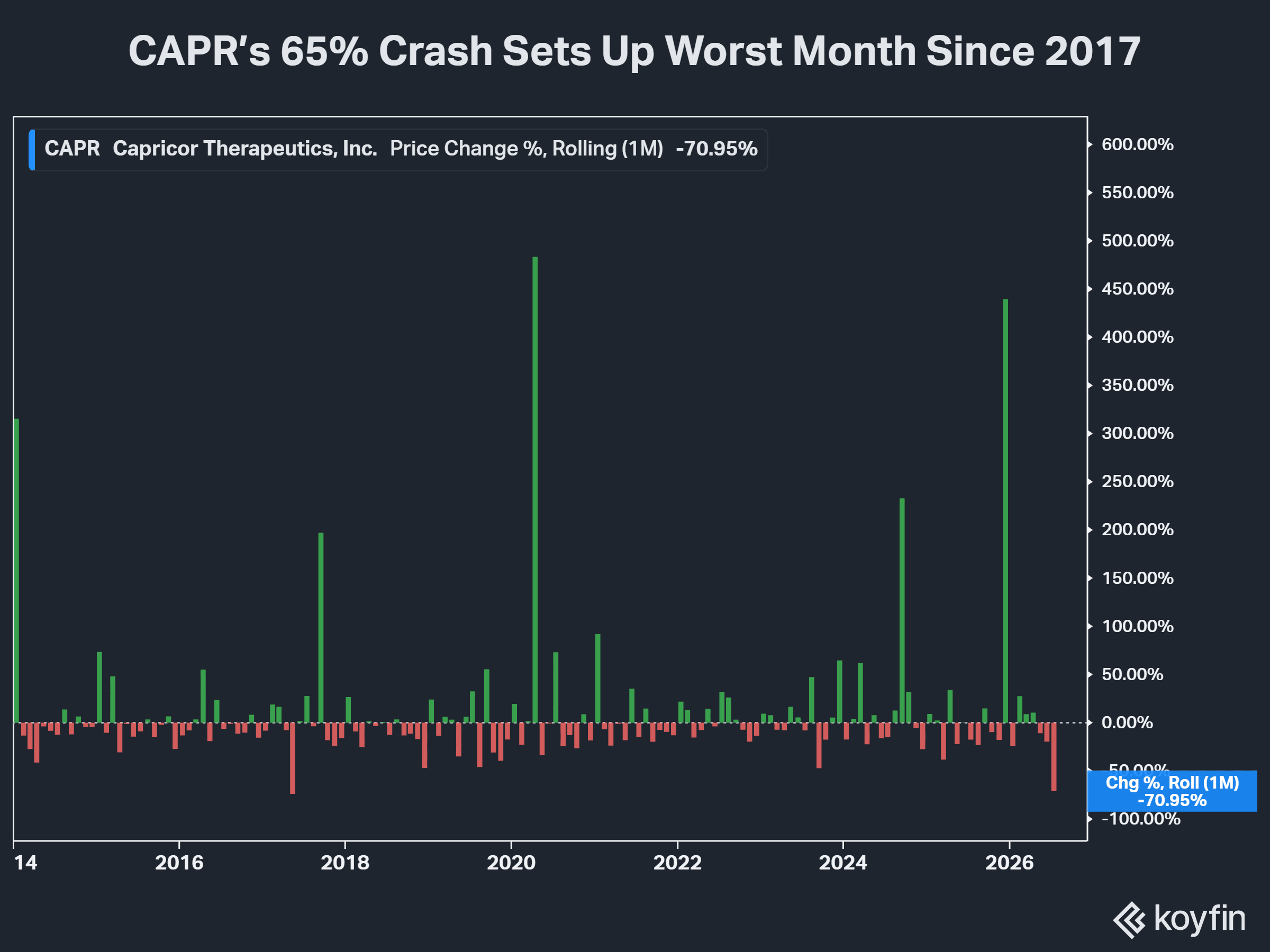
- CAPR is down 71% in July after a 65% one-day plunge, putting the stock on track for its worst month in nine years.
- The selloff followed FDA briefing documents questioning whether Deramiocel’s Hope-3 trial showed convincing evidence of effectiveness.
- Martin Shkreli revived his bearish CAPR thesis, calling the company a “complete fraud” after previously admitting his short call was a “bad call.”
Advertisement|Remove ads.
Shares of Capricor Therapeutics (CAPR) are staring at their worst month in nine years after a 65% plunge on FDA doubts over Deramiocel, its Duchenne muscular dystrophy (DMD) cell therapy. The rout has given former pharma executive Martin Shkreli fresh ammunition, even as retail traders turn more bullish on CAPR than ever.
CAPR stock is down 71% so far in July, with Monday’s selloff alone wiping out more than $735 million in market value. Shares have also given up all their gains over the past year and are now down about 1% over the same period.
Advertisement|Remove ads.
FDA Questions Capricor’s Hope-3 Analysis
The selloff came after the FDA released briefing documents ahead of Wednesday’s advisory committee meeting on Deramiocel. Reviewers questioned whether the Hope-3 trial showed convincing evidence that the therapy works and raised concerns about changes Capricor made to its statistical analysis plan.
At the heart of the dispute is which analysis should count. FDA staff said Hope-3 missed its pre-specified primary endpoint for upper-limb function and its key secondary endpoint for heart function, measured by left ventricular ejection fraction (LVEF), or how much blood the heart pumps out with each beat. Later versions of Capricor’s statistical analysis plan (SAP) changed how the trial data were evaluated.
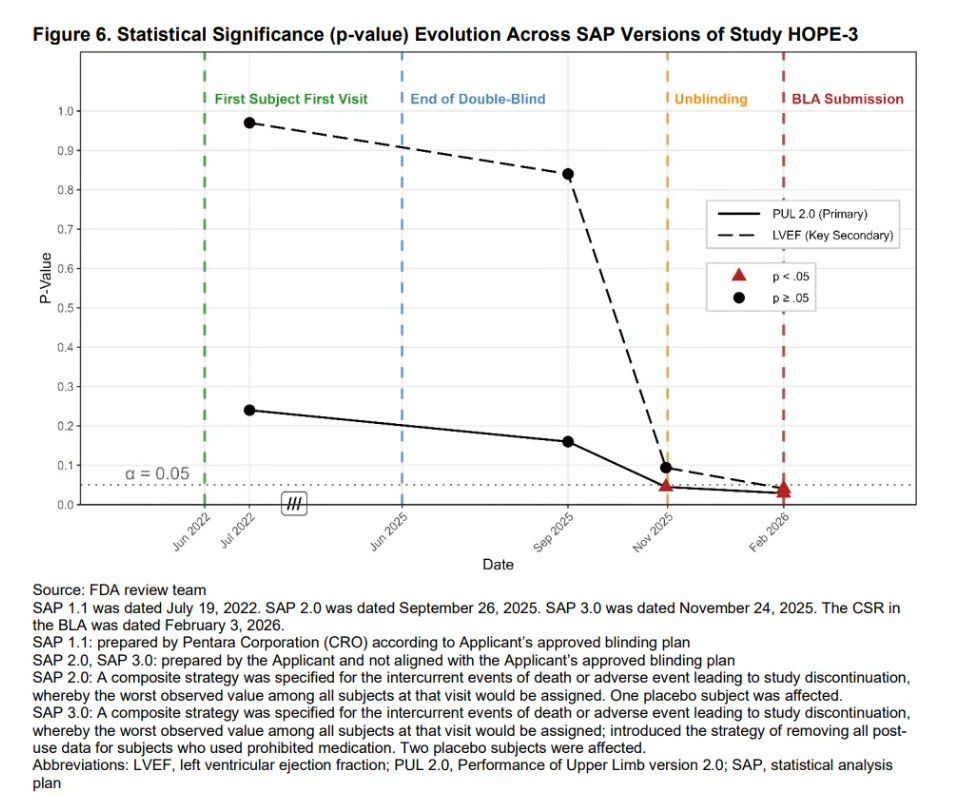
The FDA highlighted a chart showing p-values — a measure used to assess whether a result is statistically significant — becoming more favorable under eventual analysis plans, eventually crossing the commonly used threshold for significance. Reviewers said that the changes produced a “dramatic increase” in statistical significance, particularly for LVEF. The agency also said the findings were sensitive to how just a few patients were analyzed. Under SAP 3.0, Capricor’s final version of the statistical analysis plan, rules for handling missing data affected two placebo patients and had a “large influence” on the study’s conclusions.
Advertisement|Remove ads.
Capricor: FDA Is Using The Wrong Rulebook
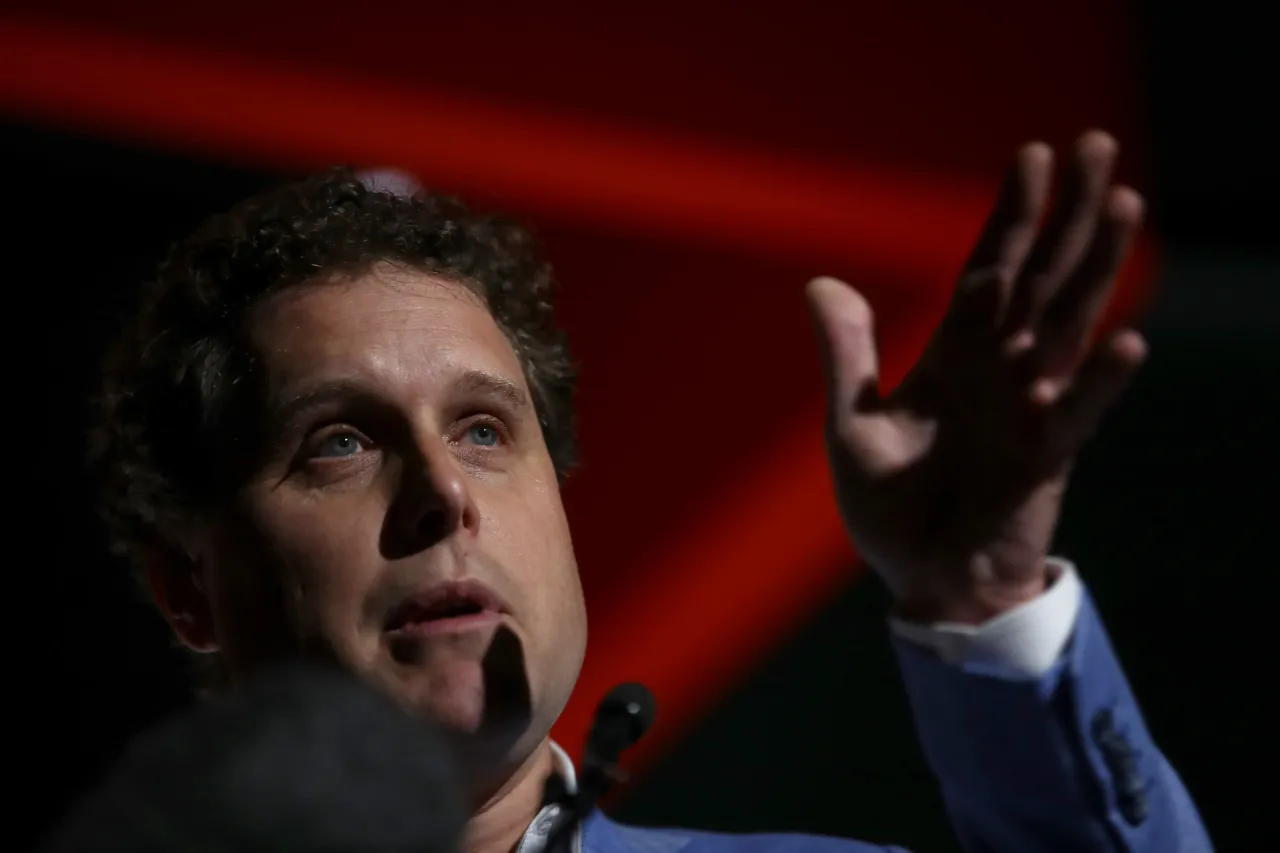
Capricor has pushed back on FDA’s claims. “We are completely shocked at how they decided to review and analyze this data,” CEO Linda Marban told Reuters, arguing that applying the wrong statistical plan could make virtually any clinical-trial dataset appear “dark and cloudy.”
Capricor said the FDA is relying on SAP 1.1, an early statistical plan that Marban calls an unsigned, incomplete draft. The company argues that SAP 3.0 — its final analysis plan, completed before the trial data were unblinded — should be used instead. Under the final plan, Capricor says Hope-3 met its main upper-limb endpoint, showing a 4.55% treatment difference with a p-value of 0.029, alongside supportive heart-function results.
Advertisement|Remove ads.
Its pre-AdCom slides lay out the divide: FDA says the original analysis failed, while Capricor argues regulators are relying on an outdated plan. FDA acknowledges the trial evolved, including the addition of a second manufacturing cohort, but maintains that SAP 1.1 contains the methods Hope-3 was originally designed around.
Wall Street Turns Cautious On CAPR
Wall Street turned sharply more cautious after the FDA briefing documents. Roth Capital called the current scenario “high-risk” for an unfavorable advisory committee outcome and potentially a second Complete Response Letter. B. Riley said that several pillars of its prior bullish thesis had broken down and called the newly disclosed issues “likely incompatible with approval,” though it still sees signs of efficacy in some patients.
Advertisement|Remove ads.
Meanwhile, Cantor Fitzgerald said that the documents “paint an ugly picture,” while noting the company's argument that PUL 2.0 reached significance under every analysis except the FDA’s preferred version. Oppenheimer was more positive, saying that “at the end of the day what should matter most for the stock will be the vote” and that the selloff had improved the risk-reward. Across the latest analyst targets, CAPR’s implied upside from current levels goes as high as 43%.
Shkreli Claims Vindication On CAPR
The FDA dispute has given Shkreli fresh ammunition for a bearish CAPR thesis he had been forced to walk back earlier this year. The former pharma executive had previously urged investors to short the stock, questioning Deramiocel’s mechanism and earlier clinical data. But after Capricor reported positive Hope-3 results, Shkreli called his trade a “bad call” and apologized to investors who followed him.
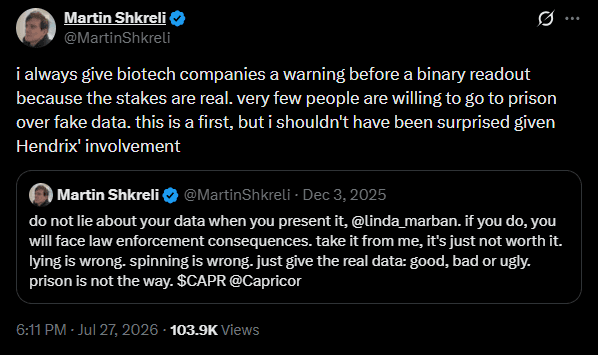
Now, he is back on the offensive. Shkreli called CAPR “a complete fraud” on X, sharing the FDA chart showing how p-values changed across successive statistical plans. He also accused Marban and statistical consultant Suzanne Hendrix of wrongdoing. He also resurfaced a December warning to Marban: “Do not lie about your data when you present it.”
Advertisement|Remove ads.
Retail Bulls Double Down On CAPR
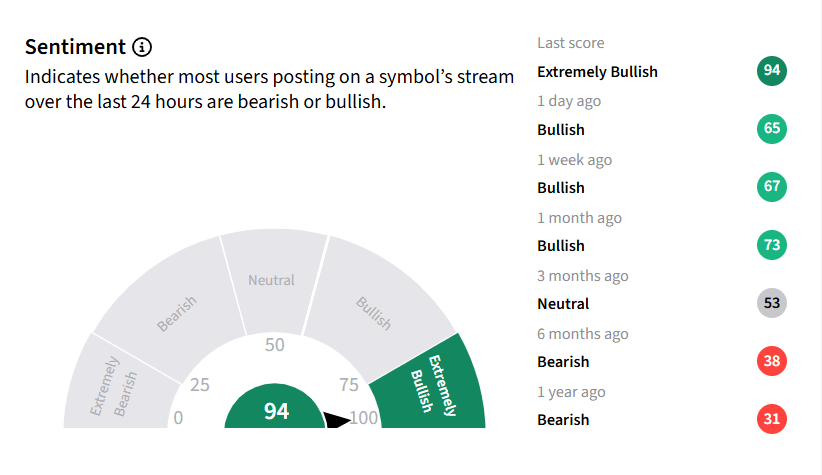
If analysts and Shkreli see the FDA report as a major blow, retail traders are reading the situation very differently. Stocktwits sentiment around CAPR has climbed to a record 94/100, firmly in 'extremely bullish' territory, while 24-hour message volume has surged 3,392%. The conversation is dominated by the SAP dispute.
One trader said that FDA’s criticisms outside the statistical issue appeared secondary, including questions over how cardiomyopathy was defined and whether Deramiocel’s mechanism of action made sense. Another user called the situation an administrative misunderstanding and argued that Capricor had remained transparent with regulators, predicting the AdCom would settle the issue and calling for CAPR above $50 by month-end and $100 by year-end.
A third trader took aim directly at the FDA p-value chart, saying it creates a visual narrative of post-hoc manipulation but does not prove that manipulation occurred. The trader said that in a small, heterogeneous rare-disease trial, changes in how one or two outliers or dropouts are treated can materially alter a p-value. Another user turned Capricor’s argument into a classroom analogy: the company says it completed the test using the final grading rubric, while FDA is judging it against an older draft.
Advertisement|Remove ads.
For updates and corrections, email newsroom[at]stocktwits[dot]com.
Read Next: Why Did AAPL, FBRX, RTX Stocks Surge To 52-Week Highs Today?
Comments posted here will also appear on symbol pages.

Latest News
/filters:format(webp)https://news.stocktwits-cdn.com/large_rocketlab_CEO_OG_jpg_27083e216d.webp)
/filters:format(webp)https://news.stocktwits-cdn.com/IMG_8805_JPG_6768aaedc3.webp) Deepti Sri·5m ago
Deepti Sri·5m ago/filters:format(webp)https://news.stocktwits-cdn.com/large_Getty_Images_2278069829_59fe6411ed.jpg)
/filters:format(webp)https://news.stocktwits-cdn.com/shivani_photo_jpg_dd6e01afa4.webp) Shivani Kumaresan·7m ago
Shivani Kumaresan·7m ago/filters:format(webp)https://news.stocktwits-cdn.com/large_NVIDA_chip_60b48a6ec9.jpg) Deepti Sri·42m ago
Deepti Sri·42m ago/filters:format(webp)https://news.stocktwits-cdn.com/large_Getty_Images_2287298723_67960e9982.jpg)
/filters:format(webp)https://news.stocktwits-cdn.com/Aashika_Suresh_Profile_Picture_jpg_2acd6f446c.webp) Aashika Suresh·1h ago
Aashika Suresh·1h ago/filters:format(webp)https://news.stocktwits-cdn.com/large_Getty_Images_2285878091_jpg_8bbc10722c.webp) Shivani Kumaresan·1h ago
Shivani Kumaresan·1h ago/filters:format(webp)https://news.stocktwits-cdn.com/large_musk_jpg_a119402ac5.webp) Deepti Sri·2h ago
Deepti Sri·2h ago