


Advertisement|Remove ads.
DPZ, CTNT, LCID Stocks Hit 52-Week Lows Today: What's Driving The Selloff?
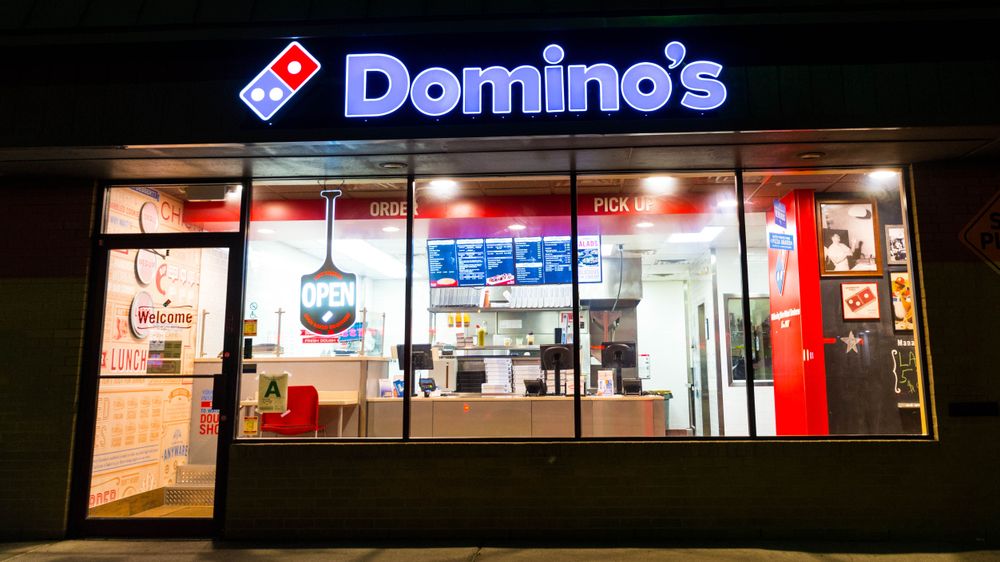


- Domino’s Pizza’s Q1 same-store sales grew by less than 1%.
- Despite recent funding support, Lucid is facing a delivery gap, producing more vehicles than it ships.
- In an SEC filing, Cheetah Net Supply Chain said it has implemented a 1-for-200 reverse stock split.
Advertisement|Remove ads.
Domino’s Pizza (DPZ), Lucid Group (LCID), and Cheetah Net Supply Chain (CTNT) all slid to new 52-week intraday lows on Monday, as investors reacted to signs of weakening demand and growing financial pressure across the companies.
Investors are rethinking how steady company profits will be as the economy slows and are paying closer attention to weaker delivery demand, the efficiency with which EV makers produce cars, and the financial stability of smaller companies.
While Cheetah Net Supply Chain stock sank over 34%, Domino’s Pizza and Lucid tumbled over 8% and 5%, respectively.
Advertisement|Remove ads.
DPZ Faces Demand Pressure
Domino’s led losses among restaurant and delivery stocks after reporting weaker-than-expected first-quarter earnings. Same-store sales grew by less than 1%, a sharp slowdown compared to its usual mid-single-digit growth in the past.
The pizza chain operator now expects its U.S. and international comparable sales to rise by low single digits in 2026, lower than its previous guidance of a 3% increase in U.S. sales and a 1% to 2% gain internationally.
The company is also facing broader macroeconomic headwinds, with high living costs and rising transportation expenses linked to Middle East tensions tied to the U.S.-Iran war, adding to inflation concerns.
Advertisement|Remove ads.
LCID Struggles With Inventory And Production Gap
Luxury EV maker Lucid also came under heavy selling pressure after touching a record low. Even with recent funding, the company is struggling because it is producing more cars than it is delivering, and supplier issues have disrupted its SUV production.
Lucid’s first-quarter deliveries fell to 3,093 vehicles, from the 3,109 units it delivered in 2025. The company attributed the decline to a temporary disruption in its Gravity SUV rollout, triggered by a supplier quality problem involving second-row seats.
Investors remain focused on whether Lucid can scale efficiently enough to approach its ambitious 2026 annual production target of 25,000 to 27,000 vehicles without further cash strain.
Advertisement|Remove ads.
CTNT Signals Micro-Cap Stress
Cheetah Net Supply Chain extended a dramatic multi-month decline, reflecting collapsing liquidity and weakening demand for niche logistics exposure. On April 24, the company confirmed a major restructuring of its share structure through a reverse stock split to stabilize its capital profile.
In an SEC filing, the company stated that the board authorized a flexible reverse-split structure allowing ratios up to 1-for-500, and later executed a 1-for-200 consolidation. The split-adjusted shares are expected to begin trading on April 29, under a new CUSIP number.
So far this year, DPZ and LCID stock have declined by over 19% and 43%, respectively, while CTNT has plummeted over 97%.
Advertisement|Remove ads.
Also See: BE Stock Jumps Overnight: Oracle’s Massive AI Campus Embraces Bloom’s Fuel Cell Power
For updates and corrections, email newsroom[at]stocktwits[dot]com.
Comments posted here will also appear on symbol pages.

Latest News
/filters:format(webp)https://st-everywhere-cms-prod.s3.us-east-1.amazonaws.com/large_citibank_window_resized_c7f400c4f5.jpg)
/filters:format(webp)https://news.stocktwits-cdn.com/vivekkrishnanphotography_58_jpg_0e45f66a62.webp) Arnab Paul·9m ago
Arnab Paul·9m ago/filters:format(webp)https://st-everywhere-cms-prod.s3.us-east-1.amazonaws.com/large_paultudorjones_resized_9aad45543a.jpg)
/filters:format(webp)https://news.stocktwits-cdn.com/Prabhjote_DP_67623a9828.jpg) Prabhjote Gill·31m ago
Prabhjote Gill·31m ago/filters:format(webp)https://st-everywhere-cms-prod.s3.us-east-1.amazonaws.com/large_crown_b_IV_3_C8_Tjq_YA_unsplash_7145a9f395.jpg)
/filters:format(webp)https://news.stocktwits-cdn.com/Harshita_3cfe02022c.jpg) Harshita Tyagi·36m ago
Harshita Tyagi·36m ago/filters:format(webp)https://news.stocktwits-cdn.com/large_Getty_Images_2295195765_631ba29211.jpg)
/filters:format(webp)https://news.stocktwits-cdn.com/Anushka_Basu_make_me_smile_in_the_picture_b92832aa_af59_4141_aacc_4180d2241ba8_1_2_png_1086e0ed8c.webp) Anushka Basu·50m ago
Anushka Basu·50m ago/filters:format(webp)https://news.stocktwits-cdn.com/large_Goldman_Sachs_resized_c6a47f630c.webp)
/filters:format(webp)https://news.stocktwits-cdn.com/Heera_1_1c30cb0170.PNG) Heera Hari·1h ago
Heera Hari·1h ago/filters:format(webp)https://news.stocktwits-cdn.com/large_unh_stock_resized_jpg_e69fd915e3.webp) Arnab Paul·1h ago
Arnab Paul·1h ago