


Advertisement|Remove ads.
FDA Decision Watch: MRK, MIRM, INCY, GRAL Face Key Regulatory Catalysts This Week



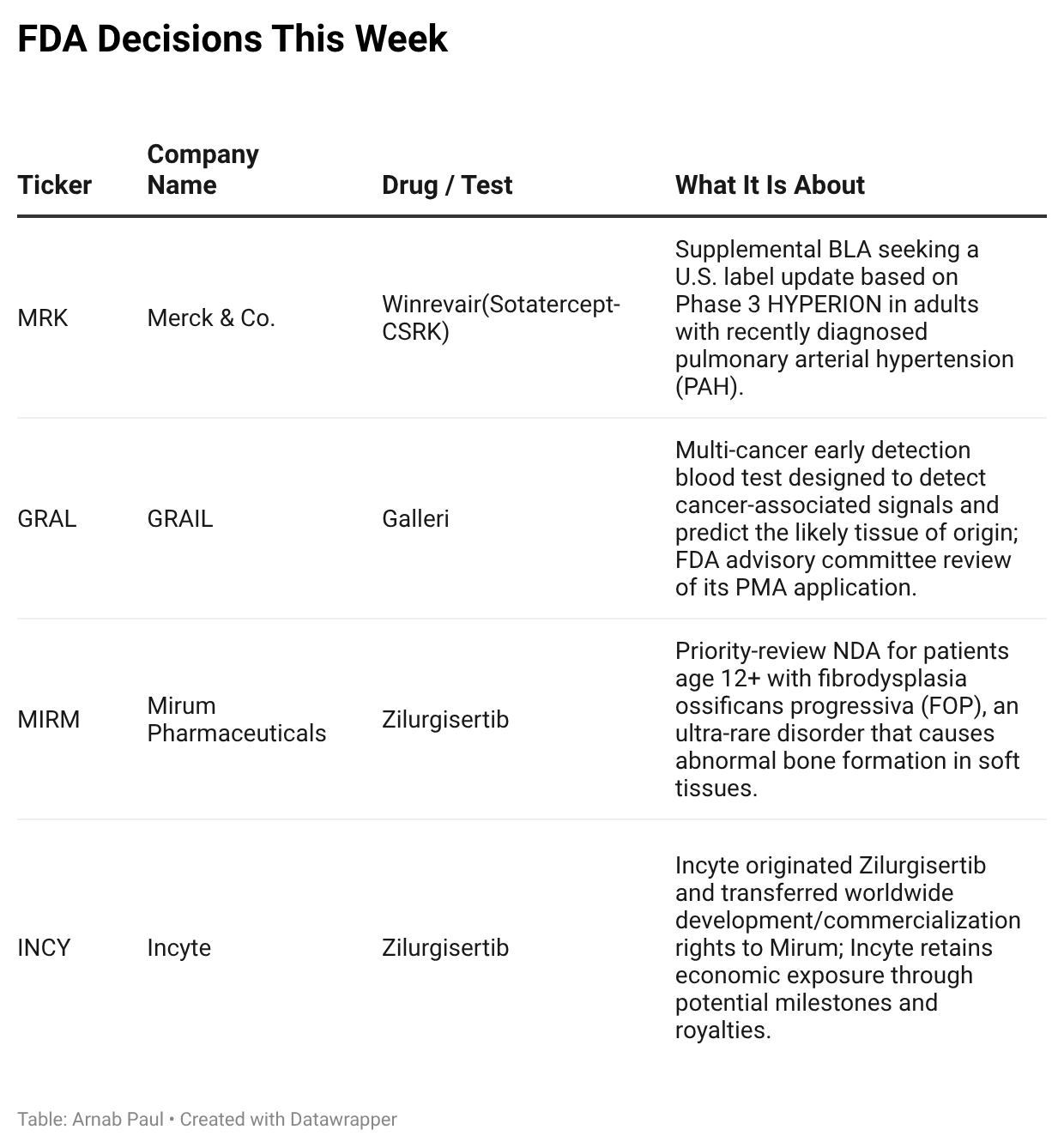
- Merck awaits an FDA decision on expanded use of Winrevair for pulmonary arterial hypertension.
- Mirum faces a FDA decision on Zilurgisertib for rare bone disorder FOP, with Incyte retaining an economic interest.
- An FDA advisory committee will review Grail’s Galleri blood test, designed to detect signals associated with more than 50 cancers.
Advertisement|Remove ads.
Biotech and pharmaceutical investors have several key U.S. Food and Drug Administration (FDA) events to watch this week, with decisions involving treatments for pulmonary arterial hypertension and a rare genetic bone disorder, along with an advisory committee meeting for a multi-cancer blood test.
The regulatory calendar could put Merck (MRK), Mirum Pharmaceuticals (MIRM), and Grail (GRAL) in focus for traders, while Incyte (INCY) also has exposure to the Zilurgisertib catalyst through its licensing agreement with Mirum.
Merck Awaits Decision On Extended Use Of Winrevair
Merck is awaiting an FDA decision on an updated U.S. label for Winrevair (Sotatercept-CSRK) based on its Phase 3 Hyperion study. The FDA assigned a Sept. 21 PDUFA date to the supplemental application.
Advertisement|Remove ads.
A PDUFA date is the deadline by which the FDA decides whether to approve a drug for marketing in the United States.
Winrevair treats pulmonary arterial hypertension (PAH), a serious condition in which blood vessels in the lungs become narrowed, causing high blood pressure in the lung arteries and forcing the heart to work harder to pump blood. Over time, the disease can lead to heart failure and death.
It is already FDA-approved for adults with PAH, while Hyperion studied patients diagnosed within the previous year, potentially supporting its use earlier in the disease.
Advertisement|Remove ads.
Winrevair generated $588 million in second-quarter sales, up 75%. Merck, which has a broad pipeline spanning oncology, cardiovascular disease, vaccines and infectious diseases, ended June with $6.85 billion in cash and cash equivalents.
FDA To Decide On Mirum’s FOP Treatment
Mirum faces a Sept. 26 PDUFA date for Zilurgisertib, an oral drug under Priority Review for patients aged 12 and older with Fibrodysplasia Ossificans Progressiva (FOP).
FOP is an ultra-rare genetic disease in which bone forms abnormally inside muscles, tendons and other soft tissues. As this extra bone accumulates, patients progressively lose movement and can eventually experience severe disability and life-threatening complications.
Advertisement|Remove ads.
Zilurgisertib inhibits ALK2, a protein whose abnormal activity drives excess bone formation in FOP.
Mirum acquired worldwide rights to Zilurgisertib from Incyte in April, while Incyte is eligible for milestone payments and royalties. Mirum paid Incyte $16 million upfront for Zilurgisertib and could potentially pay $63 million in regulatory and commercial milestones
Mirum already markets drugs to treat liver and genetic diseases, like Livmarli, Cholbam and Ctexli. It ended June with $561.3 million in unrestricted cash, cash equivalents and investments.
Advertisement|Remove ads.
Incyte, meanwhile, has nine marketed medicines and a broader oncology and inflammation pipeline.
GRAIL's Galleri Heads To FDA Advisory Panel
Grail faces a major regulatory event on Wednesday as an FDA advisory committee reviews its approval application for Galleri, a blood test that screens for signals associated with more than 50 types of cancer before symptoms appear.
The test analyzes DNA fragments in the bloodstream for abnormal methylation patterns associated with cancer and can predict where in the body a detected cancer signal likely originated.
Advertisement|Remove ads.
Galleri is designed to complement, rather than replace, established screening such as mammograms and colonoscopies. It is already commercially available as a laboratory-developed test but is not FDA-approved. Grail ended June with $767.6 million in cash, cash equivalents and marketable securities.
Retail Sentiment Ahead Of FDA Decision
Retail sentiment surrounding MRK and GRAL on Stocktwits was ‘bearish’, ‘neutral’ for INCY, and ‘bullish’ for MIRM.
Advertisement|Remove ads.
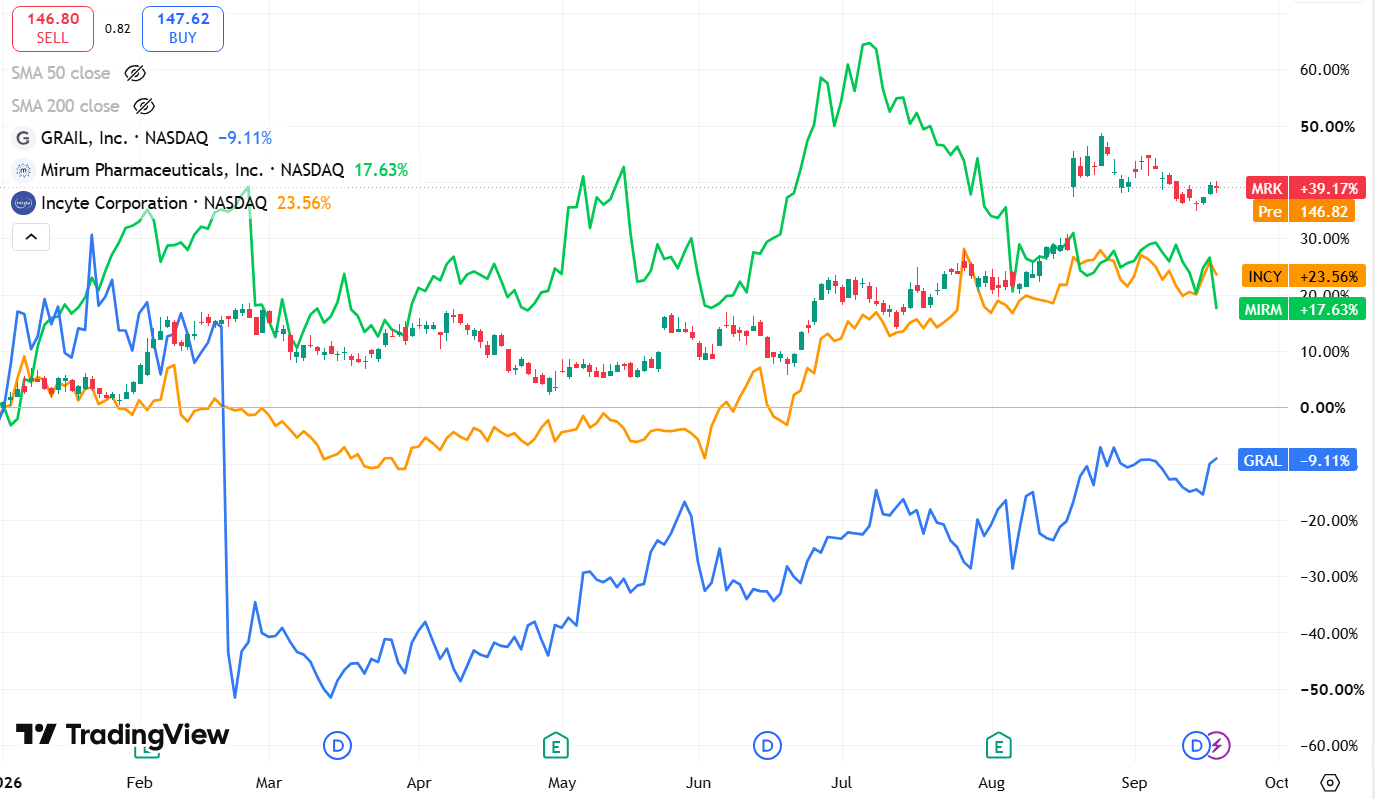
Among these stocks, MRK has gained the most, rising nearly 40%, followed by INCY at more than 23% and MIRM at 17.6%. GRAL is the only stock in the red, falling more than 9%.
For updates and corrections, email newsroom[at]stocktwits[dot]com.
Advertisement|Remove ads.
Comments posted here will also appear on symbol pages.

Latest News
/filters:format(webp)https://news.stocktwits-cdn.com/large_Palantir_jpg_d29fd424cd.webp)
/filters:format(webp)https://news.stocktwits-cdn.com/shivani_photo_jpg_dd6e01afa4.webp) Shivani Kumaresan·11m ago
Shivani Kumaresan·11m ago/filters:format(webp)https://news.stocktwits-cdn.com/large_Getty_Images_2259661360_jpg_dfabfb9ee4.webp)
/filters:format(webp)https://news.stocktwits-cdn.com/IMG_8805_JPG_6768aaedc3.webp) Deepti Sri·38m ago
Deepti Sri·38m ago/filters:format(webp)https://news.stocktwits-cdn.com/large_rocket_companies_logo_resized_jpg_1cfb06fa99.webp) Shivani Kumaresan·57m ago
Shivani Kumaresan·57m ago/filters:format(webp)https://news.stocktwits-cdn.com/large_Getty_Images_469233103_jpg_98366c7f59.webp)
/filters:format(webp)https://news.stocktwits-cdn.com/IMG_9209_1_d9c1acde92.jpeg) Yuvraj Malik·1h ago
Yuvraj Malik·1h ago/filters:format(webp)https://news.stocktwits-cdn.com/large_Getty_Images_2288109910_62a07a2c3b.jpg)
/filters:format(webp)https://news.stocktwits-cdn.com/Aashika_Suresh_Profile_Picture_jpg_2acd6f446c.webp) Aashika Suresh·2h ago
Aashika Suresh·2h ago/filters:format(webp)https://news.stocktwits-cdn.com/large_Getty_Images_109203874_8a59b7f214.jpg) Shivani Kumaresan·2h ago
Shivani Kumaresan·2h ago