


Advertisement|Remove ads.
Fed Chair Kevin Warsh Pits AI Benefits Against Economic Disruption
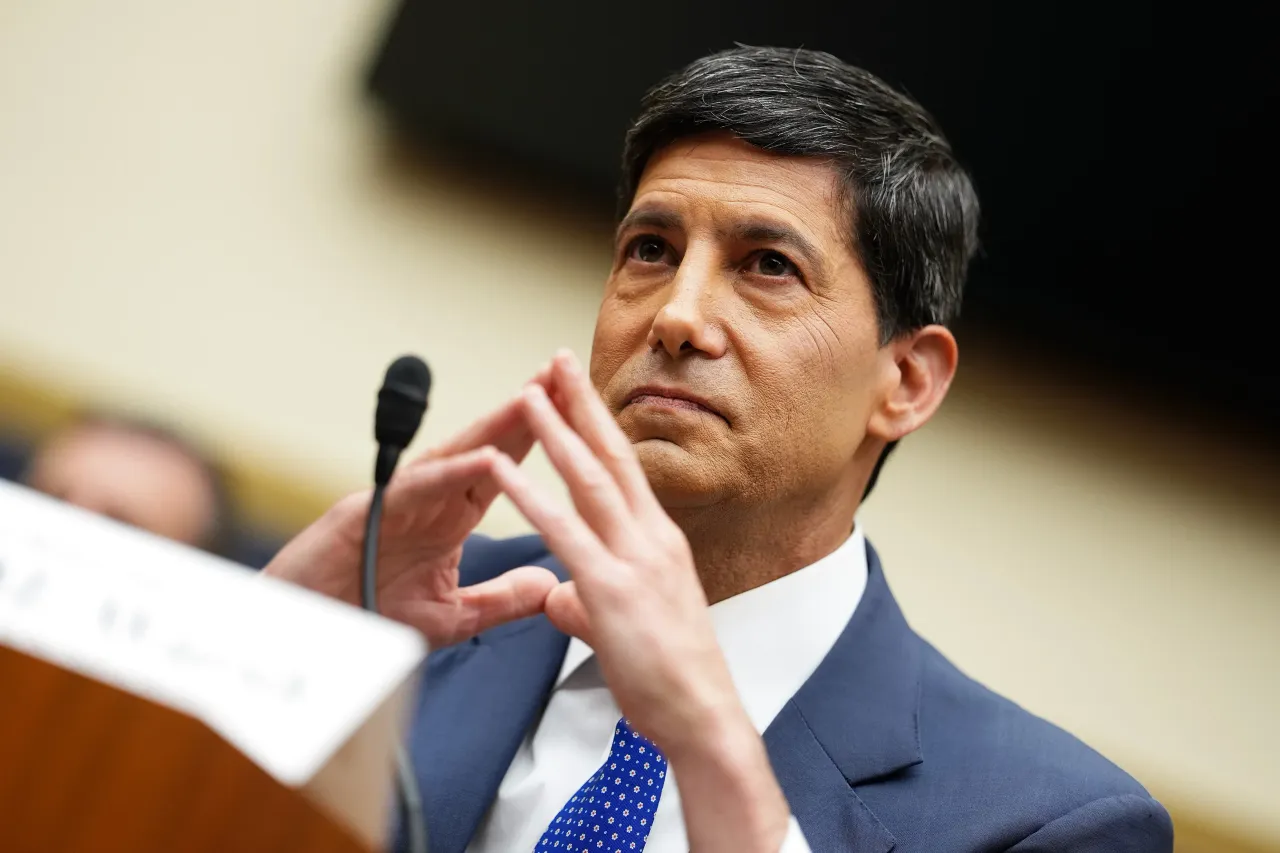


- Chair Kevin Warsh emphasized that these models are not official forecasts and are merely exploratory, maintaining the Fed’s neutral stance on the technology.
- Warsh’s remarks are from his prepared speech at a San Francisco Fed conference.
- “An SI-driven expansion could bring substantial labor market disruption as some jobs are displaced,” Warsh said.
Advertisement|Remove ads.
Federal Reserve Chairman Kevin Warsh, in his opening remarks at a San Francisco Fed event, highlighted that AI could radically supercharge economic growth but also lead to market volatility and labor disruption.
Speaking at the Productivity and Jobs Task Force Conference hosted by the Federal Reserve Bank of San Francisco, Warsh emphasized that “ideas are the ultimate resource.” However, his remarks leaned into a careful balancing act between potential financial turbulence and the benefits of rapid AI adoption.

Moreover, Warsh highlighted that staff at the U.S. central bank have begun modeling economic contingency plans to address how the rapid adoption of artificial intelligence could reshape the nation's economy. However, Warsh stressed that the models are exploratory exercises rather than official predictions, noting the central bank’s job is to understand AI's economic footprint rather than promote or oppose it.
Advertisement|Remove ads.
“The current era may be the most transformational period in my adult lifetime, marked by the arrival of the general-purpose technology called "super intelligence,” Warsh said in his prepared remarks. “SI is an entirely new force in economic life and society. It demands our special attention.”
Three Potential Economic Paths
In his prepared remarks, Warsh detailed a best-case scenario in which AI spurs an economic and productivity boom that delivers shared financial gains to both businesses and employees.
A second scenario detailed that any surge in economic output is counterbalanced by widespread job losses, while a third scenario warned of a potential bust if the technology fails to live up to the hype.
Advertisement|Remove ads.
Following heavy capital investments and surging stock prices, disappointing returns could trigger a drop in equity values, a broader economic slowdown and a noticeable jump in unemployment, Warsh noted.
Warsh has previously acknowledged at an International Monetary Fund event in Bangkok in October that AI is currently stoking broader inflation, noting that the technology is hitting the economy's demand side well before it strengthens the supply side, and said AI could provoke a “bumpy” near-term economic shock.
The AI Task Force
Warsh also highlighted the Federal Reserve’s AI task force, currently composed of venture capitalist Marc Andreessen, Xbox CEO Asha Sharma, and Stanford University scholar Charles Jones.
Advertisement|Remove ads.
The task force is one of five Warsh set up in his debut as Federal Reserve chairman. Going ahead, the task force will engage in discussions with a wide cross-section of stakeholders to include more industry input on the economic effects of AI.
The S&P 500 eased about 1.9%, the Nasdaq 100 lost nearly 2.7%, and the Dow Jones index fell 1.4% on Monday.
Retail sentiment on Stocktwits was ‘bullish’ across SPDR S&P 500 ETF (SPY), Invesco QQQ (QQQ) and SPDR Dow Jones ETF (DIA), which track the benchmark indices at market close on Monday.
Advertisement|Remove ads.
Read More: US Airlines Expected To Lose $1B From FAA Nationwide Grounding.
For updates and corrections, email newsroom[at]stocktwits[dot]com.
Comments posted here will also appear on symbol pages.

Latest News

 Shashank Nayar·6m ago

 Anan Ashraf·2h ago
 Shashank Nayar·2h ago
 Shashank Nayar·4h ago
 Anan Ashraf·4h ago

 Heera Hari·5h ago