


Advertisement|Remove ads.
Forget SPY And QQQ — These Asia-Linked ETFs Are Stealing The AI Mania


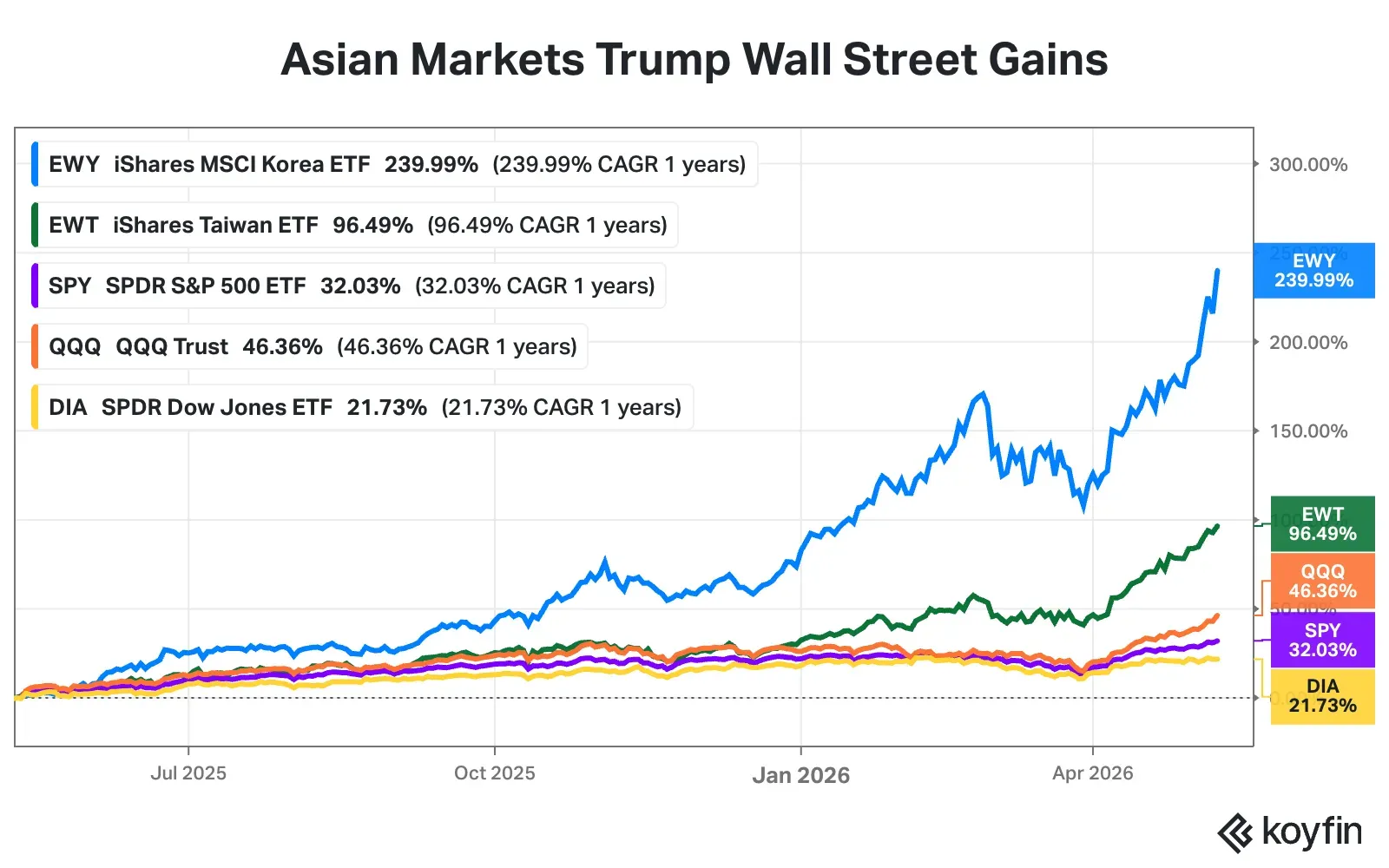
- Meanwhile, SPDR S&P 500 ETF (SPY) has gained 32%, and the Invesco QQQ Trust (QQQ) has increased 46% in the same period.
- Goldman Sachs expects South Korea’s AI-related exports to triple to almost 30% of its GDP this year.
- Taiwan’s stock market is on track to overtake India to become the fifth largest in the world as soon as next month, as per The Kobeissi Letter.
Advertisement|Remove ads.
The artificial intelligence boom has propelled benchmark indexes, the S&P 500 and the tech-heavy Nasdaq Composite, to multiple record highs in 2026, but the real breakout winners are emerging in Asia.
Taiwan and South Korea are witnessing historic stock market expansions driven by surging semiconductor demand, with exchange-traded funds linked to Asia’s chip-heavy markets outperforming Wall Street by a wide margin.
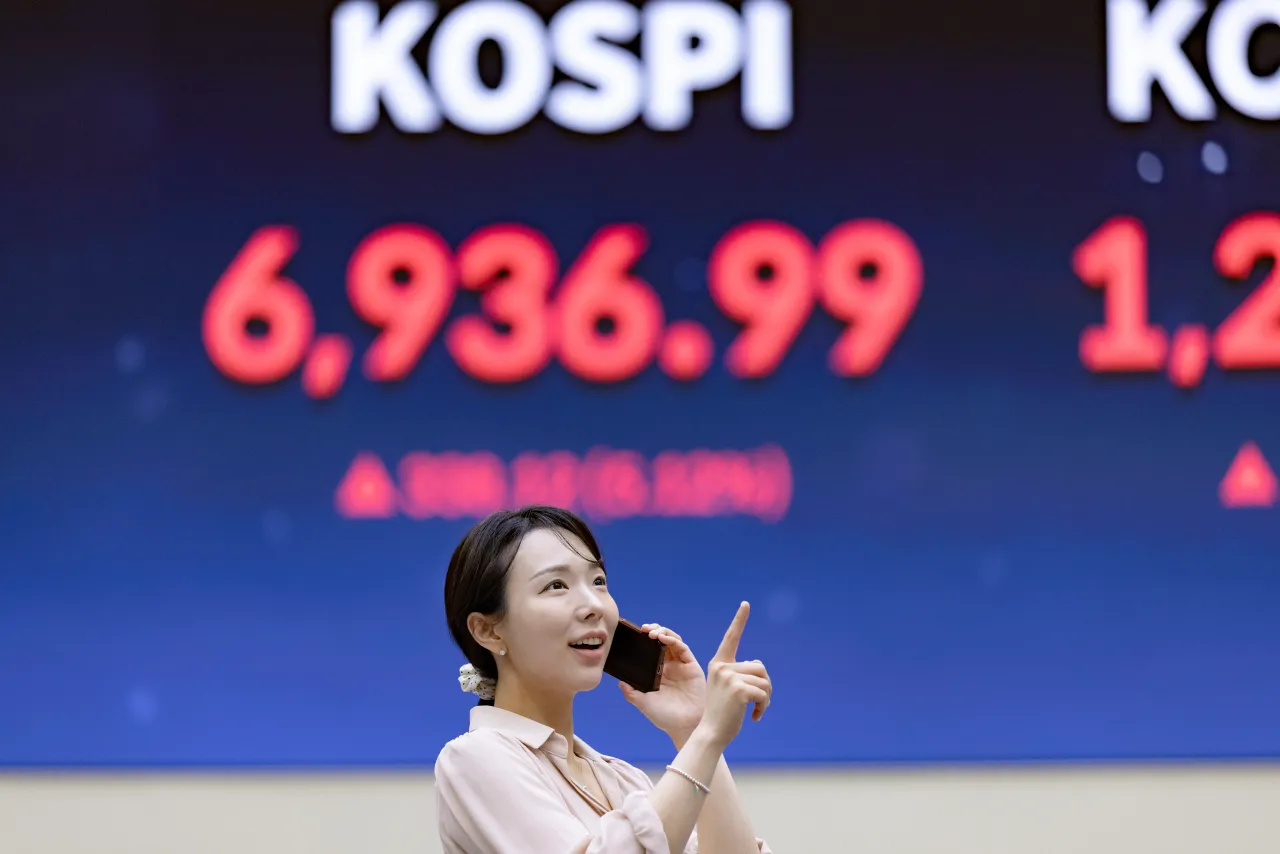
South Korea’s KOSPI hit a fresh record on Monday, surging more than 4% to 7,899.32. The Taiwan Stock Exchange Weighted Index (TAIEX) closed above 42,000 for the first time last week.
Advertisement|Remove ads.
Meanwhile, the iShares MSCI South Korea ETF (EWY), which tracks South Korean equities, has surged more than 239% in the last year, and the iShares MSCI Taiwan ETF (EWT) has gained more than 96% in the same time, far beating the 32% gains of SPDR S&P 500 ETF (SPY) and 46% of Invesco QQQ Trust (QQQ) in the same period.
Taiwan and South Korea, in particular, are benefiting sharply from the AI boom because they sit at the center of the global AI physical supply chain, particularly for advanced semiconductors and memory chips.
As of May, the EWY is heavily concentrated in technology, with SK Hynix Inc. and Samsung Electronics making up nearly 50% of the total portfolio, while Taiwan Semiconductor Manufacturing Co. (TSM) is the largest holding at EWT, comprising more than 20% of the portfolio.
Advertisement|Remove ads.
The Asian Supercycle
Taiwan’s economy has grown at the fastest pace since 1987 in the first quarter of 2026, and South Korean exports have been surging due to higher shipments of semiconductors, according to a Bloomberg report.
Goldman Sachs expects South Korea’s gross domestic product growth to hit 2.5% this year, rebounding from 1% in 2025. The analyst said that South Korea’s AI-related exports could triple to almost 30% of its GDP this year.
Meanwhile, JPMorgan Chase & Co. has raised its KOSPI target to 9,000 and its bull‑case target to 10,000, partly driven higher by the semiconductor supercycle, according to a separate Bloomberg report. This is the bank’s second raise in less than a month.
Advertisement|Remove ads.
“In these unique conditions, we believe it remains appropriate to stay positioned for further upside and not preemptively anticipate a cycle-end,” JPMorgan Chase said in a note, as per the report.
Both analysts believe that a sustained upcycle for memory chips, driven by average selling prices and volumes, is likely in the next two years.
Meanwhile, Taiwan’s GDP growth is expected to accelerate to about 10% in 2026, up from 8.7% last year, with the technology boom likely to increase growth volatility, according to Goldman Sachs. The country’s AI-related exports could rise to more than 30% of GDP, the Bloomberg report noted.
Advertisement|Remove ads.
Taiwan’s stock market is also on track to overtake India's to become the fifth-largest in the world as soon as next month, according to The Kobeissi Letter. Taiwan's stock market has already surpassed the UK's and Canada’s stock market values. Meanwhile, South Korea's stock market cap has beaten the UK and is on track to overtake Canada this month.
“Collectively, the two markets have added +$4.6 trillion in market value over the last 12 months, driven by AI-related stocks,” the industry-leading market commentary service said in a post on X earlier this month. “AI is transforming Taiwan and South Korea into a global economic power.”
US Markets Are Rallying Too
Meanwhile, U.S. stock markets have also surged to record highs amid the AI boom. The S&P 500 and Nasdaq Composite rallied to record highs on Friday, closing up 0.84% and 1.71%, respectively, driven by gains in Nvidia, SanDisk, Micron Technology, and other AI-related stocks, even as a stronger-than-expected April jobs report boosted sentiment.
Advertisement|Remove ads.
Are Retail Traders Aware Of EWT, EWY?
On Stocktwits, retail sentiment around EWY and EWT was in the ‘bullish’ and ‘bearish’ territories, respectively, amid ‘high’ message volumes at the time of writing. Retail traders have been very much keyed into the trends, with EWY’s following surging by 82% over the past three months, while EWT’s has jumped by nearly 10%.
One bullish user said, “$EWY 250+ very strong bottom formed at 180.”
Advertisement|Remove ads.
Another user said, “Korea [is] going nuts again…”
Meanwhile, for SPY and QQQ, retail sentiment was in the ‘bullish’ territory.
Advertisement|Remove ads.
For updates and corrections, email newsroom[at]stocktwits[dot]com.
Comments posted here will also appear on symbol pages.

Latest News
/filters:format(webp)https://news.stocktwits-cdn.com/gettyimages_2297721790_612x612_7ed81ac2ea.jpg)
/filters:format(webp)https://news.stocktwits-cdn.com/1707726834303_jpg_11f20a9aa9.webp) Shashank Nayar·45m ago
Shashank Nayar·45m ago/filters:format(webp)https://news.stocktwits-cdn.com/large_Getty_Images_1403832004_ec78439cd6.jpg)
/filters:format(webp)https://news.stocktwits-cdn.com/unnamed_jpg_9dff551b50.webp) Anan Ashraf·2h ago
Anan Ashraf·2h ago/filters:format(webp)https://st-everywhere-cms-prod.s3.us-east-1.amazonaws.com/large_instacart_jpg_a510adb6d9.webp) Shashank Nayar·2h ago
Shashank Nayar·2h ago/filters:format(webp)https://news.stocktwits-cdn.com/large_Getty_Images_2296187035_e6f532e3f5.jpg) Shashank Nayar·4h ago
Shashank Nayar·4h ago/filters:format(webp)https://news.stocktwits-cdn.com/large_Getty_Images_2049058934_jpg_c3bac923f1.webp) Anan Ashraf·4h ago
Anan Ashraf·4h ago/filters:format(webp)https://news.stocktwits-cdn.com/large_Getty_Images_2287054273_1_864b6e24d6.jpg)
/filters:format(webp)https://news.stocktwits-cdn.com/vivekkrishnanphotography_58_jpg_0e45f66a62.webp) Arnab Paul·5h ago
Arnab Paul·5h ago